Design Thinking
Ambiguity Handling & Problem Framing
How senior engineers ask clarifying questions, reframe vague prompts, find the real problem, and avoid premature optimization in system design interviews.
When an interviewer says "design a feed" or "design a search engine," the prompt is intentionally underspecified. Your first job is not to pick technologies—it is to turn ambiguity into constraints through clarifying questions, reframing, and explicit assumptions. Ambiguity handling and problem framing is how senior engineers avoid over-engineering the wrong problem.
If you have read What Is Design Thinking, this article goes deeper on the first gate: asking the right questions before you draw boxes. By the end, you should know how to reframe vague prompts, spot the real problem behind the stated one, and defer premature optimization without stalling the interview.
Related reading: Pair this with the 7-Step Problem-Solving Framework for a full interview workflow, and Communication & Interview Strategy for how to say your framing aloud.
The funnel below shows how a vague prompt narrows into a design you can defend—questions and constraints first, architecture second.
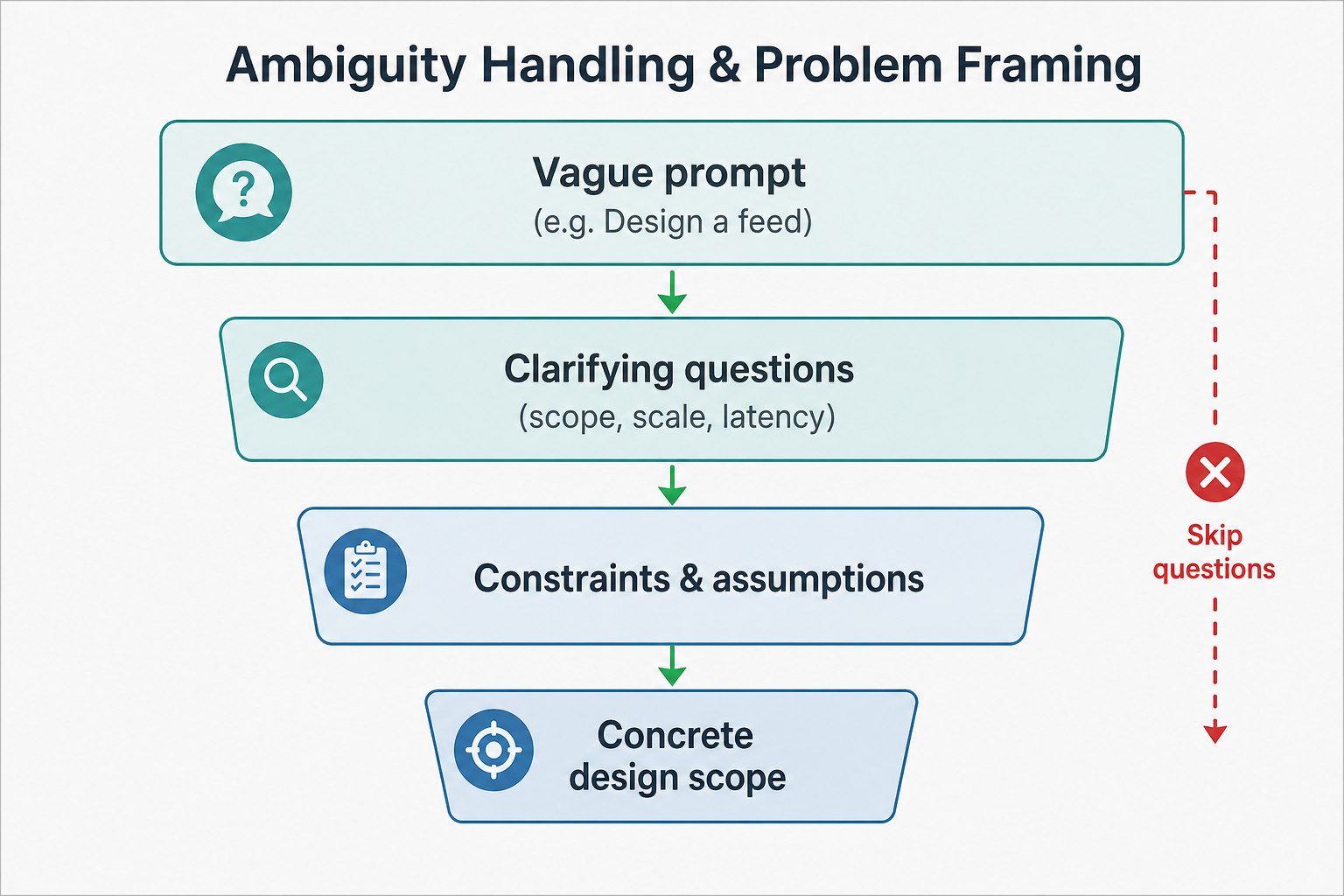
Senior signal: narrow the prompt with questions before you commit to components or technologies.
How Seniors Ask Clarifying Questions
The Purpose
- Reduce ambiguity: Turn "design X" into concrete requirements
- Reveal constraints: Time, scale, team, budget
- Identify priorities: What matters most when we can't have everything
- Uncover hidden requirements: What they didn't say but assume
Question Categories
Scope:
- "What's in scope for v1? What's explicitly out?"
- "Are we building for MVP or long-term?"
- "What features are must-have vs nice-to-have?"
Users & Use Cases:
- "Who are the primary users?"
- "What's the main use case we're optimizing for?"
- "What's the expected user behavior pattern?"
Scale:
- "What scale are we designing for? Users, requests, data?"
- "What's the growth trajectory? 10x in a year?"
- "Read-heavy or write-heavy?"
Non-Functional:
- "What's the latency requirement? p99?"
- "What's the availability target?"
- "Any compliance or security requirements?"
Constraints:
- "What's the timeline?"
- "Any existing systems we need to integrate with?"
- "Team size and expertise?"
Good vs Bad Questions
Bad: "Should we use Kafka?" (Solution before problem)
Good: "What's the throughput and ordering requirement for the event stream?" (Uncovers requirement that drives tech choice)
Bad: "Do we need microservices?" (Leading, binary)
Good: "How many teams will work on this? Do they need independent deploy?" (Reveals org context for architecture)
Bad: "What database?" (Premature)
Good: "What's the consistency requirement? Strong or eventual?" (Drives DB choice)
Reframing Vague Problems
The Pattern
- Restate the problem in your own words
- Identify the core challenge
- Propose a narrowed scope for the discussion
- Confirm with the interviewer
Example: "Design a Feed"
Vague: "Design a feed like Twitter."
Reframe: "So we're building an activity feed where users see posts from people they follow, sorted by time. I'll assume we're optimizing for read latency and scale, and we can discuss algorithmic ranking if we have time. Does that match?"
Why it helps: You've made scope concrete. You've stated assumptions. You've given the interviewer a chance to correct. You've prioritized (read latency, scale).
Example: "Design a URL Shortener"
Vague: "Design TinyURL."
Reframe: "We're creating short links that redirect to long URLs. Key operations: create short URL, redirect. I'll assume we need analytics (clicks) and high redirect throughput. Should we also handle custom short URLs or keep it random only?"
Why it helps: You've listed core operations. You've called out a common extension (analytics). You've asked about a scope question (custom URLs) that affects design.
Identifying the Real Problem vs the Stated Problem
The Stated Problem
What the interviewer or stakeholder says: "Design a notification system."
The Real Problem
What they often mean:
- "Design a system that sends emails and push notifications reliably"
- "Design for scale (millions of users)"
- "Design so we can add new channels (SMS, in-app) later"
- "Design for low latency (notify within seconds)"
How to Uncover the Real Problem
- Ask about success: "How do we know this works? What would failure look like?"
- Ask about priorities: "If we had to choose between latency and throughput, which matters more?"
- Ask about history: "What's broken with the current approach?"
- Ask about future: "What might we add in 6 months?"
Example: "Design a Search Engine"
Stated: Design a search engine.
Real problem might be:
- Full-text search over product catalog (different from web search)
- Autocomplete / typeahead (different from full results)
- Relevant for our domain (ranking is custom)
- Scale: millions of documents (not billions like Google)
Senior move: "When you say search engine, do you mean full-text search over our product catalog, or more like autocomplete as users type? And what's the scale—millions of documents or more?" — Narrows the problem before designing.
Recognizing Premature Optimization
What It Is
Optimizing for a problem you don't have yet. Choosing complex solutions "for scale" when scale is uncertain.
Red Flags
- "We'll need microservices for scale" (when scale is 10K users)
- "We need Kafka" (when a queue would do)
- "We need to shard from day one" (when single DB handles load)
- "We need multi-region" (when single region works)
Senior Approach
- State the assumption: "I'm assuming we're at 1M users. If we were at 100M, I'd change X."
- Design for current, plan for growth: Simple now, with a path to scale
- Identify the scaling trigger: "When we hit X, we'd add Y"
- Defer until needed: "We can add caching later if DB becomes a bottleneck"
Interview Example
Interviewer: "Design a paste-sharing service like Pastebin."
Junior: "I'll use Cassandra for write scale, Redis for caching, Kafka for async processing..."
Senior: "Let me clarify scale. For an MVP, we might have 100K pastes. A single Postgres instance can handle that. I'll start with Postgres and add caching if we see read load. If we hit millions of pastes and high write throughput, we'd consider Cassandra. Does that align with the scale we're designing for?"
Why it's better: Senior didn't over-engineer. Senior stated assumptions. Senior has a path to scale. Senior invited correction.
Interview Examples: Good vs Bad Clarifying Flow
Bad Flow
Candidate: "I'll use microservices. Here's the architecture..." (Jumps to solution)
Interviewer: (Thinks: They didn't ask about scale, consistency, or constraints. This might be over-engineered or wrong.)
Good Flow
Candidate: "Before I dive in, a few questions. What scale are we targeting—users and requests per second? Is this read-heavy or write-heavy? Any latency or availability requirements? And what's in scope for v1—just core paste and retrieve, or also expiration and analytics?"
Interviewer: "10M pastes, 100K redirects per day. Read-heavy. p99 under 100ms. v1 is create, retrieve, optional expiration. Analytics can be phase 2."
Candidate: "Got it. So we're read-heavy, 100K/day is about 1–2 requests per second—very manageable. I'll design for that with room to scale. Single DB + cache should work. Let me walk through the design..."
Why it's better: Candidate scoped the problem. Candidate didn't over-engineer. Candidate tailored the solution to the actual requirements.
Thinking Aloud Like a Senior Engineer
Problem: "Design a rate limiter."
My first instinct: "Redis with sliding window. Or token bucket. Done."
But wait—that's a solution. Let me frame the problem first.
Questions I'd ask:
- "Rate limit at what level? Per user, per IP, per API key?"
- "What's the limit? 100 req/min? Configurable?"
- "Where does this sit? API gateway? Per service?"
- "What happens when exceeded? 429? Queue? Reject?"
- "Distributed or single node? Do we need consistency across nodes?"
Reframe: "So we need a distributed rate limiter, likely per user, that returns 429 when exceeded. We need it at the API layer. I'll assume we need accuracy (can't exceed limit) and we have multiple API servers, so we need a shared store like Redis. Does that match?"
Now I can design: Redis with sliding window or token bucket. Single Redis or distributed? Depends on scale. For 10K RPS, one Redis can do it. For 100K, we might need sharding by user. I'll start with single Redis and mention the scaling path.
Best Practices
- Ask 3–5 questions before designing
- Reframe and confirm to ensure shared understanding
- Separate stated from real problem—ask about success and priorities
- Avoid premature optimization—design for stated scale, plan for growth
- Name assumptions so they can be corrected
Summary
Ambiguity handling and problem framing is the discipline of slowing down when requirements are incomplete: ask clarifying questions in scope, scale, and constraints; reframe the problem in your own words and confirm; uncover the real problem behind the stated one; and defer premature optimization until you have evidence. State assumptions aloud so the interviewer can correct you— that collaboration is part of the answer, not a delay tactic.
Key Takeaways
- Questions before boxes — Scope, scale, and one NFR question beat a premature architecture diagram every time.
- Reframe and confirm — Restating the problem in your words gives the interviewer a chance to correct scope before you invest in the wrong design.
- Stated vs real problem — "Design a search engine" often means catalog search or autocomplete at a specific scale; ask before you design Google.
- Premature optimization is a red flag — Microservices, Kafka, and sharding on day one signal you skipped clarifying questions.
- Name assumptions explicitly — "I'm assuming 1M users; at 100M I'd add sharding" shows senior judgment and invites correction.
- Bundle questions to save time — Three to five focused questions in one to two minutes beats seven scattered ones or zero questions.
- Design for stated scale, plan for growth — Simple now with a documented scaling trigger beats over-engineering for traffic you do not have.
Apply This Thinking
Put problem framing into practice on InterviewCrafted:
- Design Twitter — Feed scope is notoriously vague; force yourself to clarify fan-out, ranking, and read/write ratio before components.
- Design Uber — Real-time matching and geographic scope need explicit framing before you pick a stack.
- Design a URL Shortener — Small scope; practice separating core redirect from optional analytics and custom aliases.
- What Is Design Thinking — Hub intro: requirements before solutions and the full clarify → decompose → trade-off flow.
- The 7-Step Problem-Solving Framework — Step 1 is where your clarifying questions become a repeatable checklist.
Related Topics
- What Is Design Thinking — the hub mental model: clarify, decompose, trade-offs, failure, communicate.
- Structured Problem-Solving Framework: The 7-Step Approach — where clarified requirements feed into constraints and architecture.
- Communication & Interview Strategy — how to say your clarifying questions and reframes aloud without stalling.
- Trade-Off Thinking — after framing, how to justify choices under the constraints you uncovered.
- Failure-First Design Thinking — once scope is clear, design for what breaks—not only the happy path.
FAQs
Q: How many clarifying questions should I ask in a system design interview?
A: Three to five focused questions is usually right. Prioritize scope, scale, and one constraint (latency, consistency, or availability). You can ask more as you design specific components, but front-loading five minutes of questions prevents thirty minutes of wrong architecture.
Q: What if the interviewer says "use your judgment"?
A: State your assumptions explicitly: "I'll assume 1M daily active users and read-heavy traffic. If it were write-heavy at 100M, I'd change the storage layer." Then proceed. They want to see reasonable defaults and the ability to adapt—not paralysis.
Q: How do I avoid sounding like I'm stalling?
A: Bundle questions in one breath: "A few quick scope questions: expected scale, read/write ratio, and latency target?" Keep the clarification phase to one or two minutes, then start sketching while inviting corrections.
Q: How is problem framing different from the 7-step framework?
A: Problem framing is the mindset and question set for Step 1—reframe, confirm, separate stated from real. The 7-step framework is the full interview workflow that includes constraints, architecture, trade-offs, and summary after framing is done.
Q: What is premature optimization in system design interviews?
A: Choosing complex solutions (microservices, Kafka, multi-region sharding) for scale you have not validated. Seniors design for the stated scale, name the trigger for the next tier ("when we hit X, we add Y"), and invite the interviewer to correct assumptions.
Q: Should I ask about technology choices during clarification?
A: No—ask about requirements that drive technology choices. Instead of "Should we use Kafka?" ask "What throughput and ordering does the event stream need?" That uncovers constraints without sounding like you already picked a stack.
Q: How do I reframe a vague prompt without changing the interviewer's intent?
A: Restate in your words, propose a narrowed scope for this session, and ask "Does that match?" Example: "So we're building a time-sorted activity feed optimized for read latency at scale—we can discuss ranking if time allows. Is that the focus?"
Q: Can I skip clarifying questions if I know the classic problem?
A: Even for URL shorteners or notification systems, state assumptions aloud. Interviewers vary scale and features deliberately; confirming "100M creates/day, no expiration" takes thirty seconds and prevents designing the wrong TinyURL.
Keep exploring
Design thinking works best when combined with practice. Explore more topics or apply what you've learned in our system design practice platform.