Design Thinking
Cost-Aware Architecture
Design systems with cloud cost in mind. Over-engineering vs under-engineering, cost of reliability, and when cheaper infrastructure is the wrong choice.
Cost is one of the most underrated topics in system design interviews—and in production. Senior engineers treat cost as a first-class constraint: they design with it in mind, know when to spend more for reliability, and avoid both over-engineering (waste) and under-engineering (expensive failures).
If you can explain why multi-AZ is worth 2x database cost but multi-region is not—using revenue per outage, not gut feel—you sound like someone who has operated at scale. This guide covers cloud cost drivers, the cost of reliability, and when "cheap" infrastructure increases total cost of ownership.
Related reading: For build vs buy under budget pressure, see Decision-Making Under Real Constraints. For failure spend that pays off, read Failure-First Design Thinking.
Cost-aware architecture balances spending on revenue-critical reliability against waste on over-provisioned, under-used infrastructure.
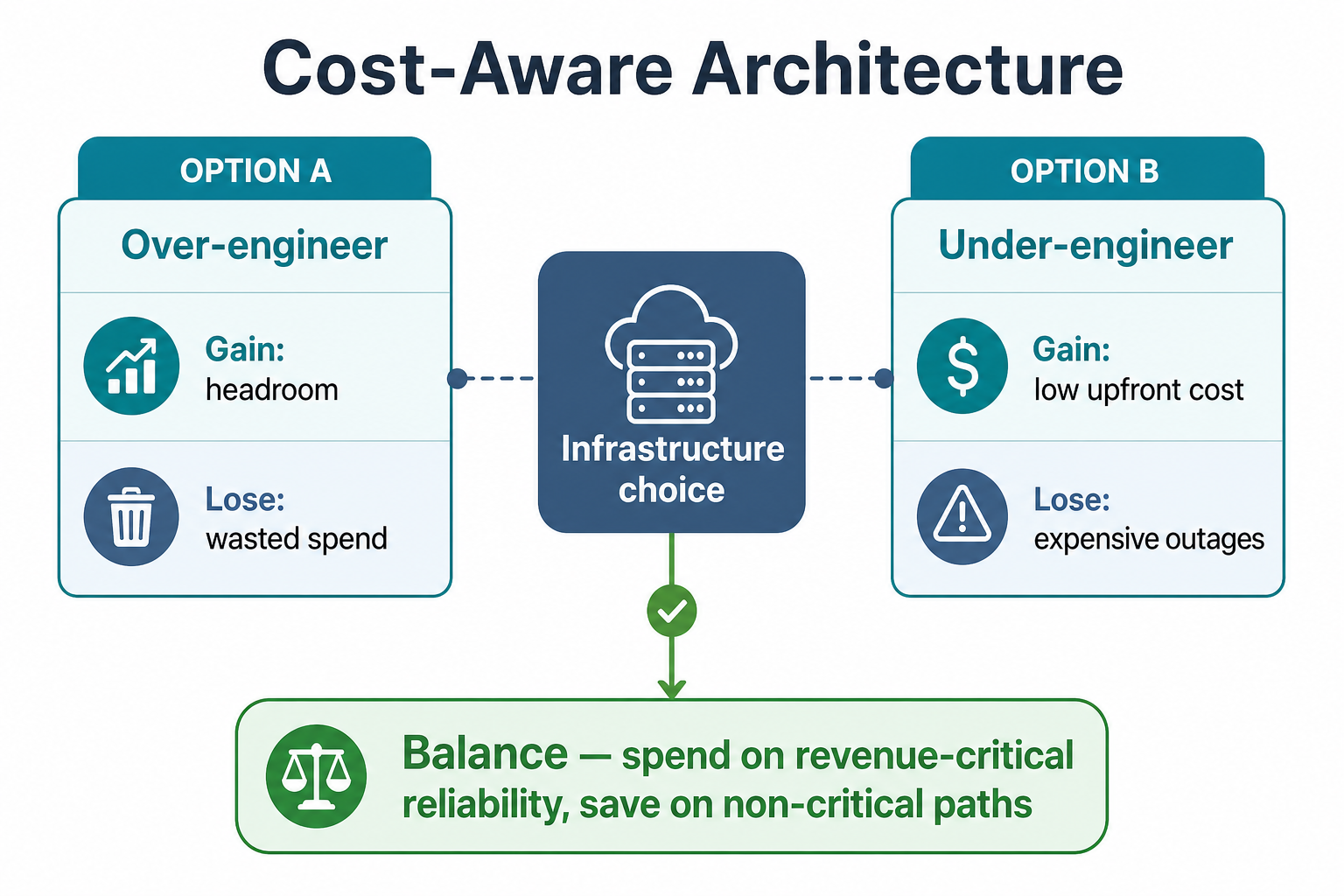
Senior signal: spend on paths where downtime costs money; save on non-critical paths where degraded service is acceptable.
Designing Systems with Cloud Cost in Mind
Why Cost Matters
- Unit economics: At scale, small inefficiencies multiply. 10% waste at $1M/month = $100K/year.
- Runway: Startups have limited budgets. Cost overruns can kill a company.
- Margins: In competitive markets, cost efficiency = margin = ability to invest.
- Sustainability: Waste has environmental impact. Efficient systems are greener.
Cloud Cost Drivers
| Resource | What Drives Cost | Levers |
|---|---|---|
| Compute | Instance hours, type | Right-sizing, spot/preemptible, auto-scaling |
| Storage | GB-months, tier | Lifecycle policies, compression, cold storage |
| Network | Data transfer, cross-AZ/region | Reduce cross-AZ, use CDN, compress |
| Database | Instance + storage | Reserved instances, read replicas vs scale-up |
| Bandwidth | Egress | CDN, regional deployment, compression |
Senior Approach
- Identify cost drivers for the system (compute, storage, network, DB)
- Estimate at scale: "At 10M users, storage = X, bandwidth = Y"
- Design for cost: Right-size, use spot where possible, minimize cross-AZ
- Monitor: Cost per user, cost per request, cost trends
Over-Engineering vs Under-Engineering (Cost Lens)
Over-Engineering = Wasting Money
- Unused capacity: Provisioned for 10x peak "just in case"
- Premature scale: Microservices, multi-region, Kafka when monolith + single DB would do
- Gold-plating: Perfect solution when "good enough" saves 80% cost
- Complexity cost: More services = more monitoring, more ops, more debugging time
Under-Engineering = Expensive Failures
- Single point of failure: One outage can cost more than redundancy
- No autoscaling: Manual scaling, slow response to traffic spikes
- Cheap storage, expensive queries: Wrong DB choice = high compute cost
- No caching: Hitting DB for every request when cache would cut cost 10x
The Balance
Spend on:
- Reliability for revenue-critical paths
- Observability (you can't fix what you can't see)
- Core infrastructure that's hard to change later
Save on:
- Non-critical paths (degraded is OK)
- Over-provisioning ("we might need it")
- Premature optimization
Real Numbers: AWS Example
- Multi-AZ RDS vs single-AZ: ~2x cost. Worth it for production DB.
- ElastiCache for hot data: Can reduce DB load 10x, often pays for itself.
- Reserved instances vs on-demand: 30–60% savings for steady load.
- Spot instances for batch: 70–90% savings. Risk: interruption.
Cost of Reliability
What Reliability Costs
| Reliability Pattern | Cost | When Worth It |
|---|---|---|
| Multi-AZ | ~2x for DB, compute | Production, revenue-critical |
| Multi-region | 3–5x | Global users, compliance |
| Backups | Storage + transfer | Always for critical data |
| Redundant queues | 2x | When message loss is unacceptable |
| Circuit breakers | Dev time | When cascading failure is risk |
| Chaos engineering | Dev time + risk | When failure modes are complex |
When to Spend on Reliability
- Revenue-impacting: Downtime = lost sales
- Compliance: SOC2, HIPAA require redundancy
- User trust: Banking, healthcare, auth
- Hard to fix later: Data model, infra choices
When to Accept Less
- Internal tools: Short outage may be OK
- Non-critical features: Degraded is acceptable
- Early-stage product: Speed > perfection
- Batch jobs: Can retry, not real-time
Senior Insight
"The cost of one hour of downtime for our payment system is $X. Multi-AZ costs $Y/month. If we have one outage per year, we break even. We have 2–3. Multi-AZ pays for itself." — Quantify the trade-off.
When Cheaper Infrastructure Is the Wrong Choice
False Economy
Cheap VMs, no managed DB: You save on RDS, spend 2x on eng time for backups, failover, scaling. Total cost of ownership (TCO) is higher.
Single region: You save 50% on infra. One regional outage loses customers and revenue. One incident can exceed years of savings.
No CDN: You save on CloudFront. Your origin gets hammered, you scale up instances. Bandwidth + compute often exceeds CDN cost.
Cheap object storage, expensive egress: S3 Standard is cheap. Egress is expensive. If you serve lots of data, CDN + lower-tier storage can reduce TCO.
When "Expensive" Is Cheaper
- Managed services: RDS, ElastiCache, managed Kafka. Higher hourly cost, lower TCO (no ops burden).
- Right-sized instances: Larger instance can be cheaper than many small ones (fewer management overhead).
- Reserved capacity: Commit for 1–3 years, save 30–60%. Worth it for baseline load.
- Correct architecture: A well-designed system can cost less than a "cheap" one that doesn't scale.
Senior Decision Framework
- TCO, not just unit cost: Include ops, incident response, engineering time
- Cost of failure: One outage can exceed years of savings
- Lock-in vs flexibility: Vendor lock-in can be costly later
- Scale assumptions: What's cheap at 1K users may be wrong at 1M
Thinking Aloud Like a Senior Engineer
Problem: "Design a system to serve 10M images. Budget-conscious."
My first instinct: "S3 + CloudFront. Standard approach."
Cost check: 10M images, 200KB avg = 2TB storage. S3 Standard: ~$46/month. But egress: if each image viewed 10x/month = 20TB egress. At $0.09/GB = $1,800/month. Egress dominates.
Mitigation: CloudFront in front of S3. Caching at edge. If 80% cache hit, egress from origin = 4TB. Plus CloudFront cost. Might still be $500–800/month total. But way better than $1,800.
Storage tier: Most images old, rarely accessed. Lifecycle to S3 IA or Glacier after 90 days. Storage cost drops 50%+.
Image size: Can we serve WebP? Smaller files = less bandwidth. 30% size reduction = 30% cost reduction.
Decision: S3 + CloudFront, lifecycle policies, WebP/optimization. Design for cost from the start.
Best Practices
- Estimate cost at target scale before building
- Monitor cost per user/request as a core metric
- Right-size: Don't over-provision "to be safe"
- Use managed services when TCO is lower
- Spend on reliability where cost of failure > cost of redundancy
Summary
Cost-aware architecture treats spend as a first-class constraint: identify cost drivers at target scale, balance over-engineering against expensive outages, and quantify when reliability investments pay for themselves. The cheapest hourly rate is often not the lowest total cost of ownership once ops, egress, and downtime are counted.
Key Takeaways
- Unit economics at scale — Small waste per request multiplies at millions of users; estimate storage, egress, and compute at 10x target scale.
- Over-engineering wastes money — Unused capacity, premature microservices, and gold-plating burn runway without improving SLOs.
- Under-engineering costs more later — Single points of failure, no autoscaling, and skipping cache can exceed redundancy spend in one outage.
- Reliability has a price tag — Multi-AZ, backups, and failover are justified when downtime cost × frequency exceeds redundancy cost.
- False economy is common — Self-managed DB, no CDN, and cheap egress-heavy storage often raise TCO versus managed services and edge caching.
- Monitor cost per user/request — Treat cost trends as a core metric alongside latency and error rate.
- Interview move — Name main cost drivers and one optimization ("CloudFront cuts origin egress") without turning the session into a finance spreadsheet.
Apply This Thinking
Practice cost-aware design on InterviewCrafted:
- Design TinyURL with Analytics — Redirect volume, storage growth, and analytics write cost at scale.
- Design Instagram — Image storage tiers, CDN, and bandwidth as dominant cost drivers.
- Design a CDN — Edge caching vs origin egress; reason about cache hit ratio and transfer pricing.
- Decision-Making Under Real Constraints — When budget forces build vs buy and MVP scope choices.
- Cost Optimization — Topic depth on right-sizing, reserved capacity, and lifecycle policies after the interview sketch.
Related Topics
- Decision-Making Under Real Constraints — time vs cost vs correctness when budget is binding.
- Trade-Off Thinking — performance vs cost forks on cache, DB, and replication choices.
- Failure-First Design Thinking — quantifying when redundancy spend beats outage cost.
- Anti-Patterns & What Not To Do — over-provisioning "just in case" as a cost anti-pattern.
- Hot Partition Problem — when scale surprises inflate cost and take down sharded systems.
FAQs
Q: How is cost-aware architecture different from trade-off thinking?
A: Trade-off thinking compares technical properties (consistency, latency, scale). Cost-aware architecture adds dollar impact—unit economics, TCO, and outage cost—so you can defend why multi-AZ is worth it or why a managed service beats self-hosting.
Q: How do I bring up cost in an interview?
A: "Given we're cost-conscious, I'd use X instead of Y because..." or "At this scale, the main cost drivers would be egress and storage; I'd optimize with CDN and lifecycle tiers."
Q: When should we optimize for cost vs speed of development?
A: Early stage: speed. Post-PMF, scaling: cost. When runway or margin is a concern: cost earlier.
Q: What's the biggest cost mistake teams make?
A: Ignoring egress and data transfer. Storage is cheap; moving data is expensive. Design to minimize cross-AZ and cross-region traffic.
Q: When is cheaper infrastructure the wrong choice?
A: When TCO rises—self-managed DB without backups, single region without failover, no CDN hammering origin compute—or when one outage exceeds years of savings on redundancy.
Q: Should I skip multi-AZ to save money?
A: Only if downtime is acceptable for the SLO and business. For revenue-critical paths, compare outage cost to ~2x DB spend; often redundancy pays for itself after one or two incidents per year.
Q: How do I estimate cloud cost in an interview without exact pricing?
A: Name the drivers (storage GB, egress TB, instance hours), rank which dominates at scale, and propose one lever (CDN, lifecycle to cold storage, right-sizing, reserved instances). Precision to the penny is not expected; reasoning is.
Q: Does cost-aware design mean under-investing in reliability?
A: No. It means spending on reliability where failure is expensive and saving where degraded service is acceptable—aligned with failure-first and SLO thinking, not blanket cost cutting.
Keep exploring
Design thinking works best when combined with practice. Explore more topics or apply what you've learned in our system design practice platform.