Design Thinking
Evolutionary Design
Design for change, not perfection. Migration strategies, schema evolution, backward compatibility, incremental rollouts, and feature flags for staff-level system design interviews.
Staff engineers do not design for today's snapshot—they design so the system can change without catastrophic rewrites. Requirements shift, traffic grows 10x, databases need migration, and org structure evolves. Evolutionary design is the mental model for planning migrations, schema changes, and incremental rollouts before you need them.
If you have named components with architecture thinking and picked patterns from architecture patterns, this article covers how those choices evolve safely over years—not in one risky weekend deploy.
Related reading: Team & Org-Level Design Thinking for how org changes drive architectural boundaries. Failure-First Design Thinking for designing rollbacks and blast radius.
The flow below is the staff-level spine: assume change, bound modules, version interfaces, roll out incrementally, avoid big-bang.
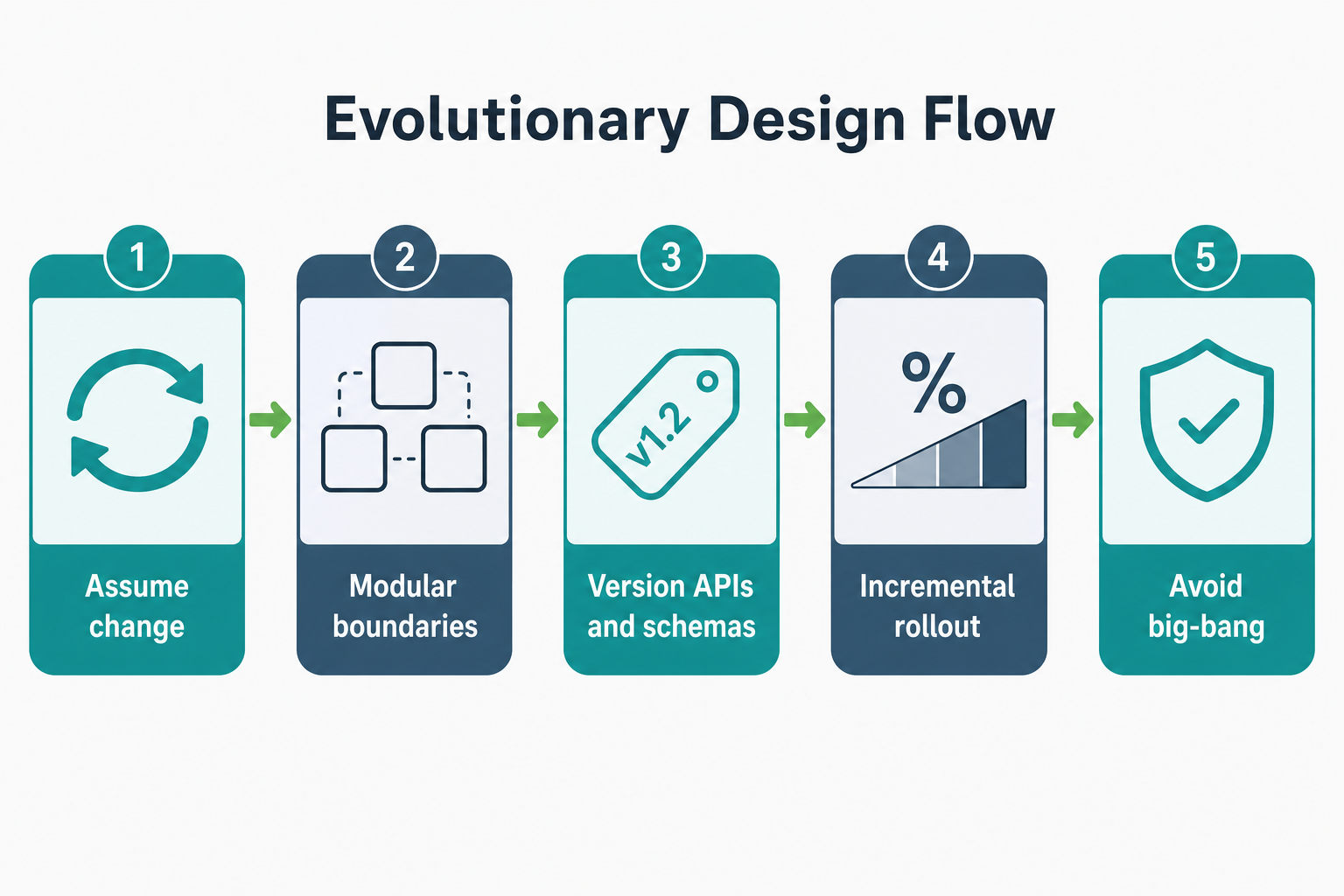
Staff signal: plan the rollout and rollback path before you design the feature—not after production is on fire.
Designing for Change, Not Perfection
The Reality
- Requirements change: Product pivots, new features, new constraints
- Scale changes: 10x growth forces different architecture
- Technology changes: New databases, frameworks, platforms emerge
- Org changes: Teams split, ownership shifts, Conway's Law applies
Evolutionary Design Principles
- Assume change: Don't optimize for today's snapshot
- Minimize lock-in: Avoid decisions that are hard to reverse
- Clear boundaries: Modular design makes replacement possible
- Version everything: APIs, schemas, configs
- Feature flags and gradual rollout: Ship change incrementally
Migration Strategies: Monolith to Microservices
Strangler Fig Pattern
Gradually replace monolith by routing new functionality to new services while keeping old code running.
Steps:
- Identify a bounded context to extract (e.g., "notifications")
- Create new service with the same interface as the monolith's module
- Route new traffic to new service via feature flag or routing rule
- Dual-write or sync data as needed
- Migrate reads to new service
- Migrate writes to new service
- Decommission old code in monolith
Parallel Run
Run old and new systems in parallel, compare results, switch when confident.
- Use case: Critical path (payments, orders) where errors are costly
- Cost: 2x infra during migration
- Benefit: Validation before cutover
Database Migration Strategies
| Strategy | Downtime | Risk | Use Case |
|---|---|---|---|
| Big bang | Yes | High | Rarely, small datasets |
| Dual-write, then cutover | Minimal | Medium | Most common |
| Change data capture (CDC) | None | Low | Large, high-traffic |
| Read replicas, flip | Brief | Low | Read-heavy |
| Logical replication | None | Low | Postgres, etc. |
Real Example: Netflix
Netflix migrated from monolith to microservices over years. They used:
- Strangler fig for most services
- Chaos engineering to validate resilience
- Feature flags to route traffic gradually
- Multiple phases: Not one big migration, many small ones
Schema Evolution & Backward Compatibility
The Challenge
- Schema changes are inevitable: new fields, renames, type changes
- Backward compatibility: Old clients must work with new schema
- Forward compatibility: New clients must work with old schema (during rollout)
Strategies
Additive changes (safe):
- Add optional fields
- Add new tables/collections
- Add new endpoints
Breaking changes (risky):
- Remove fields
- Change types
- Rename fields
- Change semantics
Handling Breaking Changes
- Versioned APIs:
/v1/users,/v2/users. Old clients stay on v1. - Deprecation period: Announce removal, give clients time to migrate, then remove
- Dual-write: Write to both old and new format during transition
- Expand-contract: Add new field (expand), migrate consumers, remove old (contract)
Example: Adding a Required Field
Wrong: Add required field, deploy. Old clients fail.
Right:
- Add field as optional. Deploy.
- Backfill data. Ensure all records have value.
- Make required in new version. Old API still accepts without it (default).
- Migrate consumers to send it.
- Eventually remove old API version.
Real Example: Stripe API
Stripe versions APIs (/v1/, 2023-10-16, etc.). They add fields additively. Renames or removals go through deprecation. Old versions supported for years.
Incremental Rollouts and Feature Flags
Why Incremental?
- Reduce risk: One bad deploy doesn't affect everyone
- Validate in production: 1% traffic can surface issues
- Easy rollback: Turn off flag, no redeploy
- A/B testing: Compare old vs new behavior
Rollout Strategies
| Strategy | Use Case | Rollback |
|---|---|---|
| Percentage rollout | 1% → 10% → 50% → 100% | Reduce % |
| Canary | New version for one server/group | Route back |
| User segment | Internal users, beta users first | Exclude segment |
| Geographic | One region first | Route away |
| Kill switch | Feature flag to disable | Flip flag |
Feature Flags in Design
When designing, consider:
- Where do we need flags? New code paths, experiments, migrations
- How do we clean up? Flags have cost: complexity, tech debt
- Who controls flags? Eng, product, ops
- What's the blast radius? One flag or many?
Senior Insight
"Design the rollout before you design the feature. If you can't roll it out incrementally, you'll either delay launch or risk a big-bang deploy. Both are costly." — Plan for rollout as part of the design.
Case Studies: Netflix, Spotify, Stripe
Netflix
- Migration: DVD to streaming, datacenter to cloud
- Approach: Phased migration, chaos engineering, regional rollout
- Lesson: Multi-year journey, not one project. Evolve continuously.
Spotify
- Squad model: Small teams own services. Conway's Law in action.
- Migration: Monolith to "microservices" (they call them something else)
- Lesson: Org structure drove service boundaries. Migration followed team autonomy.
Stripe
- API versioning: Multiple versions live. Deprecation with long runway.
- Schema evolution: Additive changes, expand-contract for breaking
- Lesson: Backward compatibility is a product commitment. Plan for it.
Thinking Aloud Like a Senior Engineer
Problem: "We need to migrate from MySQL to PostgreSQL. 100M rows, high traffic."
My first instinct: "Dual-write, sync, cutover."
But let me think about phases:
- Phase 1: Add PostgreSQL as read replica. Sync via CDC or dual-write. Validate data.
- Phase 2: Route read traffic to PostgreSQL (percentage-based). Compare results.
- Phase 3: Switch writes. Use feature flag: new writes go to both, or only PG with MySQL as fallback.
- Phase 4: Migrate remaining reads. Decommission MySQL.
Rollback: At each phase, we can revert. Phase 2: route back to MySQL. Phase 3: write to MySQL only. No big bang.
Schema: PostgreSQL and MySQL differ. We need an abstraction or adapter. Or: same schema in both during migration. Extra work but simpler.
Downtime: Zero if we do it right. Dual-write, then cutover writes, then cutover reads. Brief inconsistency window? Use distributed transaction or accept eventual consistency for that window.
Best Practices
- Assume migration: Design so components can be replaced
- Version APIs and schemas: From day one
- Prefer additive changes: Avoid breaking changes when possible
- Plan rollout: Percentage, canary, region—before building
- Clean up flags: Technical debt if left forever
Summary
Evolutionary design means building systems that can change: modular boundaries you can replace, versioned APIs and schemas, migration strategies like strangler fig and parallel run, and incremental rollouts with feature flags. Staff engineers plan for evolution from day one—many small reversible steps beat one big-bang rewrite that takes down production.
Key Takeaways
- Assume change, not perfection — Requirements, scale, technology, and org structure will shift; design for replaceability, not today's ideal snapshot.
- Strangler fig over big-bang — Route new traffic to new services gradually; decommission old paths only when reads and writes are fully migrated.
- Prefer additive schema changes — Add optional fields first, backfill, then contract; breaking changes need versioned APIs and deprecation windows.
- Plan rollout before the feature — Percentage rollout, canary, and kill switches belong in the design conversation, not as a post-launch afterthought.
- Parallel run for critical paths — Payments and orders benefit from running old and new systems side by side until results match.
- Clean up feature flags — Flags reduce risk but create tech debt; remove them after rollout completes.
- Multi-year migrations are normal — Netflix, Spotify, and Stripe evolved over years of phased steps—not one heroic project.
Apply This Thinking
Practice designing for change under interview and staff-level prompts:
- Design Twitter — Feed algorithm and schema evolution at scale; how would you roll out a ranking change?
- Design Amazon — Catalog, inventory, and ordering domains that evolve independently over years.
- Design Netflix — DVD-to-streaming migration and continuous regional rollout—classic evolutionary design case.
- Team & Org-Level Design Thinking — Service extraction often follows team boundaries; plan both together.
- The Strangler Pattern in Production — real postmortem-style walkthrough of incremental monolith replacement.
Related Topics
- Architecture Thinking: Decomposing Problems into Components — clear module boundaries make strangler fig and service extraction possible.
- High-Level Architecture Patterns — start simple (layered/monolith); evolve toward microservices or event-driven when constraints demand it.
- Team & Org-Level Design Thinking — org changes drive migration boundaries; Conway's Law applies to phased rollouts.
- Trade-Off Thinking — every migration step has explicit cost: dual-write overhead, consistency windows, operational complexity.
- API Design — versioning, backward compatibility, and expand-contract are foundational to schema evolution.
FAQs
Q: How is evolutionary design different from over-engineering for the future?
A: Evolutionary design builds optionality—clear boundaries, versioned interfaces, rollout paths—not speculative features you may never need. You plan how to change, not every change in advance.
Q: When is a big-bang migration acceptable?
A: Rarely—only with small datasets, low traffic, acceptable downtime, and no feasible incremental path. Even then, document rollback and rehearse the cutover. Most production systems at interview scale should use phased migration.
Q: How do you handle schema changes in a distributed system?
A: Version the schema and API. Support multiple versions during transition. Use expand-contract: add new fields or tables, migrate consumers, remove old paths. Change data capture (CDC) helps async sync between old and new stores.
Q: How is evolutionary design different from agile iteration?
A: Agile iteration ships small product increments. Evolutionary design is the architectural discipline behind those increments—boundaries, compatibility, and migration paths so each release does not require a rewrite.
Q: How many feature flags are too many?
A: When flags are hard to reason about, slow releases, or never get removed. Track flag lifecycle, set cleanup deadlines, and prefer fewer high-impact flags over dozens of stale toggles.
Q: What is the strangler fig pattern in one sentence?
A: Gradually replace a monolith by routing new functionality—and eventually existing traffic—to new services while old code keeps running until it can be decommissioned safely.
Q: How do you migrate a database with zero downtime?
A: Typical path: dual-write to old and new stores, backfill historical data, shift reads with percentage-based routing, validate consistency, then cut over writes and decommission the old store—with rollback at each phase.
Q: Do I need to mention evolutionary design in every system design interview?
A: Not every prompt—but when asked "how would this evolve?" or "how do you migrate without downtime?", naming strangler fig, expand-contract, and feature-flag rollout shows staff-level judgment beyond a static diagram.
Keep exploring
Design thinking works best when combined with practice. Explore more topics or apply what you've learned in our system design practice platform.