Design Thinking
Interview-Specific Senior Mistakes & Anti-Patterns
What senior candidates get wrong in system design interviews: over-engineering, jumping to tech before clarifying, and failing to justify trade-offs aloud.
Senior engineers sometimes score lower in system design interviews than mid-level candidates. The paradox: more production experience can push you toward over-engineering, buzzword stacks, and unjustified technology picks. Interviewers are not grading your résumé—they are grading whether you clarify, scope complexity to stated scale, and defend trade-offs out loud.
If you have built at scale but keep hearing "we ran out of time" or "can you simplify?", this guide names the anti-patterns interviewers flag and the fixes that read as senior signal.
Related reading: For general anti-patterns in architecture (not interview-specific), see Anti-Patterns in System Design. For the positive workflow, read The 7-Step Problem-Solving Framework. For saying trade-offs clearly, continue to Communication & Interview Strategy.
The split below is what interviewers hear in the first five minutes—anti-pattern on the left, senior fix on the right.
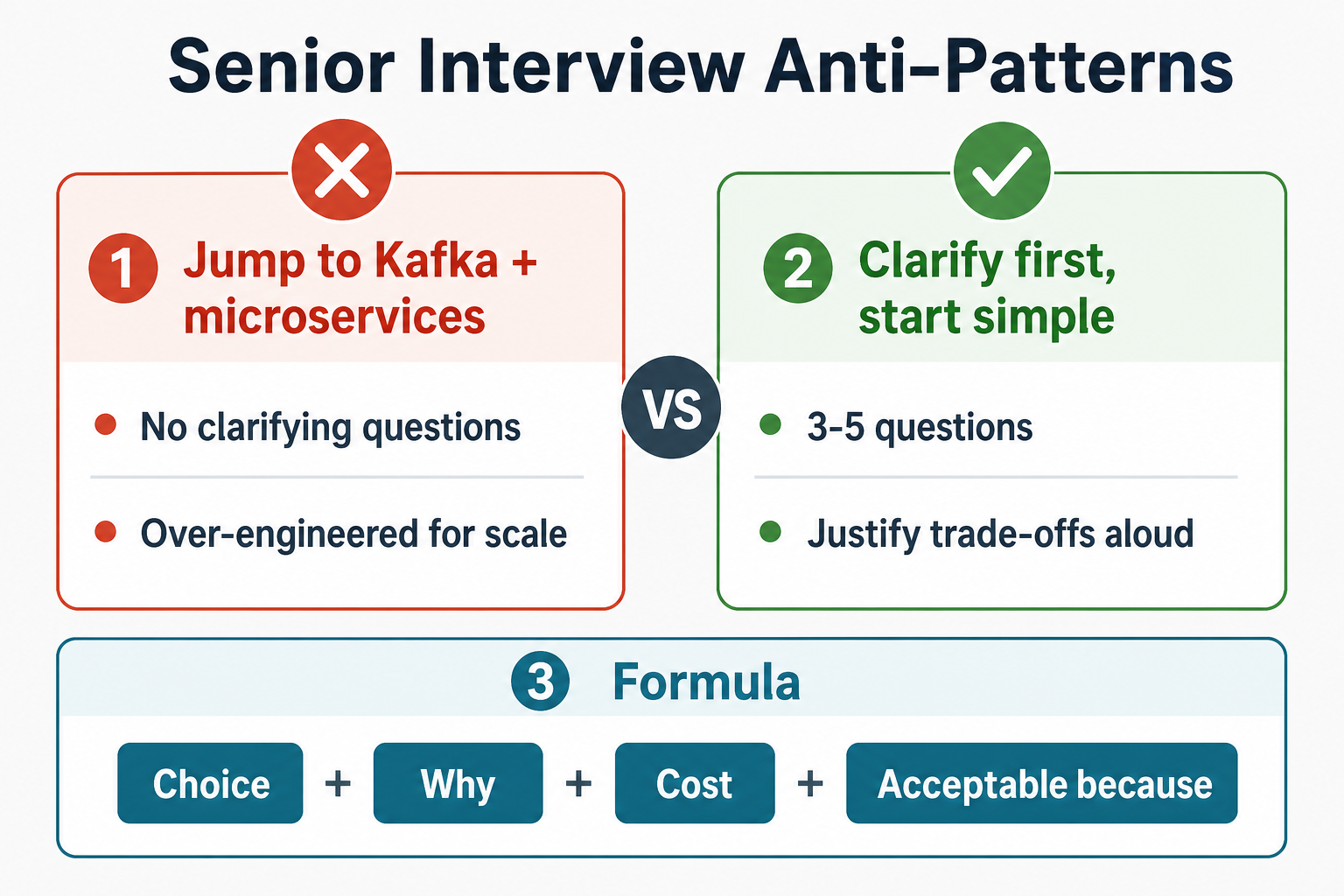
Senior fix: three to five clarifying questions, a simple v1 for stated scale, and "we get X, we sacrifice Y" on every major component.
What Senior Candidates Do Wrong in System Design
The Paradox
Senior engineers have seen more, built more, and know more patterns. That can hurt them in interviews:
- They over-engineer: "At scale we'd need X" when scale is 10K users
- They assume complexity: Skip clarification because "obviously" it's distributed
- They use jargon: Lose the interviewer or sound like they're reciting
- They don't justify: "We'll use Kafka" without saying why
- They run out of time: Spend 30 minutes on one component, never finish
What Interviewers Notice
- No clarifying questions: Red flag. Seniors should ask.
- Solution before problem: Jumping to Kafka, microservices, etc.
- Over-engineered for the stated scale: Suggests they can't tailor solutions
- Trade-offs not articulated: "We use X" — but why? What are we giving up?
- Can't simplify: When asked "what if we had 1/10 the scale?", they can't simplify
Over-Engineering in Interviews
What It Looks Like
- Microservices for a URL shortener: Overkill for 100K URLs
- Kafka for 1000 events/day: A queue or DB would do
- Multi-region for a single-country app: Unnecessary
- Custom sharding for 1M rows: Single DB handles it
- GraphQL when REST works: Adds complexity without clear benefit
Why Seniors Do It
- Production habits: In production, they design for scale. Interview scale is often smaller.
- Pattern matching: "This looks like X, we use Y for X." Doesn't fit interview context.
- Anxiety: Over-compensate by showing everything they know.
- Misread scale: Didn't ask. Assumed billions.
How to Avoid
- Ask about scale: "What scale are we designing for?" Use the answer.
- Start simple: "For 100K users, single DB + cache. If we hit 10M, we'd add X."
- Justify complexity: "I'm adding Y because [scale/requirement]. Without that, we wouldn't need it."
- Have a simplification ready: "If scale were 10x lower, I'd use a single server and SQLite."
Interview Script
"For this scale [stated by interviewer], I'll start with [simple design]. If we grew to [10x], we'd add [specific component]. I'm avoiding [complex thing] because we don't have evidence we need it yet."
Jumping to Tech Before Clarifying Constraints
What It Looks Like
Interviewer: "Design a feed."
Candidate: "I'll use Cassandra for write scaling, Redis for caching, Kafka for the event stream, and a fan-out on write approach with a background worker to populate feeds..."
Problem: No questions about scale, read/write ratio, latency, or features. The solution might be wrong. Over-engineered. Or both.
Why It Happens
- Confidence: Seniors think they know. They've built feeds before.
- Time pressure: Feel they need to show progress fast
- Habit: In real work, sometimes the problem is well-known. In interviews, it's not.
- Ego: "I don't need to ask. I know."
How to Fix
- Always ask 3–5 questions before designing. Scope, scale, constraints.
- Reframe the problem: "So we're building X with Y scale and Z constraints. Correct?"
- State assumptions: "I'll assume read-heavy. If it were write-heavy, I'd change..."
- Pause before solutions: Spend 2–3 minutes on questions. It's not wasted.
Good Opening
"Before I jump into the design, a few questions. What scale—users and requests? Read-heavy or write-heavy? What's in scope for v1—chronological feed only, or do we need ranking? And any latency or availability targets?"
Failing to Justify Trade-offs
What It Looks Like
Candidate: "We'll use Redis for caching."
Interviewer: "Why Redis and not Memcached?"
Candidate: "Uh, Redis is more popular. Better features."
Problem: No clear trade-off reasoning. Sounds like preference, not analysis.
What Good Looks Like
"We need a cache for read latency. Redis vs Memcached: Redis supports more data structures (we might want sorted sets for feed) and persistence (optional). Memcached is simpler and slightly faster for pure key-value. Given we might extend beyond simple KV, I'd choose Redis. Trade-off: we get flexibility, we accept slightly more operational complexity."
The Formula
Choice + Why + What we're giving up + Why that's acceptable
Common Trade-offs to Justify
| Choice | Justify | Trade-off |
|---|---|---|
| SQL vs NoSQL | Consistency needs, query patterns, scale | Consistency vs scale, flexibility vs structure |
| Cache vs no cache | Read load, latency requirement | Staleness vs latency, complexity vs performance |
| Sync vs async | Latency, throughput, coupling | Simplicity vs scale, coupling vs resilience |
| Monolith vs microservices | Team structure, scale, deploy independence | Simplicity vs autonomy, operational burden vs flexibility |
Interview Tip
For every major choice, say: "I'm choosing X because of [requirement]. The trade-off is we get [benefit] and we accept [cost]. For our constraints, that's acceptable because [reason]."
Other Common Senior Mistakes
1. Talking Too Much, Drawing Too Little
Interviews are visual. Use the whiteboard. Draw boxes, arrows, data flow. Talk while drawing. Don't lecture for 10 minutes with no diagram.
2. Ignoring the Interviewer
They might be guiding you. If they ask "what about X?" or "could we simplify?"—engage. Don't plow ahead with your script.
3. Getting Stuck in Details
Spending 20 minutes on the exact Redis eviction policy. Interviewer wants end-to-end. Cover breadth, then go deep where they're interested.
4. No Prioritization
Treating everything as equal. Interviewer cares about the hard parts. Prioritize: "The main challenges here are X and Y. I'll focus on those."
5. Defensive When Challenged
"If we had 10x the scale, what would change?" — Answer it. Don't defend the current design. Show you can adapt.
How to Avoid These in Practice
Before the Interview
- Practice clarifying: Every problem, ask 3–5 questions first
- Practice simplification: "For 1/10 the scale, I'd use..."
- Practice trade-offs: For every choice, say "we get X, we sacrifice Y"
- Time yourself: 5 min clarify, 30 min design, 10 min deep dive. Stick to it.
During the Interview
- Pause before designing: "Let me ask a few questions first"
- Start simple: "For this scale, here's the minimal design"
- Justify as you go: "I'm adding X because..."
- Check in: "Does this direction make sense? Any area you'd like me to go deeper?"
- Adapt: If they redirect, follow. Don't resist.
Mental Model
Pretend you're the interviewer. What would make you say "hire"?
- Clear thinking
- Good communication
- Appropriate complexity (not over, not under)
- Trade-off awareness
- Collaboration (they ask, you engage)
Thinking Aloud: Good vs Bad
Bad
Candidate: "We need microservices. I'll have a user service, an order service, a payment service. Each has its own database. They communicate via Kafka. We'll use Kubernetes for orchestration..."
Problems: No scale. No justification. Over-engineered for most interview problems. No trade-offs stated.
Good
Candidate: "A few questions first. What scale? Read or write heavy? ... Okay, 1M users, read-heavy. For that, I'd start with a monolith—simpler, faster to build. Single DB, add a cache for hot reads. If we later had 10M users and multiple teams, we'd consider splitting into services. Let me draw the initial design..."
Why it's better: Asked. Scoped. Simple first. Has scaling path. Will justify choices as they design.
Summary
Senior interview failure modes are predictable: complexity beyond stated scale, solutions before clarifying questions, and technology choices without trade-off sentences. The fix is procedural—pause, ask three to five scope questions, start with the smallest design that meets requirements, justify each major fork with benefit and cost, draw while you talk, and adapt when the interviewer redirects.
Key Takeaways
- Experience can hurt — Production habits push Kafka, sharding, and microservices when the prompt implies thousands—not billions—of users.
- Clarify before components — Three to five questions on scale, read/write mix, latency, and v1 scope beat a premature technology stack.
- Match complexity to stated scale — "For 100K users, monolith plus cache; at 10M we'd add X" shows tailoring, not pattern matching.
- Trade-off formula — Choice + why + what you give up + why acceptable—for DB, cache, queue, and service boundaries.
- Draw while talking — Ten minutes of lecture without boxes and arrows loses interviewers; breadth before deep eviction-policy rabbit holes.
- Engage redirects — "What if we had one-tenth the scale?" is a collaboration test, not an attack on your design.
- Time-box — Roughly five minutes clarify, thirty design, ten deep dive; running out of time with one over-detailed component is a common senior miss.
Apply This Thinking
Practice anti-pattern avoidance on scoped problems:
- Design a URL Shortener — Resist sharding and microservices; clarify read/write ratio first.
- Design Pastebin — Simple storage and TTL; practice simplification when scale drops.
- Design a Notification System — Balance async depth with finishing an end-to-end diagram in time.
- Trade-Off Thinking — Vocabulary for justifying Redis vs Memcached, sync vs async, SQL vs NoSQL.
- Ambiguity Handling & Problem Framing — Structured questions when the prompt is intentionally vague.
Related Topics
- Anti-Patterns in System Design — architecture mistakes beyond interview performance.
- Communication & Interview Strategy — how to narrate reasoning so interviewers follow your design.
- Trade-Off Thinking — explicit gain/lose language for every major choice.
- What Is Design Thinking? — requirements-before-solutions mental model for the whole hub.
- Trade-offs at Scale — when complexity is justified vs when it is résumé-driven over-engineering.
FAQs
Q: I'm a senior. How do I avoid over-engineering?
A: Ask about scale explicitly. Use it. Say: "For X scale, I'd use Y. For 10x, I'd add Z." Always have a "simple version" in your head. Start there unless the problem clearly needs more.
Q: What if the interviewer doesn't answer my questions?
A: "I'll assume X. If it's different, I can adjust." State assumptions and proceed. Don't stall.
Q: How much justification is enough?
A: For every major component (DB, cache, queue, service split), 1–2 sentences: "We use X because Y. Trade-off: we get A, we accept B." That's enough. Don't over-explain.
Q: How is this different from general anti-patterns in system design?
A: General anti-patterns describe bad production architecture (chatty microservices, cache-as-database). This article focuses on interview performance—how senior candidates fail the room even when production instincts are strong.
Q: Why do seniors jump to tech before clarifying?
A: Confidence from past projects, time pressure, and pattern matching. Interview prompts are deliberately underspecified; skipping questions signals you design from habit, not requirements.
Q: What is a good opening line after the prompt?
A: "Before I sketch components, a few questions—what scale, read vs write mix, latency target, and what's in scope for v1?" Then restate: "So we're building X at Y scale with Z constraints—correct?"
Q: Should I mention microservices at all on easy problems?
A: Mention them as a future path if scale or team structure grows—"I'd stay monolith now; at multiple teams we'd split on these boundaries." Do not deploy twelve services for a URL shortener at 100K URLs.
Q: How do I recover if the interviewer says I'm over-engineering?
A: Acknowledge, simplify immediately, and explain what you would add only when a specific constraint appears. Adaptability scores higher than defending an oversized diagram.
Keep exploring
Design thinking works best when combined with practice. Explore more topics or apply what you've learned in our system design practice platform.