Design Thinking
Trade-offs at Scale
Beyond buzzwords: when microservices are wrong, when eventual consistency fails, and how to choose strong consistency, latency vs throughput, and read vs write optimization at scale.
At scale, every architectural choice has a bill attached. Microservices buy independent deploys but tax you with network hops and distributed debugging. Eventual consistency keeps feeds fast but can lose money on checkout. Latency and throughput pull in opposite directions. Senior engineers do not recite "best practices"—they name what you gain, what you lose, and why the constraint makes the choice acceptable.
If you have passed the basics of system design and still default to Kafka, sharding, or microservices on instinct, this article is for you. By the end, you should be able to argue when a monolith wins, when strong consistency is non-negotiable, and how read vs write amplification should drive your data model.
Related reading: For the general trade-off vocabulary, see Trade-Off Thinking. For NFR-driven constraints (compliance, multi-region), read Non-Functional Requirements Deep Dive. When failure modes should drive the design, continue to Failure-First Design Thinking.
The matrix below is the spine of scale reasoning—every fork should end with an explicit gain, lose, and "acceptable because."
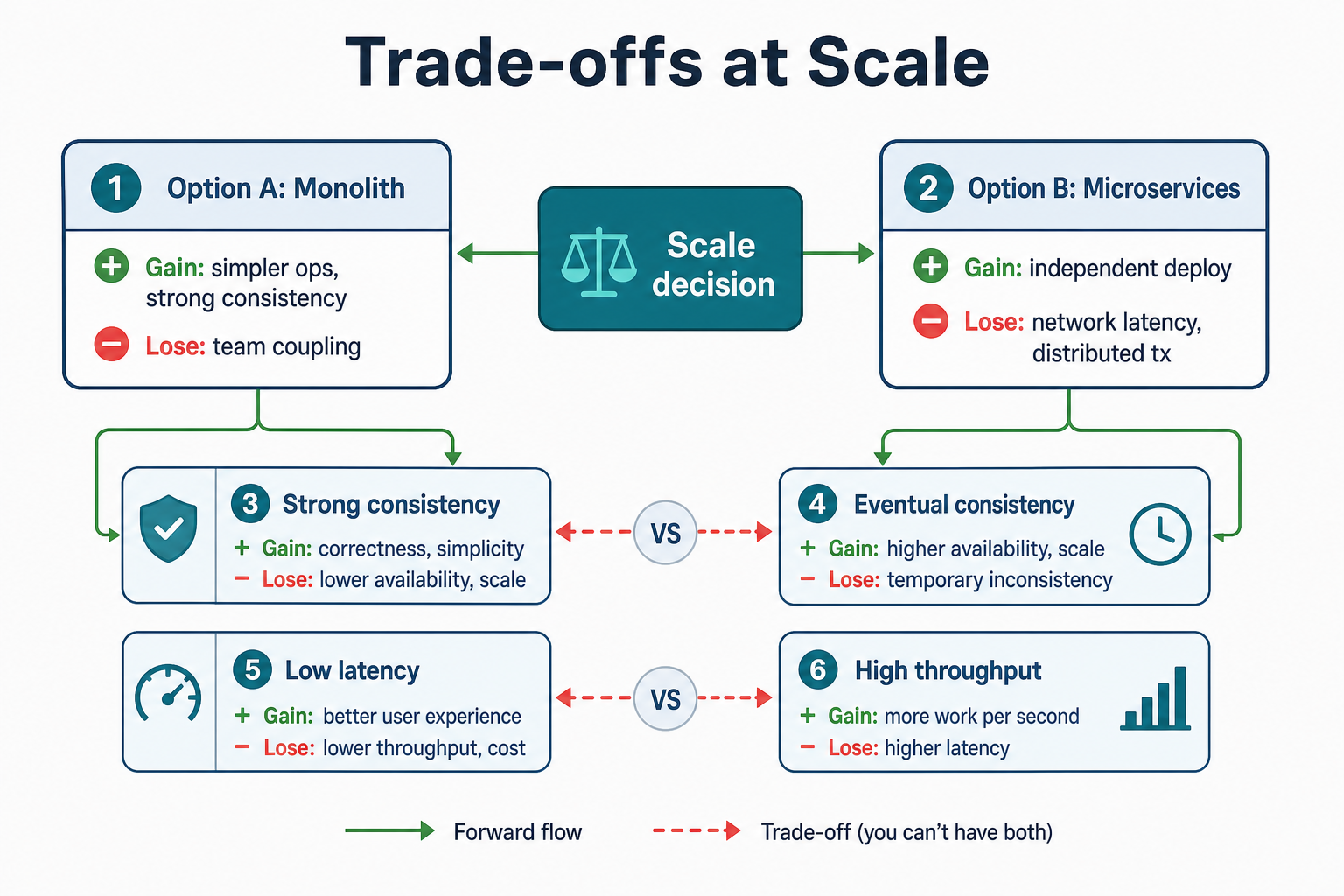
Senior signal at scale: name the option, what you gain, what you sacrifice, and which constraint makes the sacrifice acceptable.
When Microservices Are a Mistake
The Microservices Myth
"Microservices scale" is incomplete. Microservices enable:
- Independent scaling of services
- Independent deployment by teams
- Technology diversity per service
But they add:
- Operational complexity: Many services, many failure modes
- Network latency: Cross-service calls add ms
- Data consistency challenges: Distributed transactions, eventual consistency
- Debugging difficulty: Tracing across services
- Team overhead: Each service needs ownership
When to Stay Monolith
| Scenario | Why Monolith |
|---|---|
| Small team (under 10) | Coordination overhead of services > benefit |
| Low scale (under 1M requests/day) | Single deploy can handle it |
| Strong consistency needs | Transactions across domains easier in monolith |
| Rapid iteration | No API versioning, no cross-service deploys |
| Unclear boundaries | Don't split until domains are clear |
Real Example: Stripe
Stripe started as a monolith. They scaled it to billions in payments. They split into services when:
- Teams grew and needed independent deploy
- Clear domain boundaries emerged (payments, billing, radar)
- Operational maturity could support distributed systems
Senior Insight
"If we can't draw clear service boundaries, we shouldn't split. If one team owns it all, a monolith is faster. Microservices are an organizational pattern as much as a technical one." — often attributed to Conway's Law.
When Eventual Consistency Is Unacceptable
Domains Requiring Strong Consistency
- Financial transactions: Double-spend is unacceptable
- Inventory: Overselling is unacceptable
- Seats/tickets: Double-booking is unacceptable
- User identity/auth: Wrong user data is a security issue
- Compliance: Audits require consistent records
Domains Tolerant of Eventual Consistency
- Social feeds: Stale by seconds is fine
- Recommendations: Stale is acceptable
- Analytics: Eventually consistent is the norm
- Counters (likes, views): Approximate is often OK
- Caches: Stale by definition
The Cost of Strong Consistency
- Latency: Cross-node coordination (2PC, Paxos) adds round-trips
- Availability: Under partition, strong consistency may refuse writes (CAP)
- Throughput: Coordination limits write throughput
- Complexity: Distributed transactions are hard
Senior Decision Framework
- What breaks if inconsistent? Money, safety, compliance → strong
- What's the staleness tolerance? Seconds vs minutes vs hours
- What's the write volume? High write + strong consistency = hard
- Can we isolate consistency? Strong for critical path, eventual for rest
Example: E-commerce
- Cart: Eventual OK (user might see stale cart briefly)
- Checkout/payment: Strong (no double-charge)
- Inventory: Strong or compensating (oversell = bad)
- Recommendations: Eventual (stale is fine)
Choosing Strong Consistency Intentionally
When You Choose Strong Consistency
You're accepting:
- Higher latency (coordinating writes)
- Lower availability under partition (or complex failover)
- More complex implementation (distributed tx, 2PC, etc.)
You're gaining:
- Correctness guarantees
- Simpler application logic (no conflict resolution)
- Compliance and auditability
Implementation Options
| Approach | Use Case | Trade-off |
|---|---|---|
| Single primary DB | Classic SQL | Single point of failure |
| Synchronous replication | Multi-AZ | Write latency = 2x network RTT |
| 2PC / Distributed tx | Cross-service consistency | High latency, blocking |
| Saga with compensation | Cross-service, async | Complex rollback logic |
| Single-writer partition | Sharded but consistent per partition | Limits write scale per key |
Real Example: Financial Systems
Stripe, banks, and exchanges use strong consistency for balances and transactions. They pay with:
- Lower write throughput (compared to eventually consistent stores)
- Higher latency (synchronous replication)
- Operational complexity (failover, split-brain prevention)
They gain: No double-spend, correct balances, audit trails.
Latency vs Throughput Trade-offs
Definitions
- Latency: Time for one request (e.g., p50, p99)
- Throughput: Requests per second the system can handle
The Trade-off
Often you optimize for one at the expense of the other:
| Optimize For | Sacrifice | Example |
|---|---|---|
| Low latency | Throughput | Synchronous, no batching, fewer connections |
| High throughput | Latency | Batching, async, more queuing |
| p99 latency | p50 | More redundancy, caching, oversizing |
Example: Write Path
- Low latency: Write directly to primary, sync replicate. Each write = 1–2 round-trips.
- High throughput: Batch writes, async replicate, buffer in queue. Latency = batch interval + processing.
Example: Read Path
- Low latency: Read from nearest replica, maybe stale. Or: cache with short TTL.
- High throughput: Read from many replicas, spread load. Latency may increase if replicas lag.
Senior Insight
"Are we latency-bound or throughput-bound?" If users wait on each request (e.g., search), optimize latency. If we process a backlog (e.g., batch jobs), optimize throughput.
Read Amplification vs Write Amplification
Read Amplification
One logical read triggers multiple physical reads.
Examples:
- Fan-out: One feed request = read from N users' posts
- Join: One query = read from multiple tables
- Replication: Read from replica that lagged = re-read from primary
Mitigation: Denormalization, caching, pre-computation, materialized views.
Write Amplification
One logical write triggers multiple physical writes.
Examples:
- Replication: 1 write → 3 replicas = 3 writes
- Indexes: 1 row insert → N index updates
- Event sourcing: 1 event → N downstream processors
- Fan-out on write: 1 post → write to N followers' feed caches
Mitigation: Async replication, fewer indexes, batch updates, write coalescing.
The Trade-off
- Read-heavy: Optimize reads. Denormalize, cache. Accept write amplification.
- Write-heavy: Optimize writes. Minimize indexes, async fan-out. Accept read amplification or eventual consistency.
Example: Social Feed
Fan-out on read: 1 feed request reads from N friends. Read amplification = N. Low write amplification.
Fan-out on write: 1 post writes to N followers' feeds. Write amplification = N. Low read amplification (feed is pre-built).
Choice: Twitter uses fan-out on write for celebrities (many followers) and fan-out on read for regular users. Hybrid based on follower count.
Thinking Aloud Like a Senior Engineer
Problem: "Design a system for 10M writes/sec, strong consistency required."
My first instinct: "Kafka? Cassandra? Distributed something?"
But wait — strong consistency at 10M writes/sec is extremely hard. Let me clarify: Is it 10M logical writes or 10M physical? What's the consistency boundary? Per key or global?
Per-key consistency: Possible. Shard by key, each shard handles a fraction. Strong consistency per shard (single primary or Raft). 10M / 1000 shards = 10K writes/sec per shard. Doable.
Global consistency: Much harder. Distributed transactions don't scale to 10M/sec. Maybe we don't need global—just per-user or per-account?
Latency requirement? If we need under 10ms, we're limited. If we can do async with confirmation, easier.
I'd ask: "What does strong consistency mean here? Per account? Per transaction? And what's the acceptable latency for a write to be visible?"
Summary
Trade-offs at scale are not about picking the trendiest stack—they are about matching architecture to domain, team, and bottleneck. Monoliths often win early; strong consistency belongs on money and inventory paths; latency and throughput optimize for different workloads; and read vs write amplification should drive denormalization vs fan-out choices. Senior interview answers make each fork explicit with numbers and constraints.
Key Takeaways
- Microservices are an org pattern — Independent deploy helps multiple teams; a single team with unclear boundaries usually moves faster in a monolith.
- Consistency follows the domain — Money, inventory, seats, and identity need strong guarantees; feeds, recommendations, and counters can tolerate staleness.
- Strong consistency has a price — You pay in latency, availability under partition, and write throughput; isolate strong paths to the critical subset.
- Latency vs throughput — User-facing paths waiting on each request are latency-bound; backlogs and batch jobs are throughput-bound; optimize the bottleneck.
- Amplification is multiplicative — One logical read or write can trigger N physical operations; quantify N before choosing fan-out on read vs write.
- Hybrid beats dogma — Twitter mixes fan-out strategies by follower count; e-commerce mixes eventual carts with strong checkout—match pattern to subdomain.
- Clarify before distributed magic — At 10M writes/sec with strong consistency, ask per-key vs global scope and acceptable write visibility latency before naming technologies.
Apply This Thinking
Put scale trade-offs into practice on InterviewCrafted:
- Design Amazon — Inventory, checkout, and catalog force strong vs eventual consistency and read/write amplification choices.
- Design Twitter — Feed fan-out on read vs write is the classic amplification trade-off at scale.
- Design Uber — Real-time pricing and geo data combine latency, throughput, and eventual consistency domains.
- Trade-Off Thinking — General vocabulary for "we get X, we sacrifice Y" before you reach for distributed systems.
- Decision-Making Under Constraints — When time, team, and budget cap how far you can push scale architecture.
Related Topics
- Trade-Off Thinking — how to justify any architecture fork under stated constraints.
- Non-Functional Requirements Deep Dive — compliance, multi-region, and observability as scale drivers.
- Failure-First Design Thinking — what breaks when shards, replicas, or regions fail.
- Monolith to Microservices: A Step-by-Step Migration — when splitting actually paid off in production.
- Hot Partition Problem — amplification and sharding gone wrong at scale.
FAQs
Q: How do I know if we need strong consistency?
A: Ask: "What breaks if two users see different data for 5 seconds?" If the answer is "money lost" or "safety issue," you need strong. If it's "slightly stale feed," eventual is fine.
Q: When should we split a monolith?
A: When you have: (1) clear domain boundaries, (2) multiple teams needing independent deploy, (3) different scaling needs per domain, and (4) operational readiness for distributed systems.
Q: How do I explain amplification to stakeholders?
A: "One user action triggers X backend operations. At scale, that's Y total operations. We need to reduce X or optimize each operation." Use numbers.
Q: Is eventual consistency ever wrong for a social feed?
A: Usually feeds tolerate seconds of staleness, but ranking experiments, abuse moderation, or legal takedowns may need stronger guarantees on specific paths. Segment by subdomain—timeline reads can be eventual while account status updates stay strong.
Q: How is trade-offs at scale different from general trade-off thinking?
A: General trade-off thinking is the vocabulary (gain, lose, constraint). At scale adds amplification math, CAP-style consistency boundaries, and organizational patterns like microservices—where the cost of coordination becomes the dominant term.
Q: When is microservices the right answer in an interview?
A: When the prompt states multiple teams, independent deploy cadence, different scaling profiles per domain, and operational maturity—and you can draw clear service boundaries. Otherwise default to monolith plus a scaling path.
Q: Should I optimize p50 or p99 latency at scale?
A: User-facing interactive flows usually need p99 because tail latency defines perceived quality. Batch and analytics pipelines often care about throughput and average cost per job. State which metric matches the workload before sizing infra.
Q: How do I handle cross-shard queries after sharding?
A: Avoid them in the hot path—design keys so most access is single-shard. Use denormalization, async aggregation, or a separate search/index layer for cross-shard reads. Accept complexity as the trade-off for horizontal write scale.
Keep exploring
Design thinking works best when combined with practice. Explore more topics or apply what you've learned in our system design practice platform.