Mock Interviewer
Ask Coach
Tap a question to start, or type your own below.
Key-Value Store System Design
Visual Problem Diagram
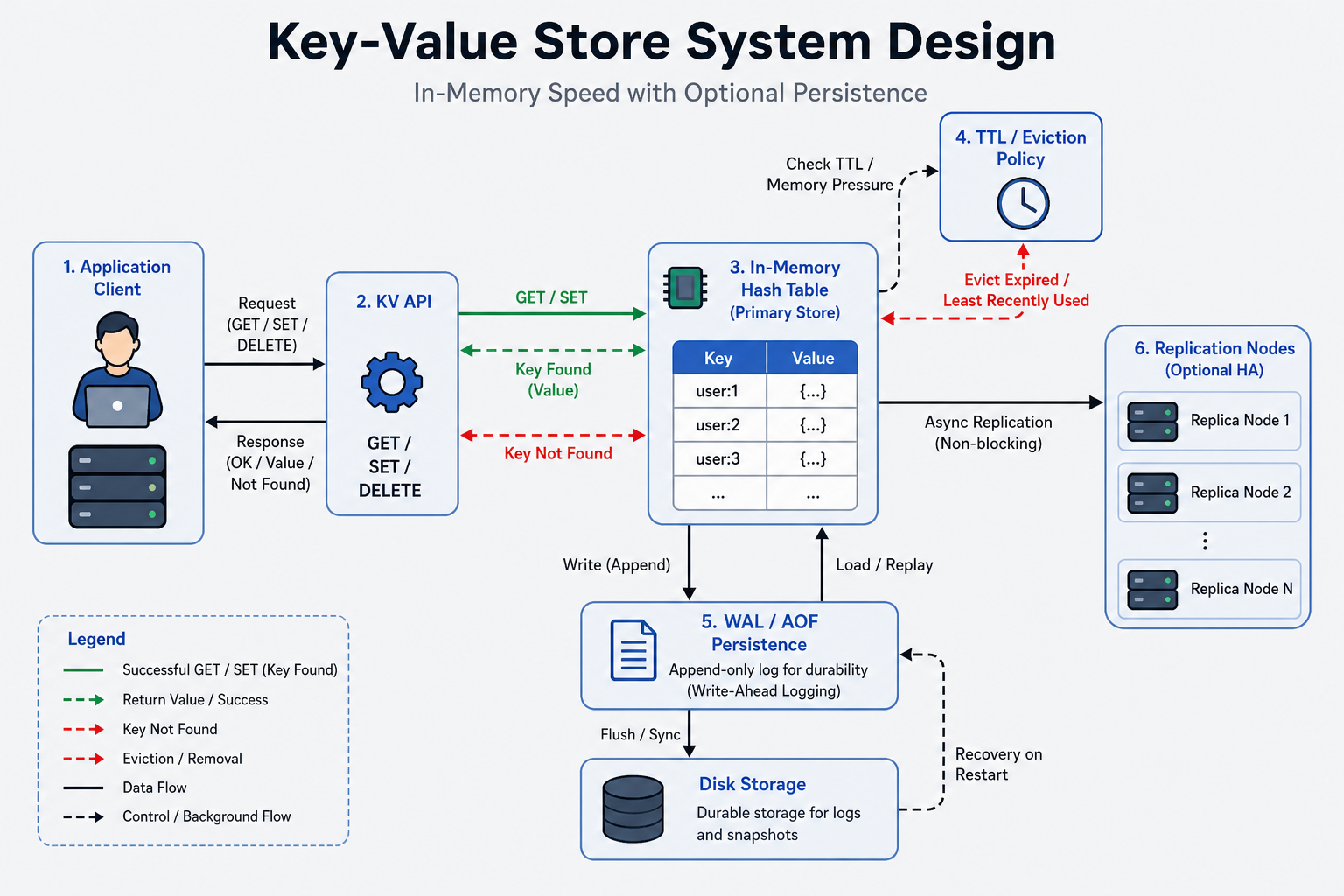
Scenario
A single hot partition holds 20% of traffic while other nodes sit idle—your "distributed" KV store just became a expensive Redis. The interview probes consistent hashing, replication, quorum reads/writes, and conflict resolution when nodes fail mid-request, not whether you can spell CAP.
Design a distributed key-value store that partitions data across many nodes, replicates for durability, and serves get/put/delete at massive scale. Naive mod-N hashing reshuffles everything when clusters grow; production systems use consistent hashing, quorum protocols, and explicit failure handling.
You should support horizontal scale, replication, tunable consistency, and recovery after node loss. Be ready to explain partitioning, read/write quorums, hinted handoff, and conflict resolution under partition. Hot keys and anti-entropy are common follow-ups.
Constraints
get/put/delete by key, TTL optional, replication factor N, tunable consistency per request
99.99% availability, < 10 ms p99 get on warm path, partition tolerance, automatic failover
Petabytes total, billions of keys, millions of ops/s aggregate, 100+ nodes per cluster, skewed key access
Stages ahead
Log in to start practicing
Preview the problem below. Sign in to start your timed session, save progress, and use the AI coach.
Want full access now? View Pro pricing