Mock Interviewer
Ask Coach
Tap a question to start, or type your own below.
Load Balancer System Design
Visual Problem Diagram
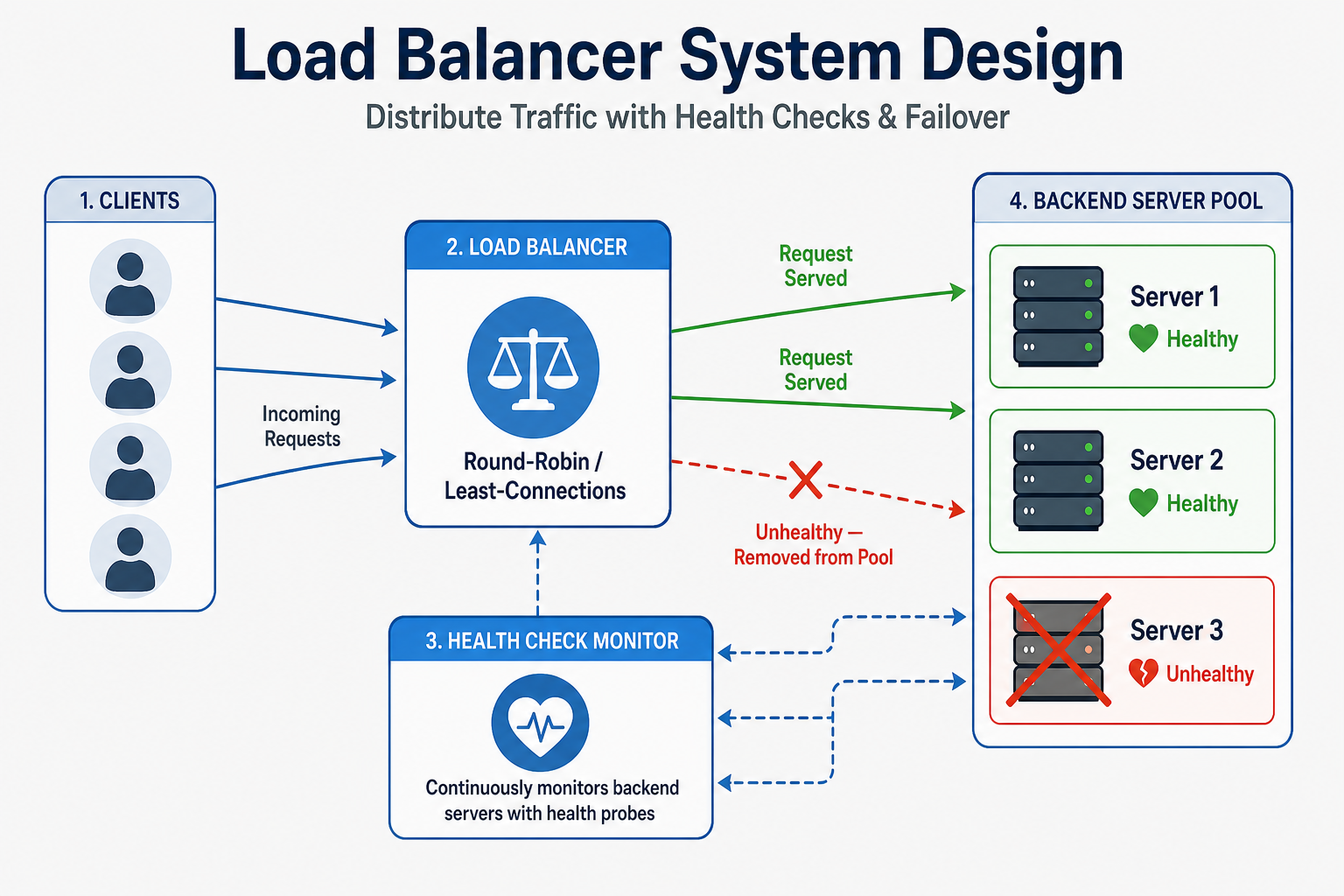
Scenario
One backend pod stops responding but still accepts TCP—half your users see timeouts while dashboards show "all green." The load balancer must detect bad nodes in seconds, reroute without sticky-session traps, and add < 1 ms overhead at 10M req/s—algorithm choice and health checks are the interview, not drawing a box labeled LB.
Design a load balancer that distributes incoming traffic across a pool of backend servers, detects unhealthy nodes, and keeps added latency minimal. In production this sits on every critical path—misconfigured health checks or naive round-robin on long connections cause tail latency spikes that look like application bugs.
You should support request distribution, health-based failover, optional session affinity, SSL termination, and per-client rate limiting. Be ready to compare routing algorithms, explain active vs passive health checks, and describe how you drain connections during deploys. Scaling the LB tier itself and L4 vs L7 tradeoffs are standard follow-ups.
Constraints
Distribute requests across backends, health checks and eject unhealthy nodes, optional session affinity, SSL termination, per-client rate limiting
< 1 ms added latency p99, 99.99% availability, handle 10M req/s through LB tier, connection draining on scale-in
10M requests/s through LB cluster, ~1000 backends, ~1 KB avg request, ~10 KB response; mix of short API and long-lived connections
Stages ahead
Log in to start practicing
Preview the problem below. Sign in to start your timed session, save progress, and use the AI coach.
Want full access now? View Pro pricing