Mock Interviewer
Ask Coach
Tap a question to start, or type your own below.
Video Conferencing System Design
Visual Problem Diagram
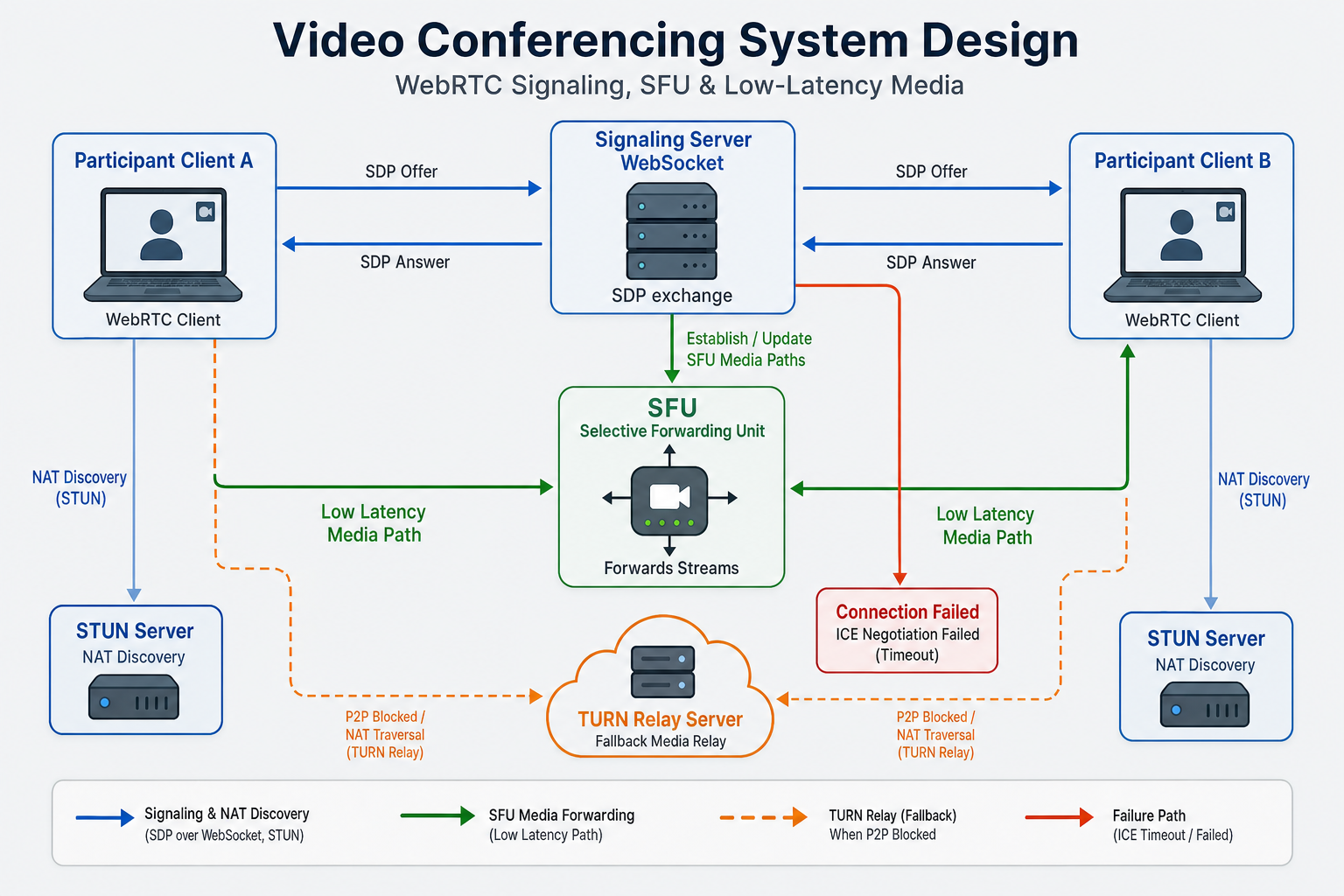
Scenario
Standup with 40 participants and two users on 3G—SFU must forward selective streams without melting CPU, while screen share needs crisp text at higher bitrate than camera. SFU vs MCU, signaling, and TURN for NAT are the interview center.
Design a video conferencing system supporting multi-party calls with screen sharing and acceptable quality on poor networks. Separate signaling from media plane and prefer SFU architecture for scale.
You should support room join/leave, A/V streams, screen share, mute, and NAT traversal. Be ready to explain WebRTC, SFU vs MCU, and TURN costs.
Constraints
Create/join room, A/V streams, screen share, mute, participant list, optional recording
< 150 ms one-way latency target, 99.9% availability, adapt to packet loss, 50+ participant modes
100M meeting minutes/day, thousands concurrent rooms, regional SFU clusters
Stages ahead
Log in to start practicing
Preview the problem below. Sign in to start your timed session, save progress, and use the AI coach.
Want full access now? View Pro pricing