Essay
Engineering Career Growth Patterns
Patterns in how engineering skills compound: breadth first, depth on leverage, then teaching. A pattern, not a rulebook for promotions.
TL;DR: Engineering skills compound when you move through a few repeatable shifts: breadth to see what is universal, depth in one skill that makes the rest easier, then teaching and systems that scale your impact. Judgment compounds while knowledge has a half-life, so seek feedback that shows the gap between your call and a more experienced one.
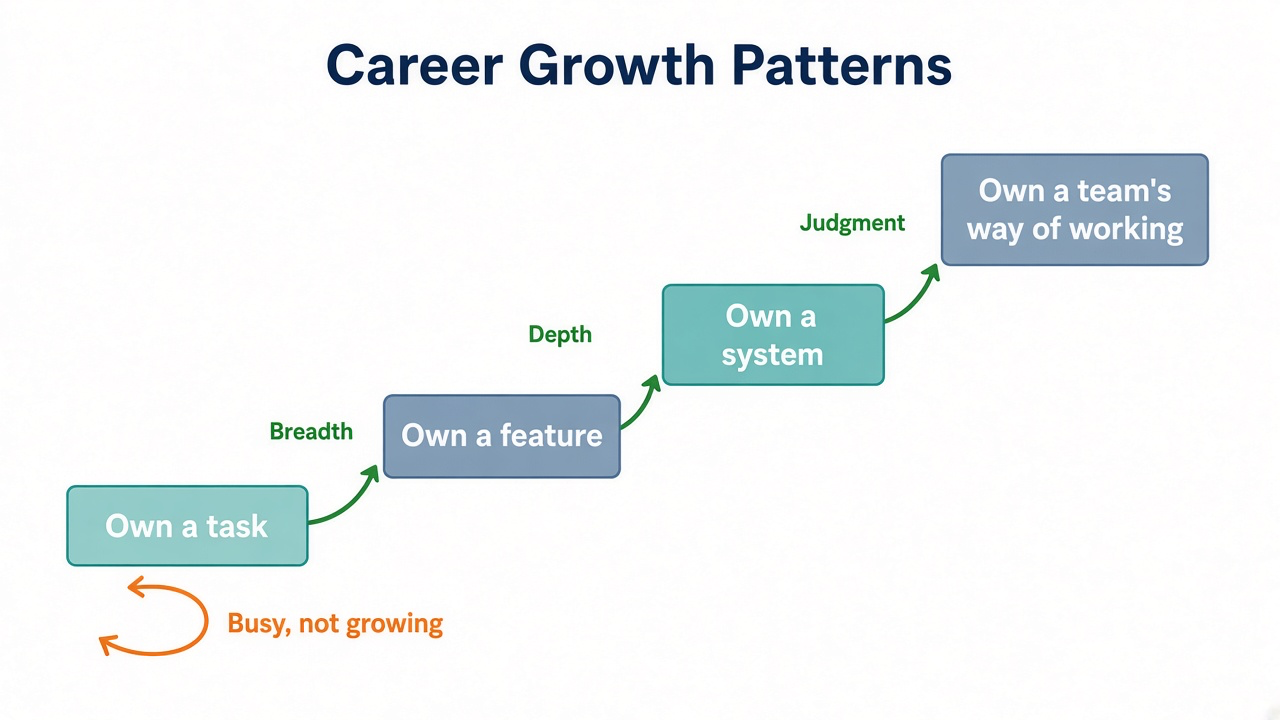
Your career isn't a checklist of technologies. It's a compounding curve. Early skills enable later skills. Learning to debug well makes you better at system design. Understanding databases makes you better at API design.
The question is: which skills compound fastest?
I've seen engineers who learned the latest framework every year. They knew many technologies but couldn't solve complex problems. I've also seen engineers who focused on fundamentals: algorithms, systems, databases. They picked up new frameworks quickly because they understood the patterns underneath.
The difference is compounding. Fundamentals compound. Frameworks depreciate.
What this essay covers, and what it doesn't
This is a set of patterns I've seen repeat across teams. It is not a rulebook, and it is not a promotion guide. Careers differ by company, by manager, by luck, and by what the business needs that year.
The stages below are a rough order, not a calendar. Some people go deep early because their first job demands it. Some stay broad for a decade and do fine. Treat the order as a lens for asking "what is missing in my growth right now?" and not as a verdict on where you should be.
It also says little about pay, titles, or switching companies. It is about what makes your work more valuable to you and to the people around you.
Early stage: build breadth
In your first few years, sample widely. Learn different languages, frameworks, and domains. Each new context teaches you what's universal and what's specific.
Don't optimize for depth yet. Optimize for pattern recognition. The patterns you see across React, Vue, and Angular will serve you longer than mastery of one.
I spent my first two years bouncing between languages: Python, JavaScript, Go, Rust. I wasn't an expert in any, but I learned what programming languages have in common: types, functions, control flow, abstraction. Those patterns transferred everywhere.
Similarly, I worked on different domains: web, mobile, backend, infrastructure. Each taught me something about software engineering that applied everywhere.
Breadth has a failure mode. If every project is a first tour of something new, you never see what happens to a system after launch. Stay on at least one codebase long enough to watch it age. That's where you learn what your early choices cost.
Mid stage: go deep on leverage
Once you've seen breadth, find what gives you leverage. What skill, once mastered, makes everything else easier?
For many engineers, it's system design. Understanding how systems work makes you better at choosing libraries, designing APIs, and debugging failures. The skill compounds across problems.
For others, it's a domain. Deep knowledge of payments, or security, or infrastructure becomes a differentiator. Domain expertise compounds with technical skills.
I chose to go deep on distributed systems. I learned how databases work, how message queues work, how caches work. That deep knowledge made me better at:
- Choosing the right database for a problem
- Designing APIs that scale
- Debugging performance issues
- Teaching others about systems
That one deep skill multiplied my effectiveness.
A practical test for "is this my leverage skill?" is to ask which skill you keep borrowing from other teams. If people keep pulling you into design reviews or incident calls, that's a signal. Go toward it on purpose.
Senior stage: teach and systematize
As you advance, your impact comes from multiplication. You don't just solve problems. You teach others to solve them. You build systems that prevent problems.
Document patterns. Write runbooks. Create abstractions. The systems you build become leverage for the whole team.
I spent my senior years building systems that made my team faster:
- Code review guidelines that taught patterns
- Runbooks that documented solutions
- Abstractions that prevented common mistakes
- Onboarding processes that got new engineers productive faster
Those systems multiplied my impact. I wasn't just solving problems. I was preventing them and teaching others to solve them.
Teaching shows up most clearly in code review. A review comment that explains why saves the next ten pull requests. A comment that only says "change this" saves one. The shift here is from "I fix it" to "the team stops needing me to fix it."
Focus on judgment, not knowledge
Anyone can learn a new framework. Judgment is knowing when to use what, what trade-offs to make, and what to prioritize. That's what separates levels.
Build judgment by:
- Making decisions and observing outcomes
- Reading postmortems, such as the real engineering stories, and design docs
- Asking "why" in code reviews and architecture discussions
- Working across different problem domains
Judgment compounds because it applies to new problems. Knowledge has a half-life. Judgment accumulates.
I've seen engineers who knew every framework but couldn't decide when to use which. I've also seen engineers who knew one framework well but could choose the right tool for any problem. The difference is judgment, not knowledge.
Judgment has a visible side. It's the habit of naming the options and the cost of each, which is the core of trade-off thinking. Under real deadlines, the same habit shows up as decision-making under constraints. You can practice both before you need them.
Seek feedback, not validation
Growth requires accurate self-assessment. Are you actually getting better, or just more confident? Seek feedback that challenges you, not just feedback that confirms what you want to hear.
Ask: "What would a more senior engineer do differently here?" Then ask someone more senior. The gap between your answer and theirs is your growth space.
I make it a habit to ask for feedback after every major project: "What would you have done differently?" "What did I miss?" "What should I learn next?" That feedback keeps my growth focused on what matters.
A small warning. Vague questions get polite answers. "Any feedback?" almost always returns "looks good." Ask about one decision: "Why did you think the queue was the right call, and what would have made you pick something else?" Specific questions get specific answers.
Build in public (within your team)
Share your learnings. Write notes. Give talks. Explain your process. Teaching clarifies your thinking. It also signals growth to others.
When you explain how you debugged a problem, you're not just sharing knowledge. You're demonstrating judgment. That demonstration is career growth.
I write weekly notes about what I learned. Sometimes it's technical: "Here's how Redis pub/sub works." Sometimes it's process: "Here's how we debugged that production issue." Sometimes it's judgment: "Here's why we chose this architecture." Sharing those notes helps me think clearly, and it helps others learn.
The same notes turn into interview material later. When someone asks you to describe a time you influenced a decision, you'll already have the story written down. The leadership stories and STAR method pages show how to shape those stories, and preparing for behavioral interviews covers the rest.
Work on problems that scale you
Not all problems are equal. Some make you better. Some just make you busier.
Choose problems that:
- Require new skills or judgment
- Have clear learning outcomes
- Push you slightly beyond your comfort zone
- Are visible enough that growth is recognized
Avoid problems that:
- Only require existing skills
- Have no learning component
- Keep you in your comfort zone
- Are invisible to the team
Growth comes from edges, not comfort zones.
I once spent three months optimizing a service that was already fast enough. I learned nothing. I just got better at something I already knew. That was wasted growth time.
I once spent three months designing a system I'd never built before. I learned a lot. I got better at system design. That was productive growth time.
You won't always get to choose. Sometimes the team needs the boring fix. A fair trade is to take the boring work and add one stretch inside it: a design note, a small tool, a measurement nobody has done yet.
Think in terms of impact
As you advance, your value shifts from "how much code can I write" to "how much impact can I have." Impact might mean preventing problems, teaching others, or making architectural decisions.
Optimize for impact that scales. A single architectural decision can prevent a year of bugs. A good abstraction can save weeks of development time. Impact compounds. The flip side is technical debt: a rushed decision compounds too, in the wrong direction, and judgment is what tells the two apart.
I measure my impact not by lines of code, but by problems prevented and engineers enabled. Did I prevent a class of bugs? Did I teach someone a pattern? Did I make a decision that saved time? That's impact.
Invest in fundamentals
Fundamentals compound. Algorithms, data structures, systems design, databases: these skills apply everywhere. Frameworks come and go, but fundamentals stay.
I spend 20% of my learning time on fundamentals, even after 10 years. That investment compounds. When a new framework appears, I learn it quickly because I understand the fundamentals it builds on.
One way to test your fundamentals is to read production code, not only tutorials. Reading production code shows you how fundamentals look after real teams have bent them to fit real deadlines.
Build a learning system
Growth isn't accidental. It's systematic. Build a learning system:
- Read regularly (technical blogs, papers, code)
- Practice deliberately (solve problems, build systems)
- Teach actively (explain what you learn)
- Reflect periodically (review what worked, what didn't)
A learning system ensures growth happens consistently, not sporadically.
I have a weekly routine:
- Monday: Read a technical paper or deep blog post
- Wednesday: Practice a problem or build a small system
- Friday: Write notes about what I learned
- Monthly: Review my growth and adjust my system
That routine keeps me learning even in weeks when work is loud. If you're also preparing for interviews, fold the practice slot into practice system design and see interview prep in 2025 for how to plan the weeks.
Try this week
Pick one recent decision you made at work. Write down three things: the options you considered, why you chose one, and what you'd check in a month to know if you were right.
Then send it to one engineer with more experience than you and ask a single question: "What would you have weighed differently?" Their answer is your next learning target. Put it on Wednesday's practice slot.
Career growth isn't linear. It compounds. Focus on skills that enable other skills. Build judgment, not just knowledge. Seek problems that scale you. These patterns have held up in the teams I've seen, though your path will look different.
Skills without impact are just hobbies. Impact without skills is just luck. The engineers I'd most like to work with have both: deep skills that create real impact.
Frequently asked questions
- What should I focus on early in my engineering career?
- Build breadth. Sample languages, frameworks, and domains so you can tell what is universal from what is specific. Also stay on one codebase long enough to watch it age, because that's where you see what early choices cost. Fundamentals compound; frameworks depreciate.
- How do I know which skill to go deep on?
- Look for the skill that makes other work easier. Ask what people keep pulling you into: design reviews, incident calls, or one domain such as payments. For many engineers that's system design. Pick it on purpose and give it a few focused months.
- Is the order of breadth, depth, then teaching a fixed timeline?
- No. It's a pattern I've seen, not a schedule. Some people go deep early because their first job demands it. Others stay broad for years and do well. Use the order to ask what is missing in your growth right now, not to judge where you should be.
- How do I build judgment if I don't make big decisions yet?
- Borrow other people's decisions. Read postmortems, ask why in code reviews, and write down the options behind small choices you do make. Practice naming trade-offs with trade-off thinking before the stakes are high.
- How do I get feedback that is actually useful?
- Ask about one decision, not the whole project. "Why was the queue the right call, and what would have made you pick something else?" gets a real answer. "Any feedback?" gets "looks good." Ask someone with more experience than you and write down the gap.
- How can I tell if I'm growing or just busy?
- Check whether the work required a skill or judgment call you didn't have six months ago. Optimizing something already fast enough is busy. Designing something you haven't built before is growth. If the team needs boring work, add one stretch inside it, such as a design note or a measurement.
- How do growth patterns show up in behavioral interviews?
- Interviewers listen for decisions, trade-offs, and impact, not job titles. Keep a short written log of what you decided and what happened, then shape it with the STAR method and leadership stories. See preparing for behavioral interviews for the full approach.
What's next?