Design Thinking
System Design Trade-Offs: How to Choose SQL, Cache, and Scale in Interviews
Learn system design trade-offs: SQL vs NoSQL, cache vs database, and consistency vs availability. Practice naming what you gain and what you give up in interviews.
In a system design interview, you will often be asked to choose: a cache or the main database, SQL or NoSQL, one service or many. A trade-off means every option helps you in one way and costs you in another. There is no perfect pick—only a better fit for the limits you stated out loud.
Here is a concrete example. Putting a cache in front of user profiles can make the homepage load faster, because most visits only need a quick read. The cost is that a profile update might take a few seconds to show up for everyone, because the cache can hold a slightly older copy. If you say “I’d use Redis because everyone uses Redis,” interviewers hear preference. If you say what you gain, what you give up, and which limit drove the choice, they hear judgment.
This guide walks through the forks interviewers expect you to name—performance versus growth, correct data versus staying online, cache versus database—and how to talk through them when the prompt is still fuzzy.
Related reading: For decisions when requirements are incomplete, see Decision-Making Under Real Constraints. To avoid the wrong level of complexity, read Anti-Patterns & What Not To Do.
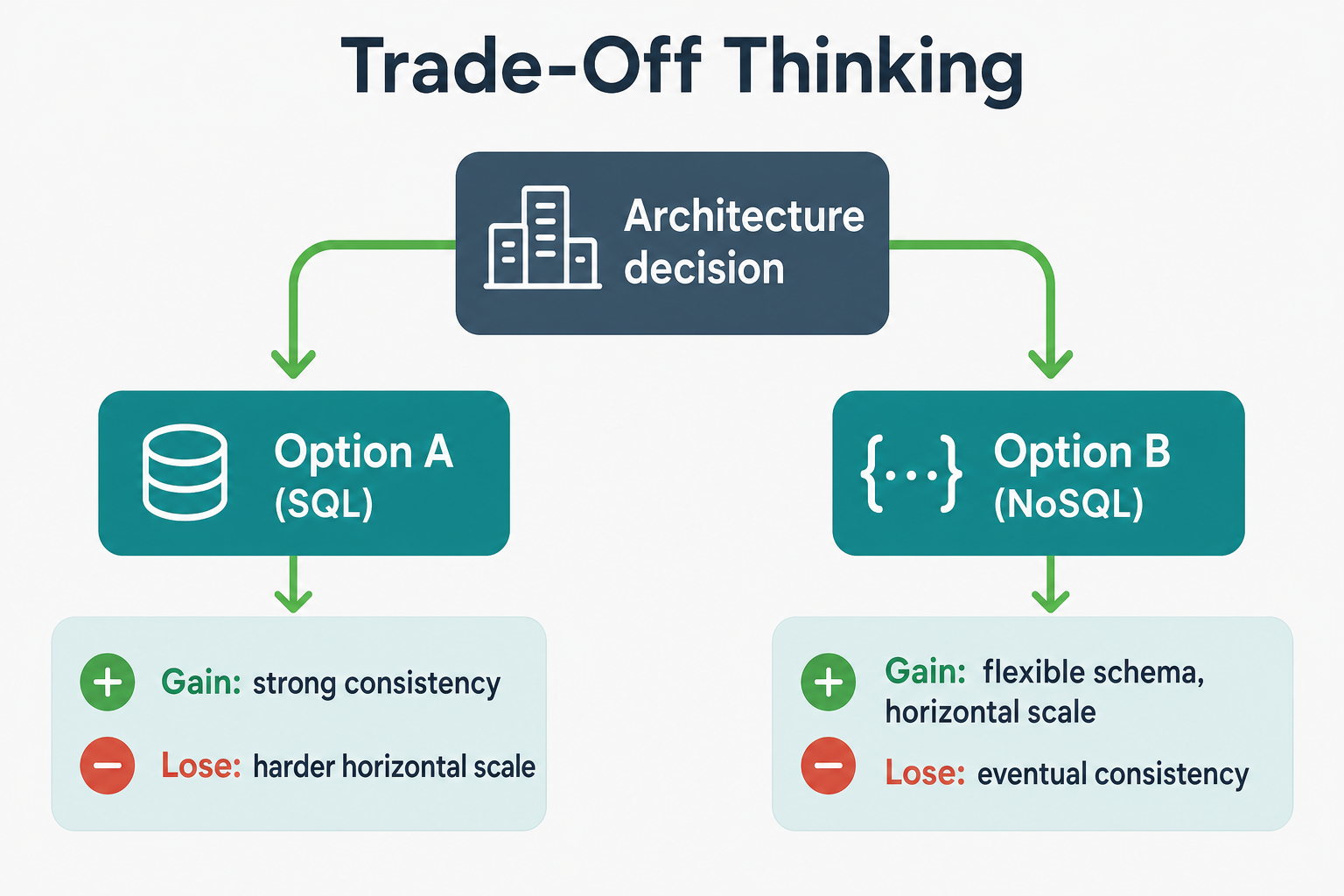
For every fork, state what you gain, what you lose, and which limit drove the choice.
What Is a Trade-Off in System Design?
A trade-off is a forced choice: picking option A means accepting a downside that option B would have avoided. In system design, those downsides usually show up as slower responses, harder operations, higher cost, weaker correctness, or more moving pieces to run.
Interviewers care because almost every “which technology?” question is really “can you defend a fork under constraints?” Naming both sides—before you lock a box on the whiteboard—is the skill this page trains.
Common pairs you will meet:
- Performance vs scalability — how fast it feels today versus how well it grows when traffic multiplies
- Consistency vs availability — everyone seeing the same data right away versus the system staying usable when parts fail
- Simplicity vs flexibility — easy to understand and ship versus easy to change later
- Cost vs performance — cheaper to run versus faster for users
Performance vs Scalability
Performance is how fast the system feels for one request right now. Scalability is how well the system keeps working when load grows—more users, more data, more machines.
Example: One Server vs Many Machines
A single server can feel very fast because the request never leaves one machine, so there is little network delay. It is also easier to debug because everything lives in one place. The cost is hard limits: one box of hardware, one place that can fail, and no easy way to grow beyond that machine.
A distributed system—work split across many machines—can grow by adding servers (horizontal scaling, growing by adding machines rather than buying one bigger box). It can survive some machine failures. The cost is network delay between machines, more moving parts, and harder debugging when something goes wrong.
How to Decide
Lean toward a single server when daily traffic is modest, you need very low delay (for example under 10ms), the product is still simple, and the team is small enough that one codebase is easier than many.
Lean toward a distributed system when traffic is huge, you need the product to stay up if one machine dies, you must grow by adding machines, and the team can operate that complexity.
Growth Story: Photo App
Early on, one server can be enough: fast reads and writes, easy to maintain, fine for the first wave of users. Later, the same product may need databases split by user (sharding), a cache for hot data, and a content network for images so hundreds of millions of people can browse without melting one box. The trade-off is clear: early simplicity for speed of building; later complexity for growth.
Consistency vs Availability (and CAP)
Consistency here means users (or servers) see the same data at the same time—or close enough that nobody sees conflicting truths. Availability means the system keeps answering requests even when some machines or links fail.
CAP in One Breath
The CAP theorem is a teaching rule for systems that must survive network splits: when the network between machines breaks (partition), you cannot fully keep both perfect consistency and perfect availability. You still design for partitions in real distributed products; the interview point is that under stress you often prioritize either “always the same answer” or “keep answering somehow.”
- Consistency — everyone sees the same data
- Availability — the system keeps responding
- Partition tolerance — the system still works when the network between sites is unhealthy
How This Shows Up: SQL vs NoSQL Style Stores
SQL-style stores (structured tables, strong transactions) often favor strong consistency—readers see the same committed data—and ACID behavior (transactions that either fully succeed or fully roll back, so money and inventory stay trustworthy). The cost is that growing across many machines and keeping complex joins fast gets harder.
NoSQL-style stores (documents, wide columns, key-value) often favor easy growth across machines and fast writes, with eventual consistency—copies catch up over time, so a feed might be a second behind. The cost is weaker multi-row transactions and fewer rich join queries unless you redesign the data layout.
How to Decide
Prefer strong consistency when wrong data is expensive: payments, account balances, inventory that must not oversell, and core account records.
Prefer eventual consistency when a short delay is fine: social feeds, analytics, and many cache layers where “almost right, soon” is acceptable.
Banking vs Social Feed
A bank account must not show two different balances after a transfer; teams accept maintenance windows and stricter stores. A social feed can show a new post a moment late if that keeps the app responsive for everyone. Same fork, different priority.
How Do You Choose Between SQL and NoSQL?
SQL usually means structured rows, fixed schema, strong consistency, and complex queries (joins, aggregations). NoSQL usually means flexible documents or keys, growth across many machines, simpler lookups, and often eventual consistency.
Decision Matrix
| Factor | SQL-style | NoSQL-style |
|---|---|---|
| Consistency | Strong | Often eventual |
| How you grow | Often scale up one bigger machine first | Scale out across many machines |
| Query complexity | High (joins, analytics) | Lower (key / document lookups) |
| Schema | Fixed | Flexible |
| Transactions | Full ACID | Limited or per-document |
| Fit | Structured business data | High-volume simple access patterns |
When SQL Fits
Use SQL when data is structured (users, orders, line items), you need joins and reports, you need ACID for money or stock, and you cannot tolerate conflicting writes.
Example — checkout orders: creating an order must succeed or fail as a whole, history queries are complex, and tables map cleanly to users, items, and payments.
When NoSQL Fits
Use NoSQL when you store huge volumes of simple records (posts, events), lookups are mostly by key, you must grow across many machines, and slightly delayed consistency is acceptable.
Example — social feed: billions of posts, “get recent posts for this user,” horizontal growth, and a feed that can lag by a second.
Hybrid Is Common
Many products keep SQL for accounts and auth (must be correct) and NoSQL for feeds or media metadata (must grow). That is still trade-off thinking: each store earns its place.
Cache vs Database (Latency vs Staying Correct)
Latency is how long a user waits for a response. Reliability here means the system returns trustworthy, lasting data—not a temporary miss or a forgotten write.
A cache is a fast temporary store (often in memory) for hot data. A database is the lasting source of truth on disk (or durable storage).
What Each Side Buys You
A cache can answer in under a millisecond, soak up read traffic, and protect the database. The cost is cache misses (empty or expired entries), stale data (an older copy than the database), and limited size.
A database keeps data permanently and is the place you trust for writes. The cost is slower reads (often tens of milliseconds), lower peak throughput for hot keys, and higher cost to scale.
How to Decide
Lean on a cache when reads dominate, delay must stay tiny (for example under 10ms), slightly old data is acceptable, and the same keys are hit over and over.
Lean on the database when writes dominate, correctness matters more than speed, data must survive restarts, and you can afford higher latency.
Timeline / Feed Pattern
A typical hybrid: keep the last few days of hot posts in a cache for sub-10ms reads and a high hit rate, and keep every post in the database as the source of truth for writes and older history. On a miss, read the database, fill the cache, and set a TTL (time-to-live—how long the cached copy may live before refresh).
That pattern is often called cache-aside: check the cache first, load from the database on a miss, then store the result for the next reader. You are trading a bit of operational complexity (cache invalidation and TTLs) for much faster common reads. For deeper patterns after you choose cache-aside, see Caching Strategies and the production story The Cache Stampede That Took Down Our API.
Strong Consistency vs Eventual Consistency
Strong consistency means readers see the latest successful write everywhere that matters, usually after waiting for replicas to agree. Eventual consistency means replicas catch up over time; some users may see an older value for a short window.
Example: Profile Update
With strong consistency, after you save a new bio, every reader should see it once the write finishes—writes can be slower because replicas must agree. With eventual consistency, some readers see the new bio immediately and others see it a moment later—writes stay faster because you do not wait on every copy.
How to Decide
Choose strong consistency for money, account identity, and logic where two truths would break the product. Choose eventual consistency for feeds, analytics, and non-critical displays where a short lag is fine.
Queues vs Cron Jobs
A queue holds work items so workers can process them as they arrive—useful for real-time fan-out and retries. A cron job runs on a fixed schedule (for example once a day)—simple, but not “the moment it happened.”
Example: Sending Email
A queue (for example Kafka or RabbitMQ) can process sends as events arrive, run many workers in parallel, retry failures, and absorb spikes. The cost is more infrastructure and operational care.
A cron job is easy to ship and debug for low volume, but it only runs on a schedule, usually on one process, and often lacks rich retry behavior unless you build it yourself.
How to Decide
Choose a queue when work must happen soon, volume is high, spikes are real, and failed items must retry. Choose a cron job for daily digests, reports, and low-volume batch work where a delay is fine.
Notification Mix
Real-time alerts often ride a queue with parallel workers. A daily digest email can stay on a cron. Same product, two trade-offs.
Monolith vs Microservices
A monolith is one deployable codebase for the product. Microservices split the product into many services that deploy and scale on their own.
Decision Matrix
| Factor | Monolith | Microservices |
|---|---|---|
| Complexity | Lower | Higher |
| Shipping speed early | Faster | Slower at first |
| How you grow | Often scale the whole app | Scale services independently |
| Fault isolation | One bug can take more down | Failures can stay more local |
| Teams | One shared codebase | Many service ownership lines |
| Deploy | One release | Many coordinated releases |
When a Monolith Fits
Small team, one clear product domain, need to ship an MVP fast, and traffic is still modest. A startup with five engineers often wins by keeping one codebase until the product proves itself.
When Services Fit
Large org, many domains (video, billing, recommendations), different scaling needs per area, and very high traffic. The trade-off is operational complexity and coordination for independence and scale.
Migration Story
Moving from one codebase to many services can unblock independent deploys and scaling, at the cost of distributed failures, more networking, and harder debugging. Treat that as an evolution decision, not a default badge of maturity.
How to Explain a Trade-Off in an Interview
Walk through a fork the way you would on a whiteboard—requirements first, tools second.
Prompt: Choose SQL or NoSQL for a social feed with about 1B posts and 10B reads per day, and feed load under 200ms.
Weak instinct: “NoSQL—it scales and everyone uses it for social.”
Better path: Restate needs (write posts, read feeds, scale, latency). Then compare options with gains and losses. For feeds, a one-second lag is often fine, so eventual consistency can be acceptable. Complex “friends’ posts sorted by time” queries may need denormalized data (copies shaped for the read path) or precomputed feeds—more write work for faster reads.
Explicit choice: “I’d use a scale-out store for posts and feeds because we must grow across machines and can accept slightly stale feeds. I’d keep SQL for accounts and login because those must stay correct. If reads still miss the latency target, I’d add a cache for hot feeds—measure first, then add the cache layer.”
You did not pick a brand for fashion. You named constraints, quantified where you could, and said what you accept.
Checklist for Any Fork
- List what each option gains and loses
- Prefer numbers over vague “faster”
- Tie the choice to stated limits (latency, cost, correctness)
- Say the sentence: “We chose X because of Y, accepting Z”
- Note what you would revisit if traffic or requirements change
- Avoid adding cache, shards, or services before you know you need them
Weak vs Strong Database Answer
Weak: “I’ll use MySQL because it’s popular.”
Strong: “I’ll use MySQL because we need ACID for financial rows, joins for reports, and structured orders and users. We can grow on one stronger machine first, and we’ll revisit a scale-out store if we hit a proven limit.”
Best Practices
- Name the trade-off — every decision has a downside; say it.
- Quantify when you can — “sub-10ms” beats “Redis is fast.”
- Start from constraints — what must be true, and what can bend?
- Make the choice explicit — write down why, and what you gave up.
- Plan for evolution — “we’ll revisit X if Y metric breaks.”
- Don’t optimize early — start simple; add complexity when evidence demands it.
Common Interview Questions
Starter
Q: What is a trade-off in system design?
A: It is a choice where each option helps in one way and costs you in another. Choosing strong consistency (everyone sees the same data) over maximum availability (always answering during failures) is a classic trade-off.
Going Deeper
Q: How do you decide between SQL and NoSQL?
A: I look at data shape, query needs, how we will grow, and how correct the data must stay. I pick SQL for structured data, rich queries, and strong consistency. I pick NoSQL for simple access patterns, growth across machines, and cases where short inconsistency is fine.
Harder Prompt
Q: Design for about 1B requests/day with under 10ms read latency. How do you approach the trade-offs?
A: I name the main forks:
- Cache vs database — cache hot keys for sub-10ms reads; database remains source of truth; use cache-aside if measurement shows we need it.
- Strong vs eventual consistency — eventual for many reads if the product allows; strong for critical writes.
- Monolith vs services — start simpler; split only when ownership or scale demands it.
- SQL vs NoSQL — NoSQL (or scale-out stores) where volume dominates; SQL where correctness dominates.
Then I say it in one line: “Cache plus a scale-out store for volume, accepting eventual consistency on reads, with strong consistency on critical writes.”
Summary
Trade-off thinking is how you defend architecture under interview pressure: every choice has benefits and costs, and strong answers make those costs explicit before naming a tool. The recurring forks—performance vs scale, consistency vs availability, cache vs database—are not trivia. They are the language of judgment.
Key Takeaways
- No perfect solutions — Every choice trades one good property for another; name both sides under stated limits.
- Quantify when you can — “Sub-10ms reads” and “80% cache hit rate” beat vague claims.
- Context drives priority — Banking favors consistency; social feeds tolerate staleness; the same fork has different answers.
- Hybrid approaches are valid — SQL for accounts, NoSQL for feeds, cache-aside for hot reads.
- Make decisions explicit — “We chose X because of Y, accepting Z” beats silent preference.
- Plan for evolution — Start simple; document what you will revisit when scale changes.
- Don’t optimize prematurely — Measure first, then add cache, sharding, or services when evidence demands it.
Apply This Thinking
Put trade-off reasoning into practice on InterviewCrafted:
- Design Twitter — Fan-out, cache vs database, and consistency trade-offs at high read volume.
- Design Amazon — Catalog, inventory, and checkout—multiple forks where you must justify SQL vs NoSQL and sync vs async.
- Design Uber — Real-time matching vs reliability; practice naming latency vs consistency trade-offs aloud.
- Decision-Making Under Real Constraints — When requirements are incomplete, how to choose build vs buy vs defer.
- Failure-First Design Thinking — Extend trade-offs into blast radius and graceful degradation.
Related Topics
- Decision-Making Under Real Constraints — build vs buy vs defer when time and budget constrain every fork.
- Anti-Patterns & What Not To Do — when the wrong trade-off is over-engineering or premature optimization.
- Failure-First Design Thinking — reliability trade-offs: graceful degradation vs hard failure.
- Caching Strategies — implementation depth after you choose cache-aside in an interview.
- The Cache Stampede That Took Down Our API — when missing cache trade-offs hurt production.
- What Is Design Thinking in Software Engineering? — mindset before boxes.
- Architecture Thinking — how to split a problem into components after you name the forks.
FAQs
Q: How is trade-off thinking different from picking a favorite technology?
A: Trade-off thinking names what you gain and lose for each option under stated constraints. Picking a favorite skips constraints and sounds like preference, not engineering judgment.
Q: Are there any perfect solutions without trade-offs?
A: No. Every solution has trade-offs. The key is to identify them, quantify them, and make informed decisions based on your constraints and priorities.
Q: How do I know which trade-off to prioritize?
A: Consider your constraints and priorities:
- What are the non-negotiable requirements? (e.g., < 10ms latency)
- What can you compromise on? (e.g., eventual consistency)
- What are the business priorities? (e.g., user experience vs cost)
Q: Can trade-offs change over time?
A: Yes. As your system evolves, trade-offs may change. What was acceptable initially may not be acceptable at scale. Design for evolution, not perfection.
Q: How do I communicate trade-offs to stakeholders?
A: Be explicit:
- "We chose X because of Y, accepting Z as a cost"
- Use numbers: "We chose cache for 10x faster reads, accepting 5% stale data"
- Explain the decision: "Given our latency requirement, we prioritized performance over consistency"
Q: What if I make the wrong trade-off?
A: That's okay. Design for evolution. If you made the wrong trade-off, you can:
- Measure the impact
- Optimize the problematic area
- Evolve the architecture
- Learn from the mistake
Q: How do I learn to identify trade-offs?
A: Practice:
- Study real-world systems (Instagram, Netflix, Uber)
- Understand why they made certain choices
- Identify the trade-offs they accepted
- Practice designing systems and identifying trade-offs
Q: Are trade-offs always binary?
A: No. Sometimes you can have hybrid approaches:
- Cache + Database (best of both)
- SQL + NoSQL (use each for its strengths)
- Monolith + Microservices (gradual migration)
The key is to understand the trade-offs and choose the right approach for your context.
Q: What is a trade-off in system design?
A: A trade-off is a choice between options where each option helps you in one way and costs you in another. For example, a cache can make reads faster while allowing data to be slightly out of date.
Q: How do you choose between SQL and NoSQL?
A: Look at data shape, query needs, how you will grow, and how correct the data must be. Prefer SQL when you need structured rows, complex queries, and strict correctness; prefer NoSQL when you need simple lookups and growth across many machines and can accept delayed consistency.
Keep exploring
Design thinking works best when combined with practice. Explore more topics or apply what you've learned in our system design practice platform.