Essay
How to Prepare for Low-Level Design (LLD) Interviews
A beginner-friendly prep plan for LLD interviews: what to learn first, a reusable delivery loop, which problems to practice, and the mistakes that waste the most time.
TL;DR: Low-level design interviews test whether you can turn a fuzzy product ask into clear pieces of code — each with one job — and show that the main path works. Prep in three layers: build intuition for simple, changeable design; learn a five-step delivery loop so you never freeze; then practice timed blank-page problems with a short reflection after each. You do not need all 23 design patterns. You need a habit you can reuse under a clock.
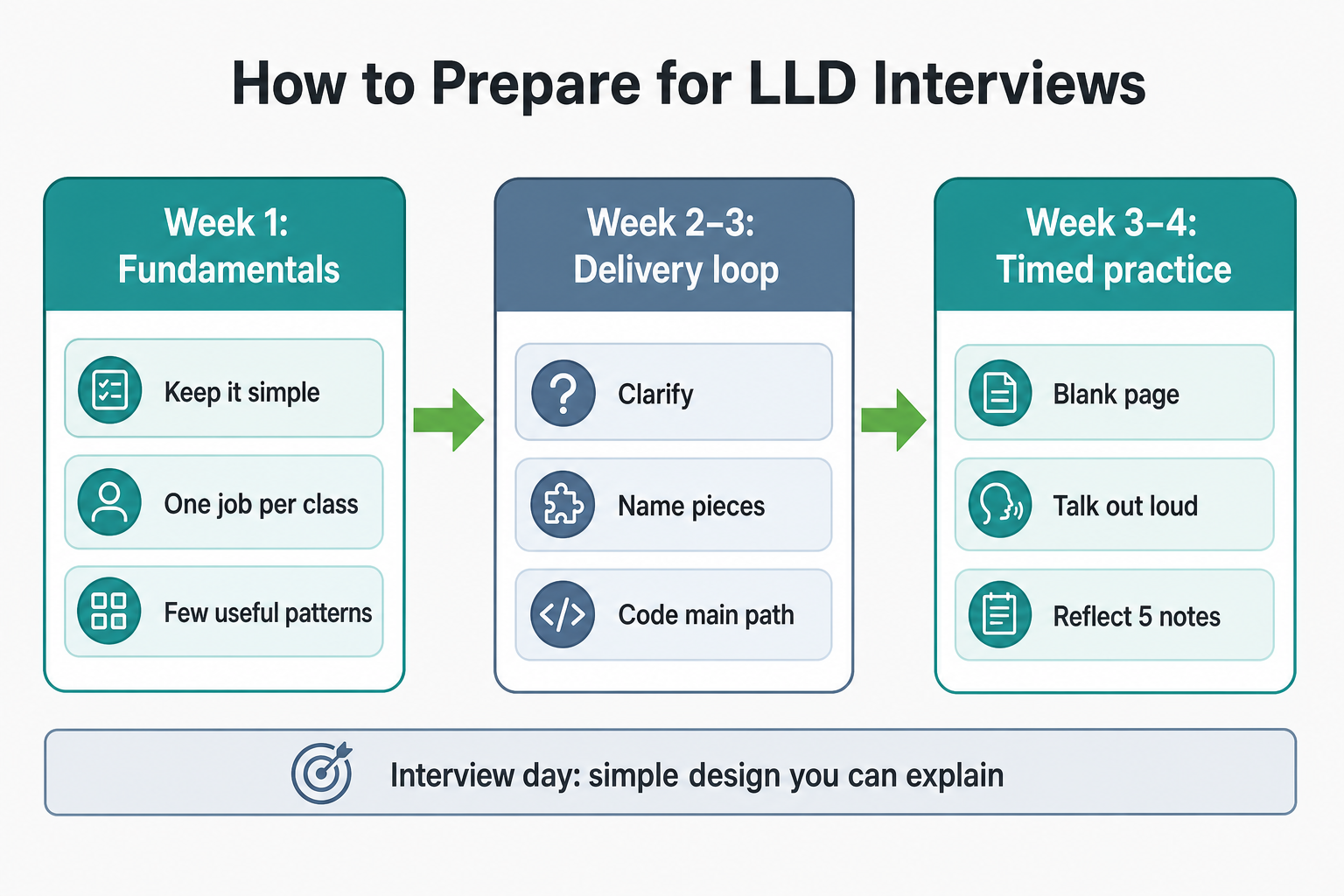
Prep is three layers: build simple-design intuition, rehearse a delivery loop, then practice from a blank page under a timer.
You just learned you have a low-level design interview. You have probably done a lot of algorithm practice. LLD still feels fuzzy — and that is normal.
There is less good prep material for this round than for coding or system design. A lot of what exists is either old UML theater or a dump of every design pattern ever named. Neither helps you when the prompt is “Design a parking lot” and the clock is already running.
This guide is the prep plan. It is written for people who are new to the round. You will learn what interviewers actually score, what to study without drowning in jargon, how to run a timed practice session, and which mistakes burn the most points. For the reusable five-step loop and a full Parking Lot walkthrough, keep How to Approach LLD Interviews — Start Here open beside this page.
What an LLD interview really is
Low-level design means designing the shape of the code for one feature: which pieces exist, what each piece owns, how they call each other, and which method names other code will use.
Think of a restaurant kitchen. System design is the whole restaurant — seating, waiters, inventory trucks, how you handle a Friday night rush. LLD is the kitchen line for one dish: who chops, who cooks, who plates, and how tickets move without everyone bumping into each other.
In a system design round you might sketch services and databases for a ride-sharing product. In an LLD round you design the Trip, the pricing rules, and how those objects work together inside one service.
Interviewers are usually watching four things:
- Can you break the problem into pieces with clear jobs?
- Do those pieces stay untangled as you add methods?
- Can the design bend when a small rule changes — without a full rewrite?
- Can you explain your reasoning while you work?
A clean design you cannot explain looks the same as a messy design from the other side of the table. Communication is not optional polish. It is half the score.
| This round (LLD) | System design | |
|---|---|---|
| Main question | How do I structure the code for this feature? | How does the whole product handle many users? |
| Building blocks | Classes, methods, in-memory structures | Services, databases, caches, queues |
| Typical prompt | Parking lot, cache, vending machine | URL shortener, feed, chat |
| What you deliver | A design story plus working main-path code | An architecture sketch plus trade-offs |
If you catch yourself drawing load balancers in an LLD round, pause. That energy belongs in system design prep.
The three-layer prep plan
Effective prep is not “read every pattern blog.” It is three layers, in order.
- Internalize a few fundamentals — as intuition, not as flashcards
- Learn a delivery loop — so you never invent process mid-interview
- Practice from a blank page — under a timer, with a short reflection after
Reading alone gets you maybe a third of the way there. The interview scores what you do when the editor is empty and someone is watching.
Plan on about three to four weeks if this round is new to you:
| Week | Focus | Time per week |
|---|---|---|
| 1 | Fundamentals + learn the five-step loop | 4–6 hours |
| 2 | Two timed problems + reflections | 4–6 hours |
| 3 | Two more problems; practice extensions out loud | 4–6 hours |
| 4 (optional) | One mock under stricter time; review weak spots | 3–4 hours |
If your interview is next week, compress layers 1 and 2 into two focused evenings, then spend every remaining session on blank-page practice. Do not spend the week re-reading pattern lists.
Layer 1: Fundamentals that actually show up
Most guides dump SOLID, DRY, KISS, and twenty-three pattern names on you. You can memorize definitions for weeks and still freeze when you see if (type == "credit") in your own draft.
The goal is a smell for clean code, not a vocabulary quiz. Here is what you need in plain English.
Keep it simple (the rule people break most)
Candidates over-build because they want to look senior. They add factories, builders, and interfaces before the happy path works. Interviewers notice.
Start with the smallest design that meets the requirements you agreed on. Add complexity only when simplicity stops working — usually when the interviewer asks “what if we add another type?” or when you see the same if/switch growing for a third time.
One job per piece
If you cannot describe what a class does in one sentence without using “and,” it is doing too much.
A Report class that builds content, formats a PDF, and saves a file is three jobs wearing one name. Split them. In parking-lot terms: finding a spot, creating a ticket, and computing a fee should not all live in one giant ParkingLot method if those rules will change for different reasons.
Keep layers apart
UI code should not own business rules. Business rules should not know how rows are stored on disk. In a short LLD round you may not build a full UI, but the same idea applies: do not bury fee math inside park(), and do not make a ticket object responsible for printing receipts and choosing floors.
The rest of SOLID — use as smell checks, not checklists
You do not need to recite Open/Closed or Liskov Substitution. You need to notice awkward moments:
- A new payment type forces edits in five places → you probably want one place that chooses behavior
- A subclass that throws when you call a parent method → the inheritance model is lying
- An interface with twenty methods that no caller needs all of → the interface is too fat
For a deeper reference later, skim SOLID Principles. During prep week, practice spotting the awkward moment, not memorizing the acronym.
Four patterns that cover most interviews
Do not memorize the full Gang of Four catalog. These four show up constantly:
| Pattern | Plain-English trigger | Example |
|---|---|---|
| Strategy | You see if (type == …) or switch on behavior that will grow | Fee rules by vehicle type; payment methods |
| Observer | Many parts need to react when something changes | Order placed → inventory, analytics, notifications |
| State machine | Behavior depends on “where we are now” | Vending machine steps; document workflow; game turns |
| Factory | Object creation is scattered and getting messy | notificationFactory.create(type) instead of new everywhere |
Patterns should emerge from a design decision, not drive it. Using one or two — or none — is fine. Forcing a pattern to look clever is a common way to lose time.
If you want deeper reading after you have practiced: Strategy, Observer, Factory.
OOP tools, used lightly
- Encapsulation: keep fields private; expose behavior through methods. Do not hand out a mutable internal list for callers to edit.
- Abstraction: when several types share a job, give them a shared method name (an interface or base type) so callers do not care which one they have.
- Polymorphism: prefer “ask the object to do its job” over long type checks.
- Inheritance: default to composition and simple type fields. Deep inheritance trees are how beginners get stuck. Many strong LLD solutions barely use inheritance at all.
Layer 2: A delivery loop so you never get lost
Knowing principles is easier than applying them under time pressure. Most people fail because they try to invent requirements, classes, edge cases, and code all at once.
The fix is a fixed sequence. Each phase builds on the last. By the time you type method bodies, the design decisions are already made.
Use the five-step loop from the start-here guide:
| Time (≈45–55 min round) | Focus |
|---|---|
| First ~8 minutes | Clarify scope; list main pieces |
| Next ~7 minutes | How pieces connect; public method names |
| Middle of the round | Code the main path end to end |
| Last 5–10 minutes | One edge case, one extension, what you would improve |
Phase 1 — Requirements (about 5 minutes)
Every prompt starts vague: “Design Tic-Tac-Toe” or “Design a parking lot.” Your job is to turn that into a short shared contract before you invent class names.
Ask (or decide out loud) around four themes:
- What operations must work in version one?
- What counts as success, failure, or a state change?
- How should invalid input be handled?
- What is explicitly out of scope?
Write four to six bullets. That list is your north star. If it is not on the list, do not build it in the first pass.
Phase 2 — Pieces and relationships (about 3–5 minutes)
Scan your requirements for meaningful nouns. Not every noun becomes a class.
- Does it keep changing state or enforce rules? → likely a piece (class)
- Is it just information attached to something else? → likely a field or input
In parking lot designs, a vehicle is often just a type you receive — you do not manage the car’s life. A ticket is internal state your system creates and owns. That difference matters.
Find the orchestrator — the entry point that coordinates the workflow (ParkingLot, Game, VendingMachine). Sketch who owns whom in plain words. Skip heavy UML. Boxes, arrows, and labels are enough. Modern interviews care about clear thinking, not diagram notation from 2005.
Phase 3 — Class design (about 10–15 minutes)
Go piece by piece from the entry point. For each one, write the state it must remember and the operations it must support. Tie every field and method back to a requirement. Extra methods that feel “more complete” usually cost you time and clarity.
End this phase with outlines: fields and method signatures. Not full bodies yet.
Phase 4 — Implementation (about 10–20 minutes)
Implement the most interesting methods — usually the ones that show cooperation and state change. Happy path first, then obvious guards. Pseudocode is fine for helpers if the interviewer agrees; the main path should still be easy to trace.
Phase 5 — Verification (about 2–5 minutes)
Walk a concrete story out loud: “Car enters, gets ticket T1, parks in spot B2, later exits with T1, pays the fee.” Does your state actually update? Catch your own bugs before the interviewer does.
If time remains, they may ask extensions: “How would you add undo?” or “What about multiple floors?” That is when you explain how the design would grow — not when you should have built every extension up front.
Drill this loop until it feels automatic. In the real interview you want your brain free for the problem, not for inventing a process.
Layer 3: Practice that transfers to the interview
LLD is a skill. If you only read breakdowns and nod along, you will still freeze on a blank page.
Problems to practice, in order
Use problems that build skills progressively. On InterviewCrafted:
- Parking Lot — entities, orchestration, tickets, fees
- LRU Cache — structure design with strict get/put behavior
- Vending Machine — steps that depend on current state
- Expense Sharing — domain rules and who owes whom
- Elevator System — requests and how cars choose floors
For each problem: run the five-step loop, set a timer, then compare your design to a trusted breakdown. Do not ask “did I match the canonical solution?” Ask:
- Did I over-model or under-model the pieces?
- Is my orchestrator doing the right jobs — or everything?
- Where does state live, and does that match the story I told?
- Are my public methods easy for a caller to use?
The goal is design intuition you can reuse on a prompt you have never seen.
How to run one practice session (about 50 minutes)
- 0–8 min: Clarify and name pieces out loud (or in short comments)
- 8–15 min: Connections and method names
- 15–45 min: Code the main path
- 45–50 min: Trace one scenario; note one extension
- After the timer: Write five notes — what you skipped, where you stuck, one piece that did too much, one method you should have named earlier, one fix for next time
That written reflection is the real preparation. The code is the proof.
Aim for one careful problem per week early on, then two if you have time. Five rushed pastes from memory teach almost nothing.
On interview day
Follow the clock
If you are fifteen minutes in and still only on requirements, move. If you are twenty minutes in with no class shapes on the board, skip polish and name the pieces now.
The most common failure mode is spending too long on early phases and never showing a working main path. The opposite failure — diving into code with no shared model — forces painful backtracks. The delivery loop exists to avoid both.
Talk while you design
Interviewers cannot read your mind. Silence makes them anxious.
Useful lines:
- “I’m making this a separate class because it has its own state to manage.”
- “I considered putting fee math here, but it belongs in a calculator so parking rules stay untouched.”
- “This could also be X; I’m choosing Y because Z.”
If you are stuck, say so: “I’m deciding where this responsibility should live.” That is better than quiet panic. If they offer a hint, take it. Hints are not a failing grade.
Do not over-engineer
You are not shipping production software. You are showing design judgment.
If a simple solution works, use it. Do not add Strategy for a single implementation. Do not build a factory hierarchy for two object types. Do not introduce interfaces where one concrete class is enough.
When they ask “how would you extend this?”, that is when you explain evolution. Building every extension up front is how people run out of time with a broken happy path.
A 60-second self-check before you stop
- Did we agree on scope in a few bullets?
- Can I list each main piece and its one job in under a minute?
- Do public method names tell a clear story?
- Does the main path work end to end?
- Can I point to one place I would change for a likely future rule?
If yes, you are in good shape even if some rare cases are unfinished.
Common prep mistakes (and what to do instead)
| Mistake | What to do instead |
|---|---|
| Only watching videos / reading solutions | Design from a blank page under a timer every week |
| Memorizing pattern names | Learn four triggers; use a pattern only when it fits |
| Jumping into code on minute one | Force clarify → pieces → method names first |
| One giant class that does everything | Split by job; keep an orchestrator thin |
| Building every extension up front | Ship the main path; describe extensions when asked |
| Silent coding for long stretches | Narrate decisions in short sentences |
| Copying a “perfect” GitHub solution | Compare entities, ownership, and APIs — then rewrite yours |
Where to go next
You now have a prep plan that matches how the round is actually scored.
- Learn the loop end to end: How to Approach LLD Interviews — Start Here (includes a full Parking Lot walkthrough)
- Practice with feedback: Practice LLD
- If you also need the distributed-systems round: How to Prepare for System Design Interviews
- For company-loop context (when LLD shows up next to DSA and HLD): Interview rounds at top companies
Keep the rule small enough to remember under pressure: clarify the problem, name the pieces, connect them, write the method names, then code the main path. Fundamentals keep the design clean. The loop keeps you oriented. Blank-page practice builds the intuition that reading alone never will.
Frequently asked questions
- How long does it take to prepare for an LLD interview?
- Most people who are new to this round need about three to four weeks of focused practice: one week building fundamentals and the delivery loop, then two to three weeks of timed problems with short reflections. If you already write clean object-oriented code at work, you may need less time on concepts and more on pacing and talking while you design.
- What should I study first for LLD interviews?
- Start with a reusable approach — clarify scope, name the pieces, say how they connect, write method names, then code the main path. That loop is in How to Approach LLD Interviews — Start Here. Then learn a few ideas in plain English: keep designs simple, give each class one job, and recognize Strategy, Observer, state machines, and Factory when they naturally fit. Do not memorize all twenty-three Gang of Four patterns.
- How is LLD different from system design?
- System design asks how a whole product handles many users: services, databases, caches, queues. Low-level design asks how you structure the code inside one feature: which pieces exist, what each owns, and which methods callers use. Remember it as “objects and methods” for LLD versus “boxes across the network” for system design.
- Do I need to memorize design patterns for LLD?
- No. Learn a small set by using them when they fit — for example, putting fee rules in one place so you can swap how money is calculated later. Say the pattern name only after you have explained the idea in plain words. Clean classes and a working main path matter more than dropping pattern names.
- Which LLD problems should I practice first?
- Start with Parking Lot or a simple board game. Then try LRU Cache for structure design, Vending Machine for steps that depend on state, Expense Sharing for domain rules, and Elevator when you want harder request scheduling. Practice on Practice LLD.
- What is the biggest mistake when preparing for LLD?
- Only reading solutions or watching videos without ever designing from a blank page under a timer. Reading builds familiarity. Blank-page practice builds the skill the interview actually scores. A close second mistake is over-engineering — adding factories and interfaces before the main path even works.
- Should I write perfect code or pseudocode in an LLD interview?
- Follow what the interviewer asks. Many rounds want real code for the main path; some are fine with clear pseudocode for helpers. Either way, names should be real, the happy path should be runnable or traceable, and your talk should match the structure on the board. Perfect syntax matters less than a design you can defend.
What's next?