Essay
Software Engineer Interview Process: Every Round Explained (2026 Guide)
Map the 2026 SWE interview process: OA, DSA, machine coding, system design, AI coding, and behavioral — plus how Google, Meta, and Flipkart remix rounds.
TL;DR: A 2026 start-here guide to the software engineer interview process. Product companies remix the same round types: online assessment, DSA coding, machine coding or LLD, system design, sometimes AI-assisted coding, and behavioral. Learn what each round scores, what fails in the room, how US MAANG and India product companies (Flipkart, PhonePe, Razorpay, Atlassian) differ by signature, then map a week of practice to the skill each invite tests — not company folklore.
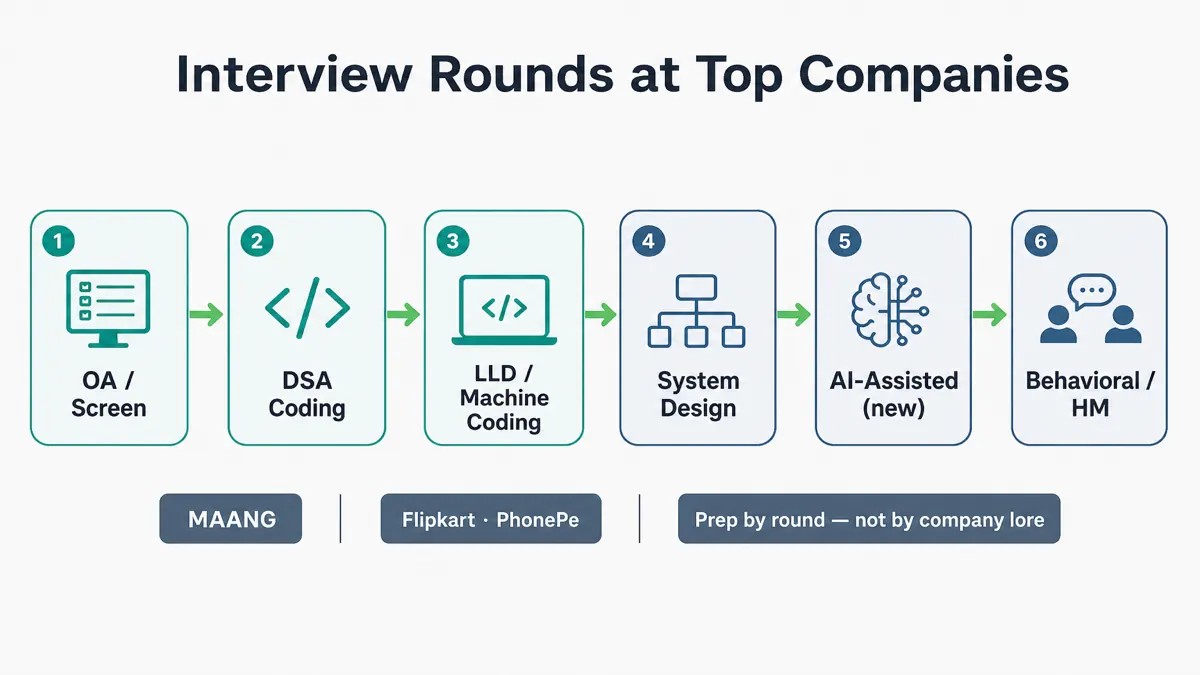
Start with the round types — companies remix these stages; they do not invent a totally different process for every logo.
The software engineer interview process is a filter chain of round types — recruiter screen, online assessment, DSA coding, machine coding or LLD, system design, optional AI-assisted coding, and behavioral — that product companies remix rather than invent from scratch.
You get an offer loop email and six calendar invites. One says “coding.” Another says “machine coding.” A third says “system design.” Somewhere online, Meta has an “AI round.” Panic is optional. A map is not.
This is the InterviewCrafted start-here guide for 2026. Logos below (Google, Meta, Amazon, Flipkart, PhonePe, Razorpay, Atlassian, and similar) are signatures on the same shared process — not separate dossiers. Confirm your exact loop with the recruiter; patterns are maps, not guarantees.
Interview rounds at a glance
| Round | Length | What it tests | Common fail |
|---|---|---|---|
| Recruiter / phone screen | 20–30 min | Fit, timeline, ownership of past work | Vague “we built X,” no role or result |
| Online assessment (OA) | 60–90 min | Correct solutions under a clock | Never opening problem 2 |
| DSA coding | 45 min × 1–2 | Algorithms, edges, narration | Silent code; no complexity said |
| Machine coding / LLD | 60–90 min | Runnable system + clean design | One giant class; no demo |
| System design (HLD) | 45–60 min | Scale, trade-offs, ambiguity | Tools before constraints |
| AI-assisted coding | ~60 min | Direct + verify the model | Paste-all; cannot explain output |
| Behavioral / HM | 45–60 min | Ownership, conflict, judgment | “We shipped it” with no decision |
Companies remix these stages. They do not invent a new process for every logo.
Company comparison at a glance
| Company | Signature | AI coding (mid-2026) | Prep bias |
|---|---|---|---|
| DSA + culture fit (“Googleyness”); design mid+ | Pilot (select teams) | Timed DSA + design talk-aloud | |
| Meta | Coding + AI-enabled + design | Widely reported on many loops | Multi-file AI + DSA |
| Amazon | Coding + Leadership Principles (LPs) with receipts | Confirm per loop | Decision + metrics in stories |
| Apple / Netflix | Team-specific coding + judgment | Confirm per loop | Map invite to round types |
| Microsoft | Varies by org; AI-product teams differ | AI orgs more often | Ask what is scheduled |
| Flipkart | ~90 min machine coding | Rare | LLD + runnable demo |
| PhonePe / Razorpay | DSA + payment-safe design | Rare | Failure modes, idempotency |
| Atlassian | Coding + design (global-style) | Rare | Trade-offs + collaboration |
Interview process by experience level
Titles vary (SDE-1 / L3 vs senior / L5). What shows up is more stable than the label.
| Level | Usually includes | Usually lighter | Prep focus |
|---|---|---|---|
| Early career | OA, 1–2 DSA, light behavioral; some India loops add machine coding | Deep multi-service HLD | DSA narration + one LLD build if needed |
| Mid-level | DSA + LLD or HLD + HM; Meta often adds AI coding | Trivia-only loops | Trade-offs out loud; ownership with numbers |
| Senior / staff | Design and judgment dominate; at Meta (and similar), AI-assisted may replace one classic coding slot | LeetCode-only as the whole bar | Ambiguity, failure modes, directing work |
Trust your recruiter schedule over this chart.
Quick FAQ
How many rounds does a typical software engineer interview have?
Often four to six scored conversations after the online assessment — commonly DSA, another technical or design round, and behavioral or hiring-manager. Some India product loops add a long machine-coding block. Your recruiter schedule is the source of truth.
How long does the SWE interview process take?
From first OA to final decision, many candidates see two to six weeks. Campus and hiring drives can compress into days; senior loops with team matching can stretch longer.
Online assessment vs live DSA coding — what is the difference?
The OA is a timed gate on a platform: submit correct solutions under a clock. Live DSA is a conversation — clarify, narrate, handle edge cases, and say complexity out loud while an interviewer watches.
What is a machine coding interview?
A long timed build (often sixty to ninety minutes) where you ship a small working system — for example a parking lot or expense splitter — then demo it and defend design quality. Flipkart is known for this format.
How should I start this week?
Pick your weakest round from the tables above. Run one timed session. Write five lines on what you skipped. Deeper sections below cover each room and the InterviewCrafted prep map.
The usual round types
Think of hiring as a filter chain. Each stage answers a different question about you. Below is what that feels like in the room — not just the label on the calendar invite.
Recruiter or phone screen
Fit, timeline, compensation band, and a light technical sniff test. You are proving you can talk clearly about what you built: your role, the hard part, and one concrete result.
What fails: vague “we built a microservice” with no numbers, no ownership, and no sense of timeline. Recruiters are filtering for signal they can hand to the hiring team.
Online assessment (OA)
Timed coding or mixed aptitude on a platform. It is a gate, not a personality exam. Speed and correctness under a clock matter more than elegant architecture.
What fails: spending twenty minutes polishing style on problem one and never opening problem two. Treat OA like a time budget: get correct solutions submitted, then improve if minutes remain.
DSA coding rounds
One or two live problems on algorithms and data structures — often forty-five minutes. Interviewers watch how you clarify, choose a structure, handle edge cases, and say complexity out loud.
A strong shape looks like this: two minutes to restate the problem and ask about constraints, a few minutes on approach and trade-offs, then code while narrating, then one or two tests including an empty or ugly input.
What fails: finishing correct code in silence. A narrated, slightly slower walkthrough usually scores better than a silent perfect solution — interviewers cannot hire what they cannot hear.
Machine coding or low-level design (LLD)
Build a small working system — parking lot, expense splitter, snake-and-ladder, library catalog — in a long timed block, often sixty to ninety minutes. The product is runnable code plus a design story: classes with clear jobs, extensibility, and a demo that does not fall over on the happy path.
A strong Flipkart-style rhythm: ten to fifteen minutes clarifying scope and naming the main pieces out loud, most of the remaining time implementing a path you can demo, last ten minutes showing park → ticket → leave → fee (or the equivalent) and answering “how would you add X later?”
What fails: one giant class that does everything; features that never run; design talk that starts only after the timer. This is Flipkart’s famous signature; many India product companies use a cousin of it. For a reusable loop, use How to Approach LLD Interviews — Start Here.
System design (HLD)
A conversation about a large product under constraints: APIs, data, scale, failure modes, and trade-offs. There is no single correct box diagram. Interviewers score how you navigate ambiguity — whether you ask questions that change the architecture before you draw.
A workable forty-five to sixty minute shape: clarify users and scale, sketch the main read/write path, deep-dive one hard piece (storage, cache, or consistency), then name what breaks at 10× traffic and what you would measure.
What fails: jumping to “we will use Kafka and Cassandra” before agreeing on write volume or consistency needs. For a reusable approach, read System design interviews — start here. For longer prep, use How to Prepare for System Design Interviews.
AI-assisted coding (newer)
You work with an approved model inside the interview environment. The bar is not “clever prompts.” The bar is whether you can direct work, verify output, and keep ownership when the model is wrong. Meta’s common shape is a longer multi-file problem in phases — debug, implement, optimize — often about sixty minutes. More on how that round is scored below.
Behavioral, hiring manager, or bar-raiser
This round is about how you work with people and make decisions, not algorithms. (A bar-raiser — common language at Amazon — is an interviewer from outside the hiring team who checks the hiring bar and Leadership Principles.) Interviewers ask for real stories: a time you owned a messy outcome, disagreed with a teammate or manager, shipped with incomplete data, or chose a trade-off under pressure. They also check whether your values fit how the team works.
STAR (Situation, Task, Action, Result) is a useful outline so you do not ramble — but a strong answer still needs a clear outcome, your specific role, and what you would do differently. “We shipped it” without your decision and the cost of that decision dies in Amazon Leadership Principle (LP) rounds and most HM chats. For how to build those stories, see Preparing for Behavioral Interviews.
If you only grind LeetCode for every invite, you will walk into Flipkart’s machine-coding round unprepared — and walk into Meta’s AI-enabled round treating the model like an oracle. Different rounds, different muscles.
Company-by-company signatures
Same ingredients. Different emphasis. Read this as “what they put their logo on,” not as a rigid script.
Typical onsite: several ~45-minute rounds — coding, coding again, system design at mid-level and above, plus Googleyness (culture and collaboration fit) or leadership. DSA remains central. Interviewers care that you explore an approach, discard a worse one out loud, and test edge cases without being chased.
In 2026, some US teams are piloting Gemini-assisted code comprehension: fix and improve an existing codebase with the model available. Treat that as a pilot on select teams unless your recruiter says otherwise. Do not skip classic DSA prep because you read one blog about AI interviews.
Meta
Meta changed faster than most of the set between late 2025 and early 2026. On many SWE loops, candidates report a traditional coding round and an AI-enabled coding round (often ~60 minutes) in a specialized editor with a model sidebar — still confirm which slots you have.
Candidate reports describe a longer problem in phases: debug existing code, implement a feature, then optimize. Rubrics emphasize problem-solving, code quality, verification, and communication. At senior levels on some Meta loops, the AI-assisted format may be the only coding round.
Practical ask for your recruiter: which coding slot is the AI one, which languages the pad supports, and whether phase one allows the model. Burning five minutes orienting in a new editor is a self-inflicted wound.
Amazon
Expect online assessment, coding, Leadership Principles (LPs) woven through behavioral and often through technical chat, plus design as level rises. Amazon’s signature is not a new editor — it is LP storytelling with receipts.
A weak answer sounds like “the team migrated to microservices.” A stronger one sounds like “I pushed back on splitting service X because of the operational cost, we measured p99, and here is what I owned.” Vague ownership is the silent reject.
Apple and Netflix
Less cookie-cutter — there is no single shared signature format. Apple is often team-specific: coding plus domain depth and fit with the hiring team. The interviewer may care more about how you reason about the product’s constraints than about a generic URL shortener.
Netflix leans on strong coding and culture or judgment conversations. High bar, fewer identical loops across teams. Map whatever the team schedules to the round types above; do not assume a Flipkart-style machine-coding block.
Flipkart
OA and DSA matter, but the round people remember is machine coding for roughly ninety minutes. You build a working application, demo it, and defend object design and extensibility. System design and hiring-manager rounds follow for many loops.
Picture the failure mode: a candidate spends seventy minutes coding a parking lot inside one ParkingManager class, never runs the fee path, and then tries to explain SOLID in the last five minutes. That is the pattern interviewers see constantly.
Picture the stronger close: named pieces (ParkingLot, Spot, Ticket, FeeCalculator), a demo that parks and exits, and a calm answer to “how would you add EV charging rates without rewriting everything?” If that sentence feels unfamiliar, start with How to Approach LLD Interviews — Start Here. Timed Practice LLD on InterviewCrafted is [upcoming] — until then, run the same build in your IDE under a timer.
PhonePe
Pattern from recent candidate reports: OA, two or three technical rounds heavy on DSA, design (LLD or HLD) that cares about reliability and fintech-scale thinking, then hiring manager.
In design discussions, expect questions that sound like payments: what happens if a debit succeeds and a credit fails, how you avoid double charges, what you log for reconciliation, what degrades first under spike traffic. Correct DSA alone is not enough if your design shrugs at inconsistency.
No widely standardized “AI round” for all SDE hires as of mid-2026 — fundamentals and design still carry the loop.
Razorpay
Expect strong DSA, then LLD or HLD where money movement and failure handling matter. Interviewers often push on idempotency, retries, reconciliation, and what you do when a downstream bank or provider is slow.
You do not need a separate “Razorpay course.” If you can explain a payment-safe design and write clean LLD under time, you are training the right muscle for this loop. Pair that with Flipkart-style machine coding only if your invite actually includes it.
Atlassian
Atlassian (including heavy India hiring) is a useful bridge between “India product company” and “global product bar.” Loops are closer to classic coding plus design than to Flipkart’s long machine-coding block — though exact rounds still vary by team and level.
Expect clear communication on trade-offs, code quality, and how you work in collaborative product orgs. If your calendar shows coding + system design + behavioral, map prep to those round types above; do not assume a ninety-minute parking-lot build unless the recruiter says so.
Microsoft
Microsoft loops vary sharply by org. AI-assisted or AI-product-team interviews show up more often in AI-focused groups than in every SWE loop. Treat Microsoft like Apple/Netflix here: ask what is scheduled, then map it to the round types above.
Where AI rounds actually are
| Company or set | AI-assisted coding status (mid-2026) |
|---|---|
| Meta | Widely reported — often sits beside or replaces one classic coding round (confirm yours) |
| Pilot on select teams / formats | |
| Microsoft | More common in AI-focused orgs than every SWE loop |
| Amazon, Apple, Netflix | Not a universal default — confirm per loop |
| Flipkart, PhonePe, Razorpay, Atlassian | Still classic coding / LLD / design — no universal AI round yet |
The industry trend is real. The uniform rollout is not. For how judgment still beats autocomplete, read The New Interview Reality and When AI Codes For You.
What an AI-assisted round actually scores
Candidates freeze in two opposite ways. One refuses to touch the model and burns the clock typing everything by hand. The other pastes the whole problem into chat, accepts the first answer, and cannot explain a single function when asked.
Neither is the job.
Treat the model like a junior pair programmer. Scope a small task (“fix the null check in parseTicket, do not rewrite the module”). Read the output line by line. Run a case that might break it. Reject bad suggestions out loud: “This ignores retries — I am not taking it.” Interviewers are listening for ownership: you directed the work, you verified it, you can still design without the sidebar if the model goes sideways.
If Meta’s three-phase shape shows up, budget time on purpose. Do not spend forty minutes polishing phase one. Leave room to implement and to talk about what you would measure under a larger dataset.
Practice differently than LeetCode. Use a multi-file toy codebase — a tiny library or expense splitter with bugs planted — and run sixty-minute sessions with an AI assistant on. Narration is scored. Silent prompting is a rejection pattern.
InterviewCrafted map — prep by round type
Do not buy a separate course for every company logo. Map each round type to a practice surface, then run it under time. The table is the shortcut; the subsections below are how to use each surface so practice actually transfers to the interview room.
| Round type | What to practice on InterviewCrafted |
|---|---|
| OA and DSA foundations | Topics [read] · Essays / Blogs [read] |
| Machine coding / LLD | How to Approach LLD Interviews [read] · How to Prepare for LLD [read] · Practice LLD [upcoming] |
| System design (HLD) | Practice System Design [practice] · System Design Guides [read] |
| Judgment under pressure | Design Challenges [practice] — Fix-the-Design and Fix-the-Code |
| AI-era verification habits | When AI Codes For You [read] · The New Interview Reality [read] |
| Behavioral / HM | Preparing for Behavioral Interviews [read] |
OA and DSA foundations
Use Topics when a concept is fuzzy — arrays and hashing, trees and graphs, concurrency basics, caching, databases — then return to timed problems. Do not treat Topics as a substitute for a clock.
How to practice: pick two medium problems, set forty-five minutes, and talk out loud even alone. Restate the problem, name the data structure, code, then run an empty input and one ugly edge case. Once a week, record yourself for one problem and listen for long silences.
Done looks like: you can explain time and space without being asked, and you finish at least one solid solution with tests inside the window. Browse Essays / Blogs when you need interview-context framing (how rounds are scored), not when you need another algorithm tutorial.
Machine coding / LLD
This is the Flipkart-shaped muscle — and useful anywhere a loop asks you to build a small working system. Start with How to Approach LLD Interviews — Start Here so you have a five-step loop (clarify → name pieces → connections → method names → code). For a multi-week study plan, use How to Prepare for Low-Level Design (LLD) Interviews. Timed Practice LLD on the platform is [upcoming] — until then, run the same loop in your IDE or on paper under a ninety-minute timer with a forced demo at the end.
How to practice: spend the first ten to fifteen minutes on design out loud before you touch the editor. Force a demo in the last ten minutes — park and exit, split an expense, play one game round. Afterward, write three notes: what stayed in one giant class, what you never demoed, what you would extract next time.
Done looks like: a runnable happy path, classes with clear jobs, and a calm answer to “how would you add X later?” If you only refactor diagrams and never ship a demo, you are not practicing machine coding yet.
System design (HLD)
Use Practice System Design for timed talk-alouds with feedback, and System Design Guides when you need a deep read on a specific problem shape (feeds, booking, rate limiting, and similar). For a multi-week plan, follow How to Prepare for System Design Interviews. If you catch yourself memorizing box diagrams, switch to System Design Without Memorization.
How to practice: forty-five to sixty minutes. First five minutes only on clarifying questions that change the design (scale, consistency, read/write mix). Sketch the main path, deep-dive one hard piece, then name what breaks at 10× and what you would measure. Say trade-offs out loud — “I pick eventual consistency here because…”
Done looks like: the interviewer (or your recording) can repeat your assumptions and your main trade-off without guessing. Drawing every trendy component is not the bar.
Judgment under pressure — Design Challenges
Design Challenges sit between “read a guide” and “live interview.” Fix-the-Design style challenges push you to find what is wrong in a flawed architecture under incident pressure. Fix-the-Code / LLD-style challenges push review judgment on broken code and call flow.
How to practice: treat one challenge like an on-call or interview block — read the brief, form a hypothesis before you open every chart or hint, write answers in plain language, then compare against the review. Notice where you jumped to a tool (Kafka, Redis) before naming the failure mode.
Done looks like: you can state the broken assumption, the blast radius, and the first safe fix — not a laundry list of technologies. This transfers to PhonePe/Razorpay reliability talk and to senior system design follow-ups.
AI-era verification habits
When Meta (or another AI-assisted loop) is on your calendar, do not only grind single-function LeetCode. Read When AI Codes For You and The New Interview Reality for the scoring mindset, then practice on a multi-file toy project with an assistant on.
How to practice: sixty minutes. Plant or find a bug, ask the model for a small scoped fix, read every line, run a failing case, reject bad output out loud. Score yourself on verification and narration — not on how fast the model typed.
Done looks like: you can explain every accepted change and point to one suggestion you refused. If the model could disappear mid-round and you would freeze, keep practicing.
Behavioral / hiring manager
Use Preparing for Behavioral Interviews to build five to seven stories that cover ownership, conflict, failure, collaboration, and technical depth. Keep each to about ninety seconds to two minutes, with a deeper version ready for follow-ups.
How to practice: pick one story per session. Lead with the outcome and a number when you have one, then your decision, then the lesson. Rehearse the follow-up “what was your specific role?” until the answer is sharp. For Amazon-style loops, map each story to a Leadership Principle in one sentence — after the story is strong, not before.
Done looks like: a listener can say what you personally decided and what changed because of it. “We shipped it” with no you in the sentence is not done.
Fundamentals that show up inside design rounds
When HLD or fintech design feels thin, go sideways into Topics — especially databases, caching, and distributed systems — and into Design Thinking for how to break vague prompts into constraints. You are not collecting certificates; you are collecting language you can use under a timer.
A practical week (repeat until the weak round improves)
- One timed DSA set (about forty-five minutes) — talk out loud; record yourself once.
- One machine-coding or LLD build (IDE or paper for now — Practice LLD
[upcoming]) with a forced demo at the end. - One system design talk-aloud on Practice System Design — clarify before you draw.
- One Design Challenge or one behavioral story rewrite — alternate weeks if time is tight.
- If an AI round is on your calendar — one sixty-minute multi-file session with an assistant, scoring verification.
That covers more loops than six company-specific rumor docs. Match the week to your invites: Flipkart-heavy → bias LLD; Meta AI on the calendar → keep the multi-file session; PhonePe or Razorpay → keep design challenges and reliability language in your HLD practice.
Key idea
Top companies do not invent totally different interviews. They remix OA, DSA, LLD or machine coding, system design, sometimes AI-assisted coding, and behavioral judgment — then put their logo on the round they care about most.
Meta’s logo right now is AI-enabled coding plus design (widely reported — still confirm). Flipkart’s is machine coding. PhonePe and Razorpay stamp reliability onto design. Atlassian looks more like global coding-plus-design with a large India hiring footprint. Google’s is still heavily DSA with rising design expectations as level climbs. Match preparation to the skill each invite tests.
Start with one round you are weakest on this week. Run it under time. Write five lines on what you skipped. That beats collecting another “company process” bookmark.
Frequently asked questions
- What are the main rounds in a software engineer interview?
- Most product-company loops mix some of these: recruiter or phone screen, online assessment, one or two DSA coding rounds, machine coding or low-level design, system design for mid and senior levels, sometimes an AI-assisted coding round, then behavioral or hiring-manager. Exact order and count vary — your recruiter email is the source of truth.
- Have MAANG companies added AI interview rounds?
- Yes, unevenly. Meta has rolled out an AI-enabled coding round for many SWE loops — you work with an LLM in the editor and get scored on problem-solving, code quality, verification, and communication. Google is piloting Gemini-assisted formats on select teams. Amazon, Apple, and many India product companies still run mostly classic loops. Always ask your recruiter what is on your schedule.
- How is Flipkart different from Google or Meta?
- Flipkart is famous for a long machine-coding round where you build a working mini-system in about ninety minutes, then defend design quality. Google and Meta still lean hard on timed DSA plus design and behavioral; Meta additionally often includes an AI-enabled coding round. Same industry, different signature tests.
- What does a strong Flipkart machine-coding run look like?
- Roughly: ten to fifteen minutes clarifying scope and naming classes out loud, most of the hour implementing a runnable happy path, then a short demo and design review. Interviewers dock for one giant class, features that never run, and design explanations that start only after time is up. See How to Approach LLD Interviews.
- Should I prepare differently for an AI-assisted coding round?
- Yes, but not by studying prompt tricks. Practice multi-file debugging, feature work, and optimization while treating the model like a junior pair — scope small asks, read every line, test edge cases, and narrate your judgment out loud. Blindly accepting model output is a common fail signal. See also When AI Codes For You.
- How should I use InterviewCrafted for each round type?
- Map prep to the skill: Topics for fundamentals; the LLD start-here guide for machine coding (Practice LLD upcoming); Practice System Design and System Design Guides for HLD; Design Challenges for judgment under pressure; Preparing for Behavioral Interviews for HM stories.
- Is system design required for every company?
- Not always at the earliest levels, but it shows up early at scale-heavy product companies and almost always from mid-level upward. Even when the loop skips a formal HLD round, interviewers still listen for trade-off language in coding and project discussions. Start with System design interviews — start here.
- How does the interview process change by experience level?
- Early career loops lean on OA and DSA, sometimes machine coding in India product companies. Mid-level adds LLD or HLD plus stronger behavioral. Senior loops weight design and judgment more; at Meta and some AI-heavy orgs, AI-assisted coding may replace a classic coding slot — elsewhere that is not the default. Your recruiter schedule always wins over a generic level chart.
- What is the biggest prep mistake across companies?
- Training only DSA for every invite. That leaves you cold for Flipkart-style machine coding, thin on system design trade-offs, and unready for Meta-style AI rounds where verification and narration matter as much as getting code on the screen.
What's next?