System design interview guide
WhatsApp System Design
Imagine billions of people treating chat like a utility—one tap to send, one glance at delivery ticks, and trust that no one at the company can read the thread. Within seconds of a viral moment, a family group shares a video, a stadium channel floods with reactions, and millions of phones retry the same send on bad train Wi‑Fi. Designing messaging that stays private, ordered, and instant under that pressure is a classic large-scale system design challenge.
Problem statement
You're designing a WhatsApp-style messaging platform: one-on-one and group chat, delivery and read receipts, and end-to-end encryption so the server routes scrambled bytes—not readable message text.
Functionally you need 1:1 and group messaging, text and media, receipts, presence, and multi-device support. Non-functionally you need very low latency for control messages when online, high availability, and strong privacy (E2E). Scale sits on the order of billions of users and hundreds of thousands of messages per second at peak—and what dominates at that scale is open live connections, per-chat writes, and group fan-out—not one monolithic "send message" API.
What interviewers reward: separate fast path vs media path; inbox saved before ack; per-chat seq and client_msg_id dedupe on retry; honest group model with a stated max size; encryption limits on server search and push text—not generic "we'll add Kafka and scale."
Introduction
You send “running late” to one friend. Their phone is offline. You still expect a checkmark that the server has it—and for the message to appear once, in order, when they come back.
That is the product problem. A chat app must feel instant on a good network, survive retries on a bad one, and keep private text off server logs—without letting photos block a one-line message.
On a quiet 1:1 chat the story is short: save the message, tell the other phone if it’s online, deliver later if it’s not. At scale, millions of phones stay connected, groups grow large, and one viral channel can write hundreds of messages per second. If the same “hello” shows twice, out of order, or as readable text in server logs, trust dies.
Keep three ideas separate:
- One send, three beats — Save first → notify online peer → offline peer catches up later. Success means “saved,” not “they already saw it.”
- Duplicates and order — Phones retry; clocks disagree. After you tell that story, name a duplicate id from the sender and a per-chat order number from the server.
- Two speeds — Short text and receipts need a fast lane; photos and video use a separate upload path so a huge file never blocks checkmarks.
Weak answers draw one “message queue” box. Strong answers walk one 1:1 send end to end, park deep crypto for later, and only then name the duplicate id and order number.
Board path (first read, ~10 min)
Start here if you have never designed chat delivery. Finish this section, then stop and try a mock. Deep crypto, group fan-out math, and capacity live in After one mock.
What problem are we solving?
For one private chat, answer:
“When A sends a text to B, what happens if B is online—and what if B’s phone is off?”
- Online → save the message, then push it on the live connection.
- Offline → save still succeeds for the sender; B syncs (and may get a wake-up) later.
- Retry → the same send must not create two copies in the thread.
Photos never share that urgent path with “running late.”
What to write on the board (start simple)
Write these lines. Plain English is enough. No protocol brand names.
- One 1:1 send — Phone → server saves → if peer online, notify now → if offline, peer pulls later.
- Success = saved — Sender checkmark means the inbox row exists—not that Apple/Google already showed a banner.
- After the story: duplicate id + order number — Sender sends a unique attempt id so retries don’t double-post; server assigns a rising number per chat so order doesn’t depend on phone clocks.
- Fast text vs slow media — Text/receipts on the quick path; big files upload elsewhere and the chat carries a pointer.
That’s your first board. Full end-to-end crypto math comes after this mock.
Clarifying questions (group size, offline promise, crypto park, out of scope)
Start with delivery promise and group size—crypto depth can wait.
You: “When the phone is offline, is the promise ‘saved on the server for later sync,’ or ‘push notification must succeed’?”
Interviewer: “Inbox on the server is the promise; push is best-effort.”
Checkpoint: Write “success = saved” before drawing sockets.
You: “What’s the max group size for this round—family, a few hundred, or stadium-scale?”
Interviewer: “Assume up to a few hundred; call out what changes at fifty thousand.”
Checkpoint: Note “small group = copy per member; huge = different model” in one line—don’t design stadium yet.
You: “How deep on encryption—high-level ‘server can’t read message text,’ or a full crypto protocol walkthrough?”
Interviewer: “High-level is enough unless I push.”
Park E2E crypto depth. Say the server stores scrambled bytes; leave ratchet math for After one mock if they ask.
You: “I want to leave full crypto protocol math, payments, and building the SMS login network out of scope—focus on one send, order, offline sync, and groups. Does that match?”
Interviewer: “Yes—focus on messaging reliability.”
If they ask for Double Ratchet proofs or exact WebSocket APIs before the send story—park it.
What you can say out loud (next to the board)
- Send path: “I’d walk one 1:1 text: save on the server first, notify if online, sync later if offline.”
- Promise: “A successful send means the message is stored—not that the other person already saw a notification.”
- Retry story first: “Phones retry on bad networks—so after that story I’ll use a sender duplicate id and a per-chat order number.”
- Crypto park: “Server routes scrambled bytes, not readable chat—I’ll keep full crypto protocol detail parked unless you want it.”
First-pass: what should stick
- Save → notify → offline later — One clear 1:1 path before groups or media.
- Duplicate id after the retry story — Same send attempt must not appear twice; order number is per conversation, not phone wall-clock.
- Media off the hot path — Huge uploads must not block text checkmarks.
End of first pass
⏸ End of first pass — stop scrolling.
You have enough for the requirements stage. Practice that now. Do not continue into capacity, deep E2E crypto, or group fan-out math until you’ve done a short requirements mock.
→ Practice requirements only (~5–10 minutes)
Ready for depth? Only then open After one mock.
After one mock
Return to Board path if this is your first read.
Everything below is for after one mock—or when the interviewer pushes on client_msg_id / seq, groups, encryption tradeoffs, and capacity.
Depth map (read in order):
- How to approach (full clarifying + pacing)
- Capacity (connections, media, hot chats)
- High-level architecture (two lanes)
- One send dig — tell the retry story, then name
client_msg_id(duplicate id) andseq(order number) - Groups, receipts, E2E product limits
Skip ahead only if the interviewer is already there.
How to approach
Start the way a user would experience the product, not by listing every service name. Spend the first few minutes turning a vague “design WhatsApp” prompt into a contract you can design against. Talk through clarifying questions out loud, then walk one text send end to end before you name WebSockets or object storage.
Clarifying questions (say these in the room)
Start with group size and encryption depth, because every later choice (inbox fan-out, push text, search, support tooling) hangs off those two answers.
You: “What is the maximum group size—a dozen family members, a few hundred teammates, or a stadium channel? That picks whether we copy each message into every inbox or store once and let members read with a cursor.”
Interviewer: “Assume up to a few hundred for normal groups; call out what changes if someone wants fifty thousand.”
That answer tells you copy-on-send is fine for small groups and that you must name a shared-log or announcement model above your cap.
You: “How deep should I go on cryptography—high-level end-to-end encryption, or a full Double Ratchet walkthrough?”
Interviewer: “High-level E2E is enough unless I push.”
Now you know to spend minutes on inbox, order, and fan-out—not twenty minutes on crypto math—while still saying the server stores ciphertext only.
You: “Do users have multiple devices that must all show the same thread, and do we need read receipts that tell who has opened a message in a large group?”
Interviewer: “Yes to multi-device; pick a product bar for receipts in big groups.”
Multi-device means encrypting for each device and syncing cursors; large-group receipts need throttling or aggregates so one “read” event per member per message does not melt writes.
You: “When the phone is offline, is the delivery promise ‘saved on the server for later sync,’ or ‘push must succeed’?”
Interviewer: “Inbox on the server is the promise; push is best-effort.”
That keeps you from treating Apple or Google delivery as proof the human saw the chat.
You: “I want to leave full cryptographic protocol math, a complete payments/commerce product, and building the national SMS OTP network out of scope so we can focus on send, order, offline sync, groups, and E2E limits. Does that match what you want?”
Interviewer: “Yes—focus on messaging reliability and privacy constraints.”
Saying out of scope early stops you from burning the round on adjacent products.
Minute pacing (about 45–60 minutes)
| Minutes | Focus |
|---|---|
| 0–5 | Clarify group size, E2E depth, multi-device, offline promise, out of scope |
| 5–12 | Capacity + two lanes (fast text vs media) + connection sketch |
| 12–30 | One send dig: client_msg_id, seq, inbox commit, socket vs push |
| 30–40 | Groups, hot partitions, receipts at scale |
| 40–50 | One production scene + failure modes |
| 50–60 | Questions / deepen one tradeoff |
In the room (say this opening in four short lines):
- “Fast lane for text and receipts; separate upload path for photos and video.”
- “One text send: save scrambled bytes to the inbox, then notify online or wake offline later.”
- “After the retry story: sender duplicate id (
client_msg_id), server order number (seq) per chat.” - “Groups: state a max size—copy-on-send below it; different model above it. Deep crypto stays parked unless you push.”
Out of scope (and why you park these)
Write a short out-of-scope list on the board so the interviewer sees you can bound the problem. Explain each line in a sentence, not only as a bullet label.
Full cryptographic protocol design (Double Ratchet math, session setup proofs). You need the system consequences of E2E—ciphertext storage, generic push, limited server search—not a cryptography lecture, unless they explicitly ask for more depth.
Building the SMS / carrier OTP identity network itself. Account signup matters, but verifying phone numbers is a separate identity path. Mention rate-limited OTP and fraud in one breath, then return to inbox and connections.
A full payments, status-stories, or broadcast-channel product catalog. Adjacent surfaces steal whiteboard time from the hard path: ordered durable delivery under retries and group fan-out.
Perfect global linear order across every chat on earth. Chat needs per-conversation order. Cross-region strict linearizability for all threads fights physics and interview pacing—say what you guarantee per chat and what failover may briefly relax.
Capacity estimation
Before you draw architecture boxes, use rough numbers to stay realistic. You do not need perfect statistics. You need a sense of scale so you do not promise something impossible—like copying one "hello" into fifty thousand inboxes in a single instant.
On most days, message volume is spread across millions of chats. During a live event or viral group, one conversation can drive a huge fraction of writes to a single database partition. If you design only for average QPS, evening peak or one stadium channel will surprise you.
| Dimension | Rough scale | What this means for your design |
|---|---|---|
| Peak messages | ~600K per second (order of magnitude) | Shard by chat id or user inbox; keep each send transaction short |
| Storage | Petabytes of history | Archive old threads; support delete-for-everyone; compress cold data |
| Live connections | ~100M+ open sockets | Regional connection clusters; tune for many idle sockets, not only CPU |
| Media volume | Much larger than text | Object storage + CDN; fast path carries pointers only |
Three practical lessons follow from this table:
- Do not put full video uploads on the same urgent path as text and read receipts.
- Do not treat a stadium-sized group like a twelve-person family chat—product must set max group size or switch storage models.
- When
SendMessagereturns success to the sender, that should mean the message row is saved in the inbox—not that Apple or Google already showed a notification.
High-level architecture
What breaks if you merge everything
One API that takes full video uploads and read receipts on the same urgent path will choke at peak. Handshakes, database writes, and push notifications all fight for the same few milliseconds. If you also log readable messages for “debugging,” you fail the encryption question before scale even matters.
What works: two lanes
Picture two roads:
- Fast lane — short messages: text, who read what, “user is online,” connection events.
- Truck lane — photos and video: upload to file storage, download via CDN.
The server moves scrambled bytes. It does not read the chat content.
How it fits together:
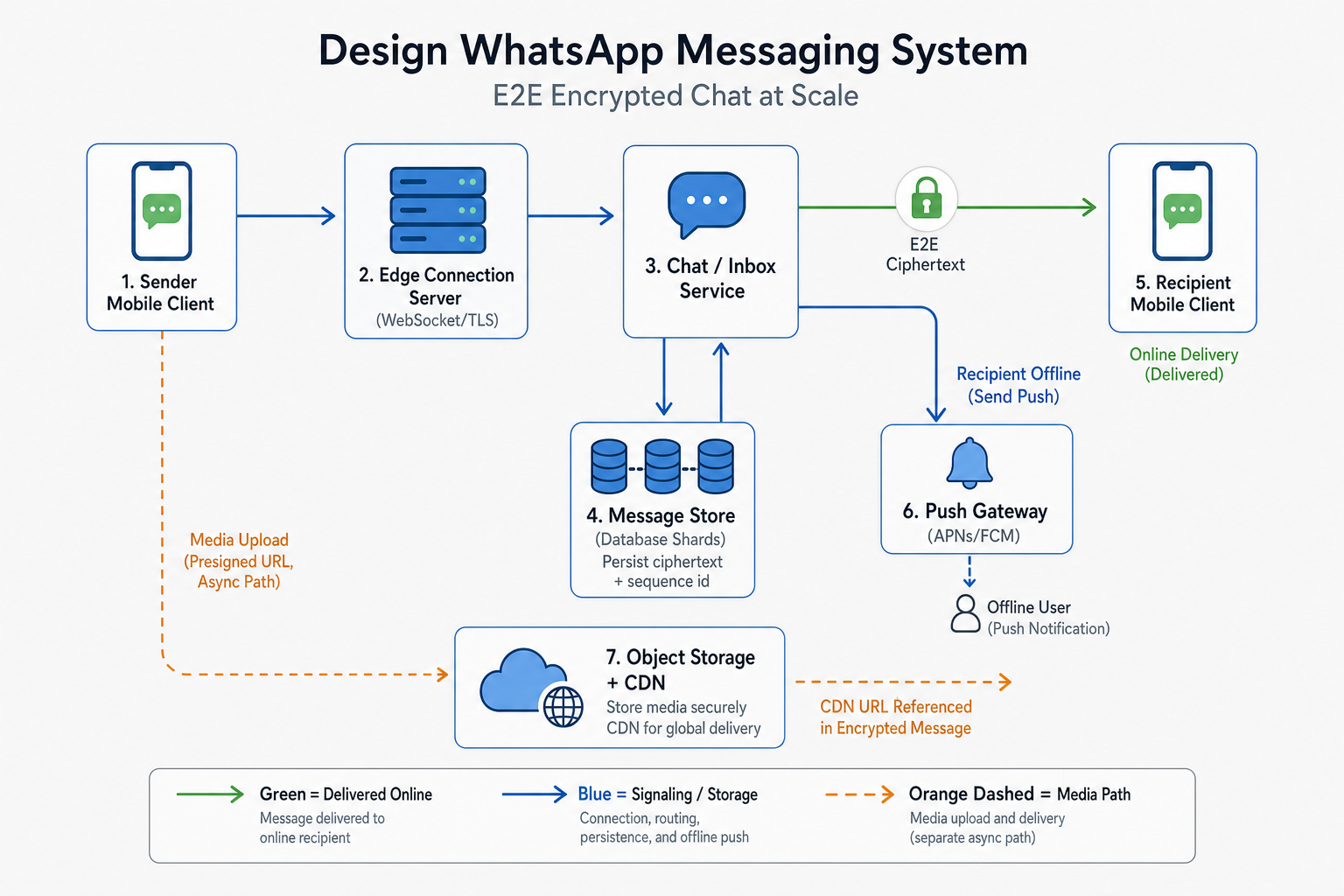
Phones keep a long-lived connection (WebSocket, MQTT, or similar over TLS) to connection servers in each region. The chat service receives encrypted text + small metadata, assigns msg_id and a sequence number per chat (seq), and saves to a database split across many machines (by chat id or by each user’s inbox). If the friend is online, send over the live connection. If offline, save to their inbox first, then send APNs/FCM push. For media, the phone uploads with a pre-signed URL; the fast lane only carries a file id.
Who does what:
- Connection servers — Keep sockets alive, heartbeats, limit queue size per user so one slow phone does not blow memory.
- Chat / inbox service — Owns message order (
seq), saves messages reliably, tracks sent / delivered / read. - Object store + CDN — Stores files; supports resume if upload breaks.
- Push service — Maps user → phone tokens; respects notification settings.
- Keys (sketch) — Stores public keys per device. Never log readable messages.
Simple version: text uses the fast lane; photos and video use the truck lane.
[ Mobile client ]
      |
      | 1) TLS + long-lived conn (signaling)
      v
[ Edge / Connection cluster ] ──► [ Chat / Inbox service ]
      |                                    |
      |                                    | persist ciphertext + metadata
      |                                    v
      |                             [ Message store shards ]
      |                                    |
      | 2) notify online peers             +--> [ Push ] --> APNs/FCM (offline)
      |
[ Same client or peer ] ◄── ack / delivery / read events

  Media path (async, large):
  Client --presigned PUT--> [ Object storage ] --> CDN URL in message body (encrypted)
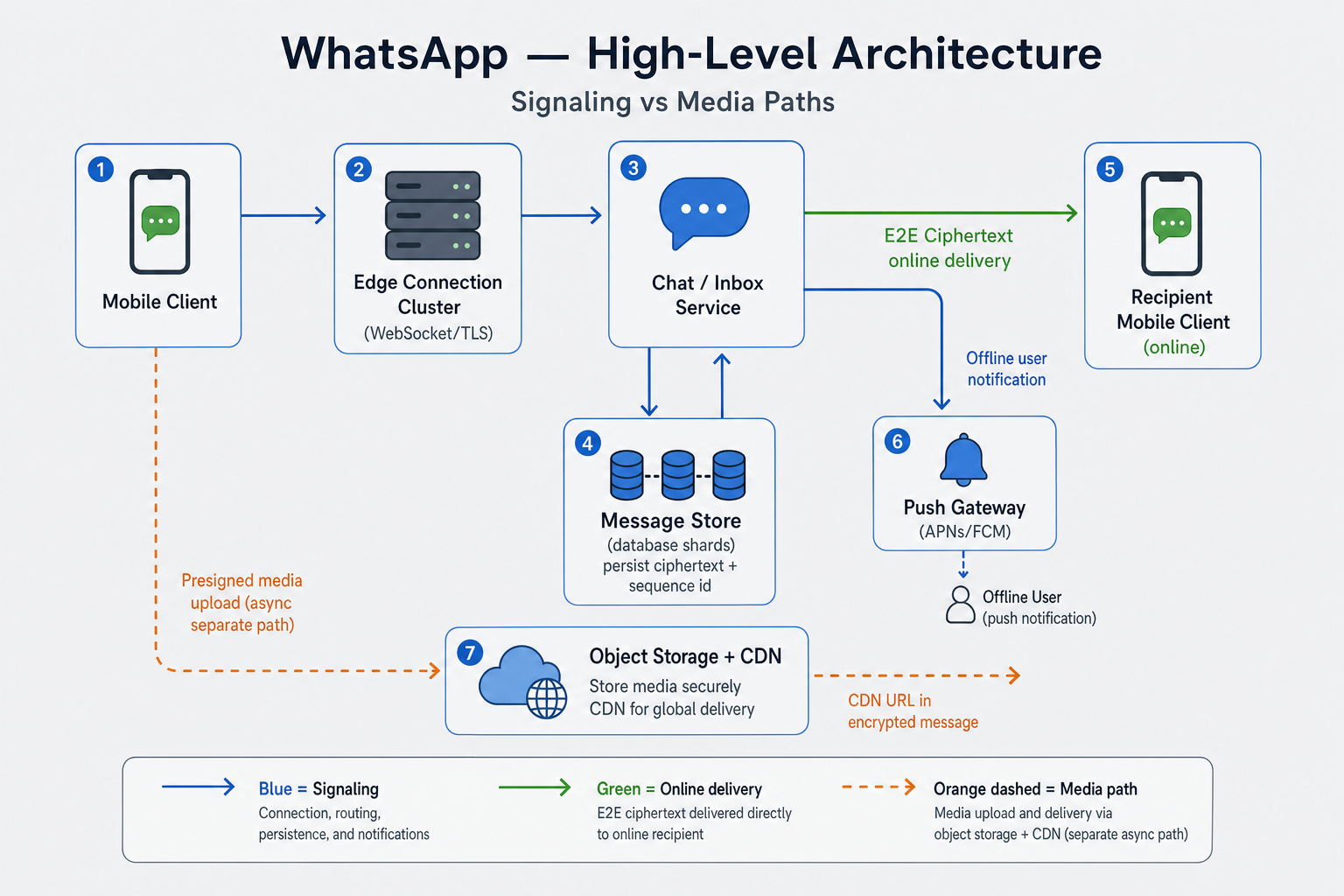
Figure: Fast lane for text (blue), delivery to online users (green), and separate upload path for media (orange). The server only stores scrambled message bytes.
In the interview, three short phrases help you sound precise. Each one answers a follow-up interviewers often ask:
-
Inbox before ack. When
SendMessagesucceeds, you are promising the ciphertext row exists in durable inbox storage—the sender can show one gray tick. Do not describe delivery as "done" only because a push worker queued a job or because Apple accepted a notification. -
Push is a hint, not the message. Under end-to-end encryption, the notification often says only "New message." The phone must open the app (or use a live socket) to fetch and decrypt. Push failure does not mean the message was lost if the inbox row exists.
-
Fast lane vs truck lane. Text, receipts, and presence use the low-latency signaling path. Photos and video upload separately; the chat message body carries a
media_idpointer. Never block checkmarks on a multi-gigabyte upload.
Core design approaches
1:1 messaging
Alice sends one line to Bob. Her phone encrypts, creates a client_msg_id (so retries do not duplicate), and calls SendMessage. The server skips duplicates, assigns seq, saves to Bob’s inbox, then either sends on Bob’s open connection or sends a simple push (“new message”). Bob’s phone decrypts and sends delivered / read when the UI allows.
Order is per chat, not one clock for the whole app.
Group messaging
A group of twelve can copy each message into twelve inboxes and still feel fine. A stadium with fifty thousand people cannot—one "hello" would mean fifty thousand writes unless you change the model.
These models trade write cost against read cost—say your max group size and which you pick above it:
| Model | Plain idea | Good when | Watch out |
|---|---|---|---|
| Copy on send | One database row per member inbox per message | Small groups (family, team chat) | Write cost grows with member count |
| Shared group log | Store once; members fetch with cursor | Large groups, broadcast channels | Read cost; hot partition on viral group |
| Announcement mode | Only admins post; members mostly read | Stadium-scale updates | Different product semantics than free chat |
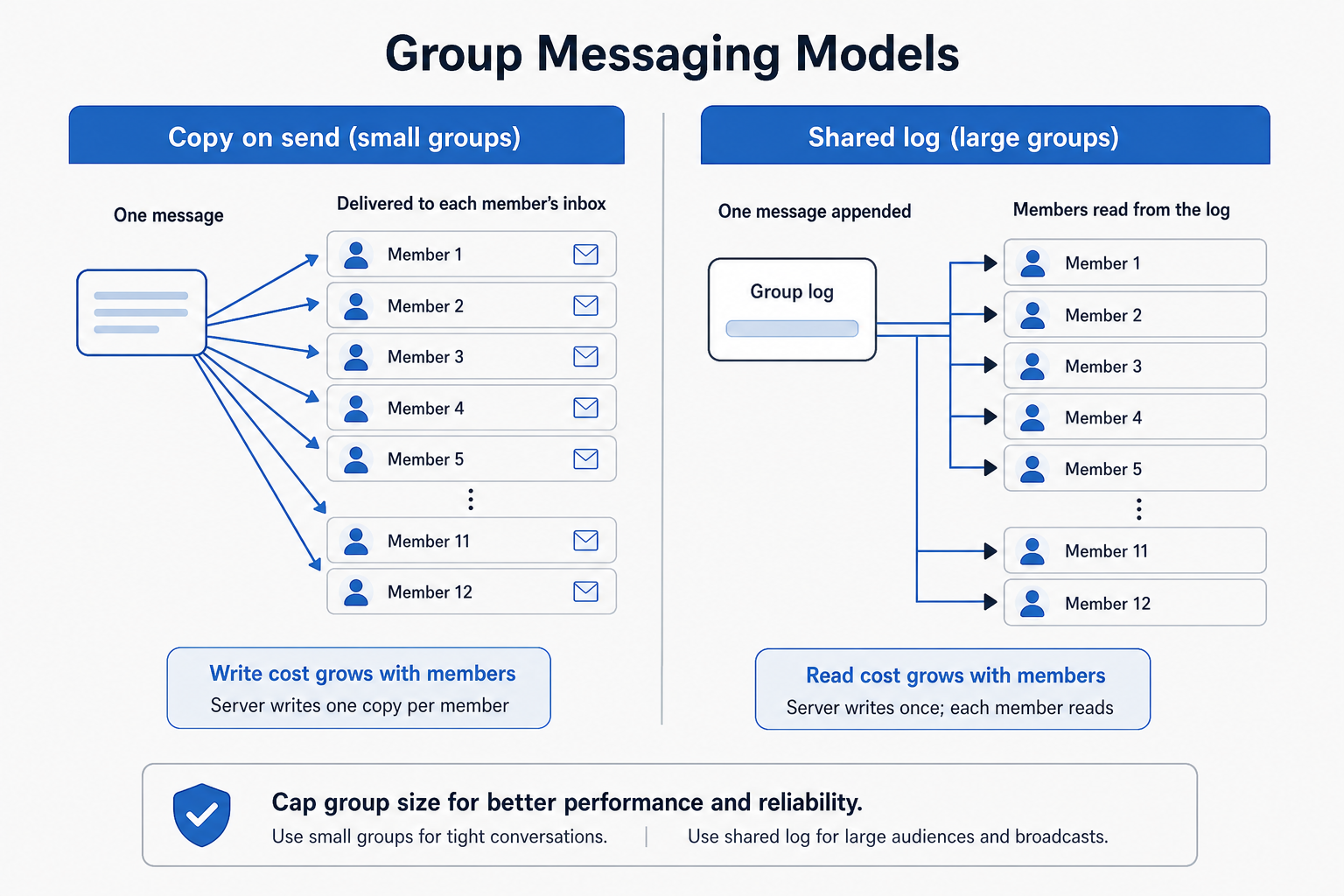
Figure: Group size is not a footnote—it picks your storage model and your hot-partition risk.
Receipts
Delivered (two gray ticks) usually means the server placed the message on the recipient's live connection or in their inbox. Read (two blue ticks) means the recipient's app reported they opened the thread—the server forwards that signal but does not independently know the user read with their eyes.
In a twelve-person family group, per-member read events are fine. In a five-hundred-person group, one read event per member per message explodes write load—throttle, batch, show "read by 42" aggregates, or disable granular receipts. Say which product bar you pick in the interview.
Data model
Think in three stores: the message / inbox plane (hot path), the media plane (pointers only on the fast path), and light presence / device state that must stay cheap.
Messages and inboxes
| Field / concept | Why it exists |
|---|---|
conversation_id | Shard and sequence key for the thread |
msg_id | Server-assigned stable identity returned to the client |
seq | Rising integer per conversation—the order users should render |
client_msg_id | Sender-generated id so retries map to one bubble |
sender_id, recipient / membership | Routing and access checks |
ciphertext + small metadata | Body the server cannot read under E2E; size, media pointer, timestamps |
delivery_state | Sent / delivered / read signals the product surfaces as ticks |
For copy-on-send groups, you materialize (or fan out) rows toward each member inbox. For a shared group log, you store one sequence of messages for the group and keep a cursor / last_seq` per member so each phone knows what to fetch next.
Devices, keys, and push
| Concept | Where it lives | Note |
|---|---|---|
| Device public keys | Key directory / identity service | Used so senders can encrypt for each device |
| Push tokens (APNs/FCM) | Push mapping store | Delete dead tokens; never place plaintext bodies in the map |
| Media blobs | Object storage + CDN | Encrypted client-side when product requires it; chat row holds media_id |
Interview land: Draw conversation_id → (seq, msg_id, client_msg_id, ciphertext) and say which secondary indexes you need for sync-by-cursor—not a giant “messages” table with no key story.
Detailed design
This section follows one ordinary text message from Alice's phone to Bob's phone. The goal is to make the send path understandable before we dig into the retry race, so keep the words tied to what each side experiences: Alice taps send, the server saves a durable row, Bob catches up from the inbox, and the live socket is only the fast way to hear about work that is already safe.
When Alice taps Send, her phone encrypts the message body before it leaves the device. The server receives ciphertext, which means scrambled bytes it can route and store but not read as chat text. Alice's phone also attaches a client_msg_id, a unique id for that one tap. This id matters because mobile networks often lose responses. If the first request succeeds on the server but the phone never hears back, the phone can retry with the same client_msg_id and the server can answer, "I already saved this exact send," instead of creating a second bubble.
The chat service first checks whether (conversation_id, client_msg_id) already exists. If it does, the service returns the same msg_id and seq it created the first time. If it does not, the service creates a stable msg_id for the message and assigns the next seq, a rising number inside that one conversation. The seq is the order the UI should render. It is deliberately not the sender's phone clock, because clocks can be wrong and packets can arrive in a different order from the one the user expects.
After identity and ordering are settled, the service saves the ciphertext and small routing metadata to inbox storage. That save is the delivery promise. If SendMessage returns success before the inbox row is durable, Alice may see a sent tick for a message the system can still lose. Once the row commits, the server can acknowledge Alice and move into notification work: online devices receive a frame on their live connection, while offline devices receive a generic push notification that only says something like "New message." Under true end-to-end encryption, the push provider and the server should not carry the readable body.
Bob's app has two ways to learn about the row. If the app has an open socket, the connection server can deliver the new ciphertext immediately. If the phone is asleep, out of network, or the push never appears because of battery settings or notification permissions, Bob still catches up later by calling SyncMessages(cursor). The cursor is Bob's last known position in the conversation or inbox. The server returns ciphertext rows after that cursor, Bob's phone decrypts them locally, and the UI renders them in seq order.
Receipts follow the same "save the truth, notify as a hint" pattern. A delivered receipt usually means the server placed the message on a device connection or made it available in the inbox. A read receipt is different: Bob's app reports that the thread was opened, and the server forwards that signal according to product rules. In large groups, you should throttle or aggregate those receipts because one read event per person per message can become more expensive than the message itself.
Media uses a separate path. Alice uploads an encrypted photo or video to object storage through a resumable upload, often using a pre-signed URL. Only after the upload has a stable media_id does the chat message reference that media pointer on the fast path. A huge video should not hold the same transaction that assigns a text message seq, and a broken media upload should not block every receipt in the conversation.
In the room (spoken recap): "One send works like this: the client encrypts, reuses a stable client_msg_id on retry, the server dedupes that id, assigns one per-chat seq, saves ciphertext to the inbox before acknowledging, then notifies online devices on sockets or offline devices with generic push. The inbox is the truth; push and sockets are delivery hints. Bob catches up with SyncMessages(cursor) and renders by server seq, not phone timestamp."
Architectural dig
One SendMessage under retries
High-level boxes told you where traffic goes. This dig is how one send stays correct when the elevator kills TCP mid-flight and two phones disagree about “what time it is.”
1) Connection and session ownership
Responsibility: Connection servers own live sockets, heartbeats, and per-user outbound queues. The chat service owns durable order and inbox rows.
Interview land: Sticky routing helps session locality, but durability never lives only in connection-server memory—reconnect must resume from an inbox cursor.
2) Race on retries (bad vs great)
Imagine Alice taps Send in an elevator. The request reaches the server and commits, but the response never returns. Alice’s app times out and sends the same text again.
Bad design: new id every attempt, order by phone clock
Each retry invents a fresh client identity (or none). The server treats each attempt as a new message and sorts bubbles by the phone’s wall clock. Users see two identical bubbles, or a later retry that leaps ahead because clocks are skewed across regions.
Attempt 1: commit message A (wall 12:00:01)
Response lost ↓
Attempt 2: commit message B (wall 12:00:02)  ← duplicate bubble
UI sorts by wall clock → wrong or doubled story
Great design: stable client_msg_id + server seq
The client reuses one client_msg_id for that tap. The server looks up (conversation_id, client_msg_id):
- If found → return the same
msg_idandseq(HTTP 409 or success with identical body—say which). - If not → allocate the next
seq, persist ciphertext, then ack.
Rendering sorts by seq, then msg_id on ties—not by wall clock.
Attempt 1: client_msg_id=X → seq=17 commit → response lost
Attempt 2: client_msg_id=X → same seq=17 returned
UI shows one bubble in seq order
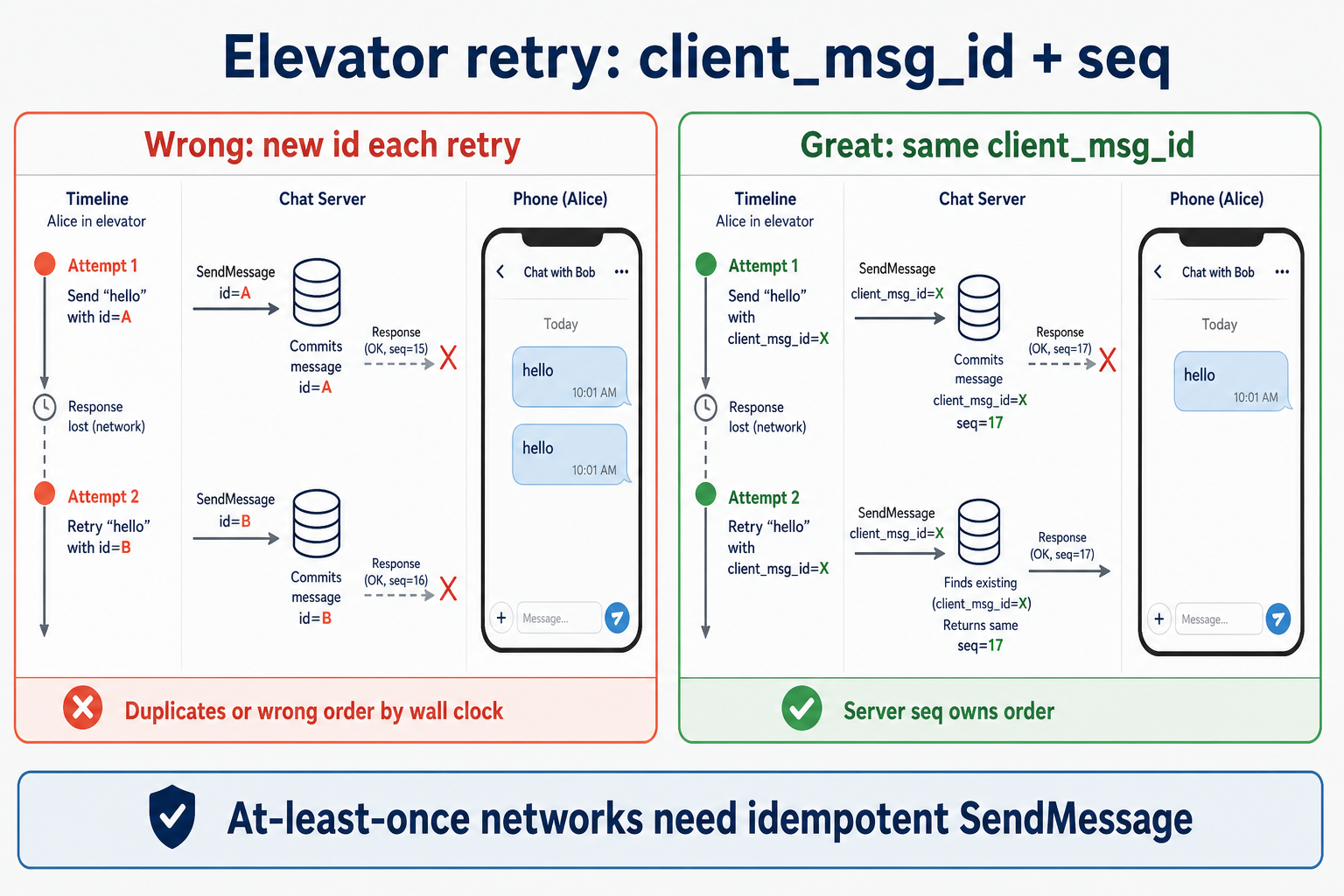
Figure: At-least-once networks need idempotent sends. The server seq—not the phone clock—owns order.
Why this shape: Mobile networks are at-least-once. At-most-once delivery “to keep the design simple” loses messages users care about. Wall clocks fight time zones and NTP skew.
Scale inside the box: Idempotency keys need a TTL or retention window per chat so the lookup table does not grow forever. Sequence allocation for one hot conversation_id is a natural single-writer pipe—correct for UX, a hot partition risk for viral groups.
Failure inside the box: If the commit succeeds but notify fails, the message is still safe in the inbox; reconnect + sync repairs the UI. If you ack before commit, you invent false “sent” ticks and trust collapses.
3) Online notify vs offline push
After commit:
- Look up connection placement for the recipient (and each of their devices).
- If a socket is live and healthy, enqueue ciphertext on that connection (respect queue caps).
- If offline, enqueue a generic push (“New message”) and rely on
SyncMessageslater.
Do not put the decrypted body in the push payload under true E2E.
4) Numbered happy path (put it together)
- Client encrypts →
SendMessage(ciphertext, client_msg_id, conversation_id). - Chat service dedupes on
client_msg_id. - Allocate
msg_id+seq; commit to message store. - Ack sender (one gray tick / “sent”).
- Socket push to online peers or generic push + inbox wait for offline.
- Recipient decrypts; optional
AckDelivered/AckReadaccording to product rules.
If you remember one thing: Success on SendMessage means inbox durable, not “friend’s lock screen already showed the text.”
Key challenges
These are the problems that separate weak diagrams from designs you can defend. For each row, say what the user sees if you get it wrong.
| Challenge | What users see if it goes wrong | What to say in the interview |
|---|---|---|
| Encryption + many devices | "Waiting for message" on one phone while another works | Encrypt for each device; key repair and multi-device sync flow |
| Order on network retry | Duplicate bubbles or wrong order | Sort by seq, then msg_id; dedupe client_msg_id on retry |
| Big groups | Lag, failed sends, phone gets hot | State max size; shared log, announcement mode, or rate limits per group |
| Typing indicators | Sluggish app, battery drain | Throttle; send only when app is in foreground; respect hide last seen |
| Video on bad Wi‑Fi | Stuck on one checkmark while text works | Chunked upload with resume; separate timeout and path from text |
Correct order and durable inbox matter more than which message broker brand you name—and encryption limits what receipts and search can mean on the server.
Scaling the system
Shard inbox storage by chat id (until one chat becomes "celebrity hot") or by user id (each user's inbox partition). Watch traffic per partition—one viral group can concentrate writes on a single shard.
Connection servers scale horizontally by user id or region. Use sticky routing so the same user tends to land on the same box when you need local connection state. Cap outbound queue size per socket so one slow phone does not exhaust server memory. Plan for thundering herd reconnects after deploys with exponential backoff.
Multiple regions may be required for data residency. Strict order across regions is hard—be honest that failover can produce brief inconsistencies; per-chat seq is still authoritative within a region.
Push workers scale separately from chat writes. Respect Apple and Google rate limits; delete dead device tokens so you do not retry forever.
Watch time from database save to first byte on the peer's socket—not only SendMessage HTTP success rate. A high lag there means users see "connecting…" while APIs look green.
Failure handling
| Scenario | What the user sees | What to build |
|---|---|---|
| Connection drops mid-send | "Sending…" spinner on phone | Reconnect with backoff; resend same client_msg_id |
| Video upload stops halfway | Stuck on one gray tick | Resume upload; expire broken partial blobs |
| Push accepted but app closed | Message late until user opens app | Inbox sync on open—normal, not a bug |
| Whole region unavailable | Delay, possible brief order glitch | Fail over; admit cross-region limits honestly |
When in doubt about whether a message was saved, fail closed on ambiguity for the sender—do not show "sent" until the inbox row commits. Users will tap send again; duplicate detection must make that safe.
A real outage is "cannot send at all" or messages disappear. Saving to inbox before ack to the sender prevents loss; slow delivery is a different class of problem.
API design
These are the main calls the mobile app uses (often gRPC or similar over TLS). Walk the hottest path first—SendMessage—before listing every RPC.
Messages
| Endpoint / RPC | Role |
|---|---|
SendMessage | Upload ciphertext + metadata; returns msg_id, seq |
SyncMessages(cursor) | Paginated since cursor |
AckDelivered / AckRead | Receipt pipeline |
Query params (sync):
| Param | Role |
|---|---|
cursor | Opaque last seen position |
limit | Max messages per response (capped server-side) |
conversation_id | Thread scope |
Media
| Step | Role |
|---|---|
POST /v1/media:prepare | Returns pre-signed upload URLs + media_id |
PUT to object storage | Client uploads encrypted blob |
SendMessage references media_id | Pointer only on signaling path |
In simple terms: save the scrambled message to the database, then either push on the live socket or send “new message” to the phone.
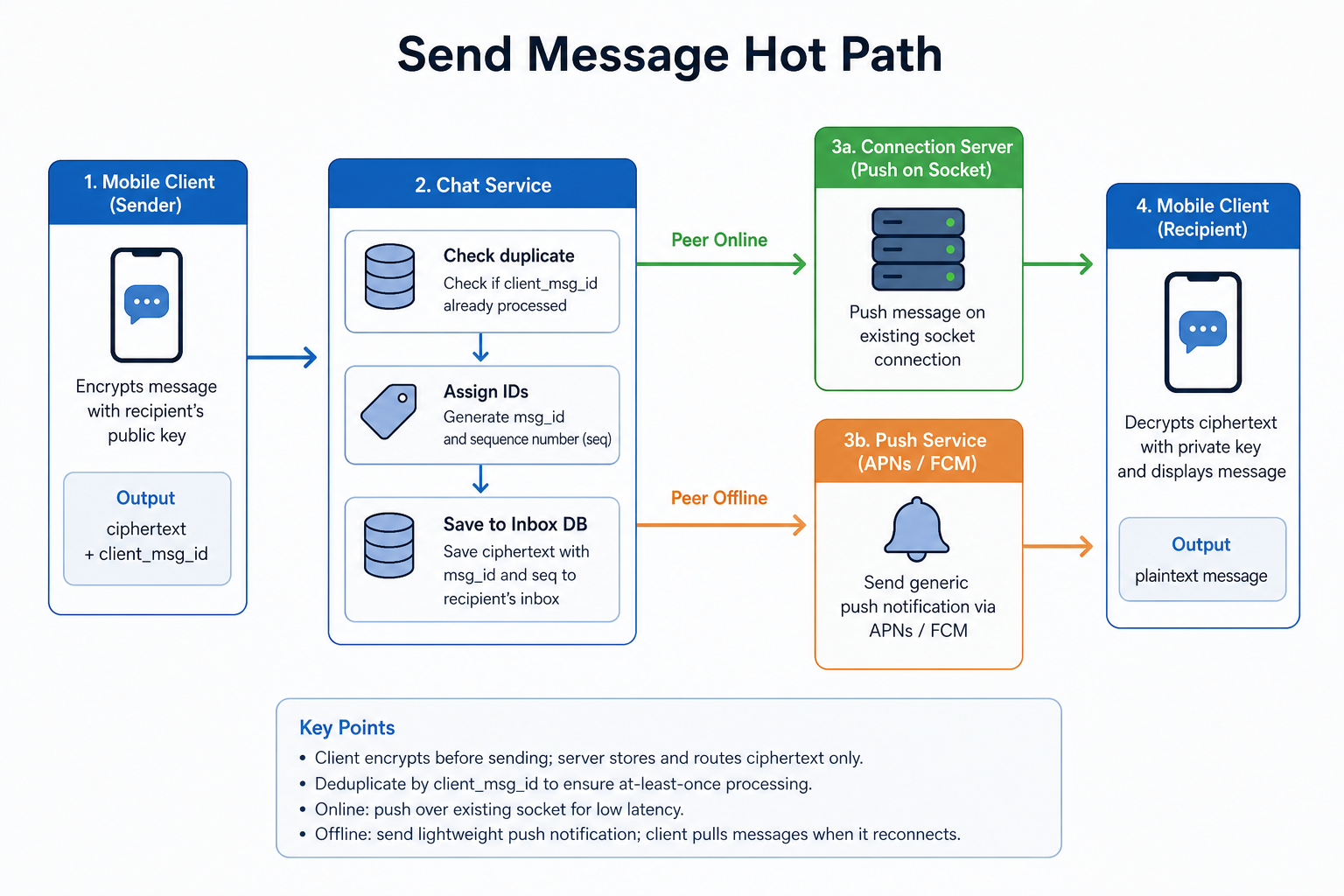
Figure: Commit to inbox before ack; online peers get the socket path, offline peers get a generic push.
Diagram (send hot path):
Client --SendMessage(ciphertext)--> Chat svc --> DB commit
                                        |
                                        +--> if peer online: conn push
                                        +--> if offline: Push "new message"
Errors: 429 too many requests; 413 metadata too large; 409 duplicate client_msg_id → return the same msg_id as the first send so mobile retries stay safe.
The usual flow runs in three steps: SendMessage commits ciphertext to the inbox, online peers receive on the socket, offline peers get generic push and catch up with SyncMessages(cursor) when the app opens.
In the interview, walk SendMessage in order: encrypt on client → dedupe → save inbox → notify. Say aloud that 409 is intentional—"same send twice is OK."
Observability
Green SendMessage HTTP rates alone will lie. Measure the path users feel:
| Signal | Why it matters |
|---|---|
| Inbox commit success / latency | Delivery promise to the sender |
| Save-to-socket p99 | Time until an online peer can decrypt |
| Push accept vs in-app render lag | Separates vendor delivery from UI truth |
Writes per partition / top conversation_id | Catches viral-group hot shards |
| Connection queue depth / disconnect reason | Memory pressure before CPU looks busy |
Dedup hit rate on client_msg_id | Confirms retries are common and working |
Alert when save-to-socket or partition write skew moves, not only when API 5xx jumps.
Security and abuse
Authenticate every send and sync; authorize membership before writing into a conversation. Under E2E, the server never needs plaintext for routing—treat accidental plaintext logging as a privacy incident. Rate-limit SendMessage, OTP, and group create; throttle typing and presence so bots cannot write-storm connection clusters. Abuse pipelines should use metadata, graph signals, and user reports—not “read the chat from the DB.” Multi-device key directories and stolen-session revoke paths matter as much as TLS on the wire. Media upload URLs must be short-lived and scoped so one leaked pre-signed URL cannot empty object storage.
Cost awareness
Every open socket costs memory; every copy-on-send group multiplies storage and write IOPS by member count; every media blob stored forever dominates disk more than text ever will. Choosing shared-log for huge groups trades write cost for more read traffic and hotter partitions. Generic push at billions of users is an invoice line with Apple and Google—delete dead tokens aggressively. Client-side search indexes cost device battery and storage so the server can stay ignorant of plaintext; that trade is intentional, not free. Archive and delete-for-everyone policies are cost features as much as product features.
Production scenes
Textbooks teach boxes and arrows. On-call teaches this: the graph can look fine while users are furious.
SendMessage returning success is not the same as the friend seeing the bubble. Apple marking a push "delivered" is not proof the human read the chat. Interviewers love this gap—it separates diagram-only answers from people who have thought about launch day.
Three nightmares that look "healthy" on a dashboard:
| What the dashboard shows | What is actually happening |
|---|---|
| Chat API success rate and database latency look normal. | Users stare at "connecting…" for seconds because connection servers are saturated or reconnect storms after a deploy. |
| Push provider reports delivered to Apple or Google. | The user saw no banner—Do Not Disturb, battery saver, or stale token—and the message waited in the inbox until they opened the app. |
| Global QPS and CPU are flat on chat workers. | One viral group hammers a single database partition; sequence allocation and typing indicators make the hot shard worse. |
Track the whole path—inbox commit → fan-out → socket or push → decrypted UI—not one green metric in the middle.
Scene 1: APIs green, chat feels slow
The moment: Evening peak. Users complain messages take forever to show one checkmark, then two. Status dashboards show healthy API latency.
The trap: Long-lived sockets fail differently than one-off HTTP. Teams alert on 5xx on REST but not on time from inbox save to first byte on the peer's connection. TLS handshakes, GC pauses, and reconnect herds after deploys hurt chat without moving the "API success" graph.
What to build:
- Measure save-to-socket latency end to end—not only
SendMessage200. - Load-test connection pools before peak; rehearse deploy with reconnect backoff so clients do not amplify an outage.
- Remember: queue lag zero does not mean the user saw the message on screen.
Scene 2: Push delivered, user saw nothing
The moment: Support tickets say "I never got notified." Vendor dashboards show pushes delivered.
The trap: Push only tries to wake the app. Under E2E, the server often cannot put message text in the banner. "Delivered to Apple" is not "user read the thread" and not even "app decrypted and rendered."
What to build:
- Treat push as help, not proof of human attention.
- Drive unread state from synced inbox rows on the device.
- Measure push failures separately from in-app rendering bugs.
Scene 3: One viral group melts one shard
The moment: Live event channel. Messages fail or lag. One conversation_id drives hundreds of writes per second.
The trap: Sharding by chat id works until one chat becomes enormous. Per-chat order requires a single logical sequence pipe—correct for UX, a hot partition at scale. Typing indicators multiply writes.
What to build:
- Rate-limit messages per group; use announcement mode for broadcast-scale channels.
- Cap group size or move stadium traffic to a different product surface.
- Chart writes per partition, not only global message QPS.
Scene 4: CPU calm, memory spikes, random disconnects
The moment: Connection servers disconnect healthy-looking clients. Memory climbs while CPU looks bored.
The trap: Each socket has an outbound queue. A phone on slow Wi‑Fi or in the background reads slowly; frames pile up until the server must shed load.
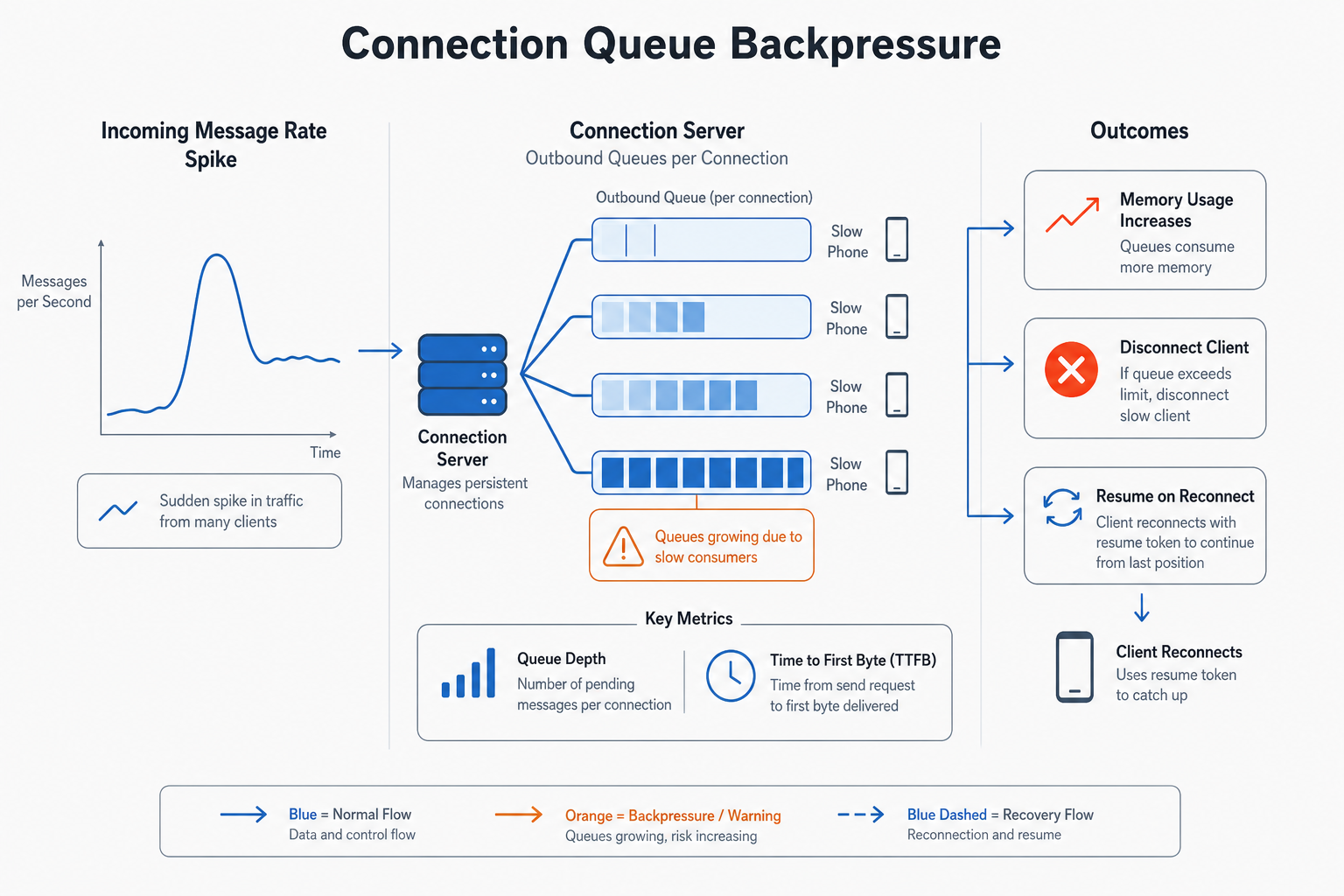
Figure: A flat CPU graph can hide per-connection queues eating memory.
What to build:
- Cap queue depth per connection; merge repeated typing events.
- Disconnect gracefully with a resume cursor so clients do not replay full history blindly.
- Alert on queue depth and time from save to first byte sent.
In the interview: Pick one scene. Tell it like a short story—what users felt, what metric lied, what you would ship next. End with: you do not need global order—one rising seq per chat is enough, and say why.
Bottlenecks and tradeoffs
Encryption vs search and moderation
The tension: Users want private chats; the product also wants search, abuse detection, and support tooling.
What "fair" can mean for privacy:
- True E2E — server stores ciphertext only; search and moderation use metadata, reports, or client-side indexes.
- Metadata search — who talked to whom, when, message size—never the body.
- Product honesty — name what you give up on the server; do not pretend support can "just read the chat."
What to build: Client-side search index after decrypt, or limited server tools on metadata. Abuse pipelines on rate, graph, and user reports—not logging plaintext "for debugging."
In the interview: Say explicitly what the server cannot do if chat is E2E. Weak answers claim "we'll index messages for support."
Same order on every device vs speed and cost
The tension: Users expect the same thread on phone, tablet, and web; perfect instant sync everywhere costs extra round trips.
What breaks: Brief moments where two devices show slightly different order until SyncMessages catches up.
What to build: Many products accept good enough order that converges in seconds; stricter linearizability costs latency and engineering.
In the interview: Pick a bar—"good enough for chat" vs "strict same order everywhere"—and justify it with seq and sync cadence.
Small groups vs stadium groups
The tension: Copy-on-send feels simple for family chats; at stadium scale, writes explode.
What breaks: One viral group overloads one database partition.
What to build: State max group size; switch to shared log + cursor or announcement mode above that limit.
In the interview: Group size is not a footnote—it picks write amplification vs read amplification. Name your cap and model aloud.
Interview tips
You have the full design in mind now. These five back-and-forths are how interviewers test whether you can defend it under pressure. Each one starts with a tempting shortcut, an interview push, and a clear answer.
Two phones show different order — wall clocks are not the source of truth
You might say: "Messages are ordered by timestamp."
Interview Push: "Alice in London and Bob in Tokyo both send at 'the same second' on bad clocks—what order do users see?"
Land here: The server assigns a rising seq per chat, not per planet. If two messages tie, break ties with msg_id. Never sort by the phone's wall clock—clocks disagree, networks reorder packets, and a later retry can look “earlier” on a skewed device clock. When two devices briefly diverge after reconnect, SyncMessages(cursor) converges them onto the same seq order. Global total order across every chat on earth is not the goal; per-conversation order is.
The elevator retry — at-most-once loses messages users care about
You might say: "At-most-once delivery is simpler—we won't duplicate."
Interview Push: "User taps send in an elevator, TCP retries, they tap send again—do you drop one copy or show two bubbles?"
Land here: Mobile networks are at-least-once. Dropping the second attempt to “avoid duplicates” can lose the only successful commit when the first response never returned. Keep a stable client_msg_id for that tap; the server returns the same msg_id and seq when the same id arrives again. The UI shows one bubble; order stays tied to seq, not to how many times the phone retried. If you remember one picture from the dig, it is the elevator: response lost → same id → same seq.
Push carries the message — encryption says otherwise
You might say: "Push notification delivers the chat text."
Interview Push: "If messages are end-to-end encrypted, what appears on the lock screen?"
Land here: Usually only "New message"—not the body. The durable row lives in the inbox; the app fetches and decrypts after open (or over the live socket). Push is a wake-up call. Apple or Google accepting a notification is not proof the human saw the thread, and it is not how ciphertext becomes readable.
We log message text for support — that breaks E2E
You might say: "We log full message content so engineers can debug faster."
Interview Push: "What can the server legally and technically know if chat is truly E2E?"
Land here: The server moves ciphertext and metadata (sender, size, time)—not readable text. For abuse: rate limits, who-sent-to-whom, user reports. Do not claim support can open a thread from the database. If you need structured debugging, store reason codes on delivery failures—not chat bodies. Saying “we’ll add searchable plaintext later” quietly undoes the privacy promise you opened with.
Typing updates to everyone — write storms at billion-user scale
You might say: "We broadcast typing to all contacts in real time."
Interview Push: "A billion daily users open keyboards—what happens to your write load?"
Land here: Throttle typing and presence; send only when the app is foreground. Batch or sample updates; merge repeated “typing…” events on the connection server so memory does not grow forever. Respect hide last seen. Presence is optional polish—not on the same urgency path as SendMessage. If you put typing on the durable inbox path at full fidelity, you invent a second product’s worth of writes without improving chat reliability.
Red flags to avoid without correcting yourself: “Order by phone timestamp,” “push is the message,” “log plaintext for support,” “copy every send into fifty thousand inboxes,” “at-most-once so we never dedupe.”
After each interview push, close with one real part of the design you would build—seq, client_msg_id, inbox sync, ciphertext storage, or throttled presence—not "we'll scale it later."
What should stick
After reading this guide, you should be able to explain:
- Two paths — Fast lane for text and control; truck lane for photos and video on object storage + CDN.
- Inbox before push — Durable server inbox is the delivery promise; push only tries to wake the app.
- Per-chat seq + client_msg_id — Server numbers beat phone clocks; duplicate IDs make retries safe.
- Groups pick the model — Copy-on-send for small groups; shared log + cursor or caps for large ones.
- Ops beyond HTTP 200 — Track socket delivery latency, hot partitions, and per-connection queue depth.
Tell it in the room: "I split text and media. One send: encrypt, dedupe with client_msg_id, save to inbox with seq, notify online peer on the socket or offline peer with generic push. Groups: I state max size and pick copy-on-send or shared log. E2E means ciphertext only on the server—push cannot quote the message."
Related Topics
- Notification Service System Design - Push delivery, device tokens, and why “delivered to Apple” is not “user read”
- Facebook Feed System Design - Contrast read fan-out and ranking with per-thread chat order
- Distributed Cache System Design - Presence maps and hot key patterns for online-user routing
- Message Queues - Where async workers fit after the inbox commit (not always on every text send)
- WebSockets and Real-Time - Long-lived connections, heartbeats, and reconnect storms
Frequently asked follow-ups
- How does end-to-end encryption work with server routing?
- How do you order messages across bad clocks and retries?
- How do large groups fan out without overloading storage?
- How do offline users catch up?
- How is this different from designing a social feed?
Deep-dive questions and strong answer outlines
Walk through sending one text message in a 1:1 chat.
I would start by asking encryption depth and group size limits. For one text: Alice's phone encrypts the body, generates a unique client_msg_id, and calls SendMessage with ciphertext and metadata. The server checks whether this client_msg_id already exists for the chat—if yes, return the same msg_id (idempotent retry). Otherwise assign msg_id and rising seq for that chat, persist ciphertext to Bob's inbox, then notify: if Bob has an open socket, push on the connection; if offline, save first and send a generic push ("new message") that cannot include plaintext under E2E. Bob's phone decrypts and sends delivered/read acks when the UI allows.
How do read receipts scale in large groups?
Delivered means the server handed the message to the recipient's connection or inbox. Read (two blue ticks) means the recipient's app reported they opened the thread—that is client-reported, and encryption limits what the server can infer. In a twelve-person family group, per-member read events are fine. In a five-hundred-person group, one read event per member per message explodes write load—throttle, batch, show "read by 42" aggregates, or disable granular receipts. Say which product bar you pick.
How would you design a five-hundred-member group?
Copy-on-send—writing one row per member per message—works for small groups but fails at stadium scale. For hundreds of members I would store messages once in a shared group log and have each member read with a cursor (last seen seq). Cap group size or use announcement mode (only admins post) for broadcast-like traffic. Rate-limit messages per group and chart traffic per database partition so one viral group cannot hot-spot a shard.
What can the server do if chat is end-to-end encrypted?
The server routes ciphertext and metadata (sender, recipient, timestamp, size)—not readable message text. Push notifications are usually generic. Keys stay on devices; the server may store public keys per device for setup. Abuse handling uses rate limits, reports, and metadata—not reading chats from the database. Search on the server is limited unless the phone builds a client-side index.
How do offline users receive messages?
The message is durable in the inbox on the server before the sender gets acknowledgment—that is the delivery promise. Push tries to wake the app but may fail (Do Not Disturb, dead token, battery saver). When the user opens the app, SyncMessages(cursor) pages through everything after their last cursor until caught up. Push means "please open the app," not "the human definitely read it."
How is messaging different from designing a news feed?
Feeds optimize read fan-out and ranking; chat optimizes per-thread order, low-latency delivery, and strong privacy. Feeds tolerate seconds of delay; chat users notice hundreds of milliseconds. Feeds often store plaintext for ranking; E2E chat stores ciphertext and uses per-chat seq, not a global timeline score. Connection servers and inbox sync matter more than a pull-based feed API.
AI feedback on your design
After a practice session, InterviewCrafted summarizes strengths, gaps, and interviewer-style expectations—similar to a written debrief. See a static example report, then practice this problem to get feedback on your own answer.
FAQs
Q: Do I need to explain Double Ratchet cryptography in detail?
A: Usually no unless the interviewer pushes. At system-design depth, say phones establish keys, messages are encrypted on the client, and the server sees only ciphertext. If they want more, name forward secrecy (old keys cannot decrypt future messages after compromise) and multi-device key distribution—then return to inbox, seq, and fan-out. Do not spend twenty minutes on crypto math while ignoring ordering and offline sync.
Q: Should Kafka sit on the hot send path?
A: Many production chat systems use custom inbox storage plus long-lived sockets for sub-100ms signaling—not a heavy queue on every send. Queues still help for async work: push delivery, abuse scoring on metadata, analytics, and media processing. In the interview, say: commit to inbox first, notify online peers synchronously or near-sync, offload everything else async. Pick Kafka if they ask about cross-service decoupling, not as the default answer for every text message.
Q: How does phone-number signup fit the architecture?
A: Signup is a separate identity path: verify SMS or voice OTP, create user id, register device tokens for push, upload initial public keys. It is not on the hot message path. Mention it in one sentence unless they ask about fraud (rate-limit OTP, detect SIM swap abuse). The messaging design stands on inbox, connections, and encryption—not on how the account was created.
Q: How do you scale connection servers to billions of users?
A: Shard connection servers by user id or region. Use sticky routing so the same user tends to land on the same box for stateful features. Cap outbound queue size per socket so one slow phone does not exhaust server memory. Plan for thundering herd reconnects after deploys with backoff. Measure open sockets, queue depth, and time from DB save to first byte on the wire—not only HTTP API success rate.
Q: Can the server search encrypted messages?
A: Not the message body if chat is truly end-to-end encrypted. Search happens on the phone (client-side index built after decrypt) or you accept limited server-side search on metadata only. Moderation relies on user reports, rate limits, and who-sent-to-whom graphs—not reading every chat from logs. Name this tradeoff explicitly; pretending the server can "just index messages" fails the privacy question.
Q: What is the difference between delivered and read?
A: Delivered (two gray ticks) usually means the server successfully placed the message on the recipient's connection or in their inbox. Read (blue ticks) means the recipient's app reported they viewed the thread—the server forwards that signal but does not independently know the user read with their eyes. Under E2E, notification text cannot quote the message. In interviews, separate server delivery from human attention and from push notification accepted by Apple/Google.
Practice interactively
Open the practice session to use the canvas and stages, then review AI feedback.