System design interview guide
Distributed Cache System Design
A flash sale starts and one product id owns a single Redis shard—CPU looks fine while the database melts. The interview is consistent hashing, eviction, replication lag, and cache-aside invalidation, not memorizing RDB flags or opcode trivia.
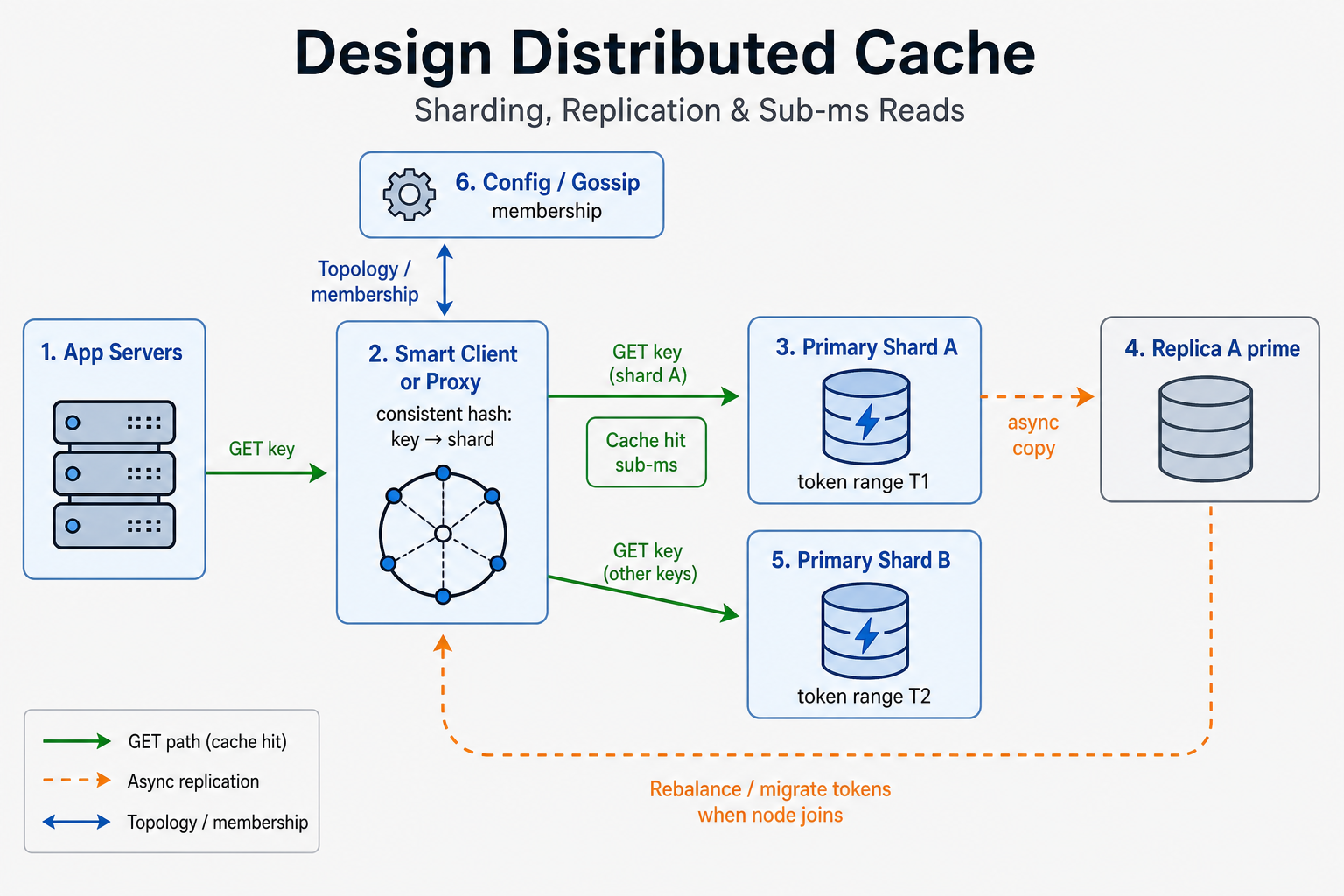
Problem statement
Design a distributed in-memory cache that partitions keys across nodes, replicates for availability, evicts under memory pressure, and survives node failure—while keeping the database as source of truth and surviving hot keys, rebalance events, and miss storms.
Introduction
A flash sale starts. One product id is in every cart. Your cache cluster shows healthy CPU—but the database catches fire and checkout fails for everyone.
That is the product failure this interview is about: a green cache dashboard next to a melting database. The first story you owe is simple—read looks in a fast copy, and on a miss loads the database once; write updates the database, then deletes that copy so the next read does not serve yesterday’s value. Routing tricks (which machine owns a key, what moves when a node joins) come after that contract is clear.
Weak answers say “we add Redis.” Strong answers walk one GET (hit or miss) and one database write that clears the cached copy, then plan for one viral key or many clients missing at once—before they recite store brands.
The line that saves you: The cache is not the source of truth. The database is. The cache protects the database only if miss and update behavior are designed—not just hit ratio on a dashboard.
If you remember one thing: A green cache graph can coexist with a melting database when hot keys, rebalance, or herd on expiry are ignored.
If this is your first time, go to Board path below—come back to this intro after one mock.
Board path (first read, ~10 min)
Start here if you have never designed a distributed cache. Finish this section, then stop and try a short mock. Hash rings, virtual nodes, replica routing, and eviction flags live in After one mock.
What problem are we solving?
Apps want a fast copy of data so the database is not hit on every scroll. During a sale, one product key can still melt the database if every miss or every expiry stamps it at once—or if a write leaves a stale copy in cache.
You are designing: where does a read look, what happens on miss, and what happens to the cached copy after the database changes.
What to write on the board (start simple)
- Source of truth — Database wins. Cache is a speed layer that can disappear.
- Read (GET) — Look up the key → hit return it → miss load DB once, store a copy with a time limit, return it.
- Write — Commit the database first, then delete (or version-bump) the cached copy so the next read reloads fresh data.
- Many servers — Keys live on different machines; say “route by key” without drawing a ring yet.
- What can go wrong — One hot key, or many clients missing the same key at once, can still burn the database.
That’s the first board. Hash ring and virtual nodes come after this mock.
Clarifying questions (say these in the room)
You: “Is the cache just a fast layer in front of the database that can be empty after a restart, or must the cache cluster itself survive restarts?”
Interviewer: “Ephemeral is fine—database is source of truth.”
That answer lets you park persistence digressions and focus on read-miss and delete-on-write.
You: “After someone saves a profile, can reads be slightly stale for a moment, or must the next read always see the new value?”
Interviewer: “Mostly eventual; profile name after save should not flip-flop if you can help it.”
Checkpoint: Write “DB write → delete cache key” (or bump a version inside the value). That is invalidation—clearing the fast copy so it cannot disagree with the database for long.
You: “Is this mostly reads with occasional writes?”
Interviewer: “Read-heavy; load on miss is the common path.”
So you lazy-load on miss and delete on update—not “write the cache and DB together every time” unless they push.
You: “How skewed is access—uniform keys, or one product id during a sale?”
Interviewer: “Very skewed—call out hot keys.”
You must plan beyond “add more machines,” because one viral key still lands on one owner.
You: “I want to leave CDN edge caching, arbitrary SQL result caches, and multi-region active-active cache writes out of scope so we can focus on app key-value caching. Does that match?”
Interviewer: “Yes—focus on the distributed cache layer.”
What you can say out loud (next to the board)
- Truth: “Database is source of truth. Cache is acceleration that can be empty.”
- Read: “GET: hit returns the copy; miss loads the DB once, stores with a time limit, returns.”
- Write: “Commit DB, then delete the cached copy so we don’t serve stale data.”
- Risk: “I’d call out one hot key and many clients missing the same key at once—those still burn the DB.”
First-pass: what should stick
- Hit / miss / delete — Read path and write-clears-copy before tooling names.
- DB is truth — Cache protects the DB only if miss and invalidation are honest.
- Hot key and miss stampede — Green cluster CPU can still melt the database.
End of first pass
⏸ End of first pass — stop scrolling.
Practice clarifying questions and this board now. Do not continue into hash rings, virtual nodes, or capacity until you’ve done a short requirements mock.
Ready for depth? Only then open After one mock.
After one mock
Return to Board path if this is your first read.
Everything below is for after one mock—or when the interviewer pushes on consistent hashing, virtual nodes, replicas, hot keys, and production failure modes.
How to approach
Clarifying questions for the requirements stage live in the Board path. After that mock, deepen with capacity, hash routing, and one GET on miss plus one database update with invalidation before you name eviction flags.
Minute pacing (about 40 minutes)
| Minutes | Focus |
|---|---|
| 0–5 | Clarify ephemeral vs durable, consistency bar, read/write pattern, hot keys, out of scope |
| 5–12 | Capacity + high-level architecture + hash routing story |
| 12–25 | Cache patterns + data model + architectural dig (GET miss + invalidation) |
| 25–35 | Hot keys, failure, replication lag, observability |
| 35–40 | One production scene + tradeoffs + questions |
If this is your first distributed-cache design, spend minutes 0–12 only on the Board path. Hash rings and virtual nodes wait until after one mock.
In the room (say-aloud lines — fuller depth after Board path):
- “Cache is ephemeral acceleration; the database stays source of truth.”
- “Reads: GET from the owning shard; on miss load DB once, SET with TTL.”
- “Writes: commit DB, then DELETE (or version-bump) affected keys.”
- “I’d park ring detail until after the GET/miss and invalidation stories—then call out hot keys and miss stampedes.”
If you remember one thing: Tell one GET miss story and one invalidation story before you recite LRU versus LFU.
Out of scope (and why you park these)
Write a short out-of-scope list on the board so the interviewer sees you can bound the problem.
CDN and browser caching. Edge caches static assets and some API responses at the network edge. They matter for global latency but do not replace an application-tier distributed cache for mutable session and catalog state. Acknowledge them; design the in-memory cluster the app servers talk to.
Caching arbitrary SQL query results. Query-result caches tie invalidation to table changes and are fragile at scale. The interview usually wants entity key-value caching (user profile, product row) with explicit invalidation on write.
Active-active multi-region cache with conflicting writes. Two regions accepting writes to the same key without coordination creates merge conflicts. Most designs use read replicas per region with async replication and stale SLAs, or route writes to one region—unless the interviewer explicitly expands scope.
Full transactional cache covering cross-shard ACID. A cache is not a database. Cross-key transactions on a sharded cache are out of scope for a typical round; per-key atomic ops (INCR, CAS) on one primary are enough.
Capacity estimation
Rough numbers anchor the whiteboard (tune in the room):
| Topic | Anchor | Implication |
|---|---|---|
| Working set | ~100 GB aggregate (illustrative) | Eviction pressure; hot versus cold key skew |
| Aggregate QPS | ~10M ops/s | Per-node ceiling; connection limits; pipelining |
| Distinct keys | ~100M | Memory per key × metadata; hash slot spread |
| Average value size | ~1 KB | Network bandwidth; large values need compression or chunking |
| Hot keys | Top 0.01% of keys | One logical key can saturate one shard—replicas, L2, split key |
Worked skew sketch: Ten million operations per second sounds evenly spread only on paper. If one product id during a flash sale absorbs even one percent of read traffic, that is on the order of 100,000 ops/s on one logical key—one primary thread, one NIC, one hash slot. Adding nodes does not split one key unless you replicate or shard the key itself.
Implications:
- You shard to spread RAM and CPU across machines—but hot keys are a logical problem, not solved by fleet size alone.
- Eviction must be explicit when working set exceeds RAM; otherwise miss rate climbs and the database becomes the cache.
- Connection counts from thousands of app servers matter; smart clients or proxies pool connections to shards.
If you remember one thing: Capacity math exists to expose skew—averages lie when one key owns the sale.
High-level architecture
Clients either embed a smart client (knows the hash ring and token ownership) or talk to a proxy (stateless routing layer). The cluster exposes a logical keyspace partitioned into slots or token ranges on a ring; each range is owned by a primary with one or more replicas. A configuration service or gossip protocol publishes membership and epoch. Persistence (RDB snapshots, AOF logs) is optional and usually off the critical read path—the database remains truth.
Who owns what:
- Routing layer (client library or proxy) — Hash(key) → token → node; handles MOVED/ASK-style redirects when topology changes (Redis Cluster pattern).
- Shard primary — Serializes writes per key; serves reads or delegates to replica depending on consistency mode; enforces memory limit and eviction.
- Replicas — Async copy from primary; promoted on failover after health checks and epoch bump.
- Control plane — Add/remove nodes, rebalance throttles, placement across racks/AZs, hot key alerts.
[ App servers ]
       |
       |  GET / SET / DEL (sync, sub-ms target on hit)
       v
[ Smart client or Proxy ]  ----membership----► [ Config / gossip ]
       |
       |  consistent hash: key → token → primary
       v
+------------------+     async replication    +------------------+
| Primary A        | ----------------------► | Replica A'         |
| (token range T1) |                         | (read optional)  |
+------------------+                         +------------------+
+------------------+                         +------------------+
| Primary B        | ----------------------► | Replica B'       |
| (token range T2) |                         |                  |
+------------------+                         +------------------+

  Rebalance (background): new node C → migrate token ranges → throttle → HANDOFF
In the room: Walk one GET: hash key → route to primary → memory lookup → hit or miss. Then one failover: primary dead → replica promoted → clients refresh ring. Mention that rebalance is async and throttled—not instant free capacity.
If you remember one thing: GET is hash → primary (or replica with stale rules); rebalance is an ops event with migration protocol, not a magic scale button.
Core design approaches
These patterns answer who loads on miss and who updates on write. Most read-heavy interviews land on cache-aside; know the others to compare when the interviewer pushes on consistency.
Cache-aside (lazy loading)
The application checks the cache first. On miss, it loads the database, then SETs the cache with a TTL. On database update, the app commits the write, then DELETEs cache keys (or bumps a version in the value). Simple and common; invalidation is the app’s job.
When to pick: Read-heavy workloads where slightly stale data is OK between TTL and invalidation, and the database is clearly source of truth.
Read-through
The cache module itself loads the database on miss—the application only talks to the cache API. Invalidation can still be triggered by the app or change-data-capture on write.
When to pick: You want a uniform cache API and central miss handling; teams accept more logic inside the cache layer or sidecar.
Write-through
Writes go to cache and database together before ack. Reads always see what was written through the cache path.
When to pick: Stale reads after write are unacceptable and you accept higher write latency. Less common at huge scale than cache-aside plus delete-on-write.
Write-behind (write-back)
Writes ack after cache update; flush to database asynchronously. Fast writes; loss risk if the cache dies before persist—rare for generic cache interviews unless explicitly scoped.
When to pick: Write-heavy buffering where loss window is product-tolerated—say the durability tradeoff out loud.
| Pattern | Who loads on miss | Invalidation / write | Consistency | Typical latency |
|---|---|---|---|---|
| Cache-aside | Application | App DELETE after DB commit | Eventual + TTL | Fast reads; app owns races |
| Read-through | Cache layer | Cache or app on DB change | Eventual | Uniform API |
| Write-through | N/A (write path) | Sync to DB on every write | Stronger | Slower writes |
| Write-behind | Cache | Async DB flush | Weakest durability | Fastest writes |
If you remember one thing: Cache-aside means the app owns invalidation; the database is truth—never pretend the cache alone is authoritative.
Data model
Think in three layers: how keys map to shards, what lives in each slot, and how the cluster knows who owns what.
Key → slot / token (routing)
| Concept | Purpose |
|---|---|
Logical key (user:42:profile) | What the application GET/SETs |
| Hash(key) → token on ring | Stable mapping to a token range |
| Token range → primary node | Ownership for reads and writes |
| Virtual nodes (vnodes) | Many tokens per physical machine so load stays even when node count is small |
Clients compute hash(key) → token → owner locally (smart client) or ask a proxy. During rebalance, a key may temporarily redirect (MOVED/ASK) until migration completes.
Value + TTL + version (payload)
| Field | Role |
|---|---|
| Value bytes (JSON, protobuf, string) | Cached representation of database row or computed object |
| TTL (seconds) | Automatic expiry; safety net when invalidation misses a key |
Version or updated_at (optional) | Detect stale writes on SET; compare on read after DB update |
| Flags (compressed, null marker) | Operational metadata |
Interview land: On database update, prefer DELETE or version bump over blind SET of old data—ordering races can repopulate stale values if a slow read finishes after your write.
Membership (cluster topology)
| Store | Contents |
|---|---|
| Ring config | Node id → token ranges; epoch generation |
| Health state | Primary/replica role, last heartbeat |
| Migration map | Keys mid-handoff from old owner to new owner |
Gossip or a small config service pushes updates; clients cache topology with TTL and refresh on redirect storms.
If you remember one thing: Draw key → token → primary separately from value + TTL—routing and payload are different failure domains.
Detailed design
Think of two everyday moments: an app reads a product page while the flash sale is hot, and later ops changes that product’s price in the database. The cache only helps if both paths are intentional.
Read path (cache-aside)
The application asks for a key—say a product cache entry. A smart client (or proxy) hashes that key and sends the GET to the machine that owns that slice of the keyspace. If the value is in memory, the call returns in well under a millisecond on a healthy cluster. That is the happy path.
If the key is missing or expired, you are looking at a cache miss, which is not the same as “the cache is broken.” The application then loads from the database (source of truth), writes the result back into the cache with a TTL, and returns it to the user. The dangerous part is when thousands of concurrent requests miss the same viral key at once: without coordination each one hits the database, which is how a healthy-looking cache still melts Postgres. The fix is singleflight (one loader per key; others wait or retry GET), plus TTL jitter so expiry times do not align like a marching band.
Batch helpers such as MGET reduce round trips when you need many keys. Keep miss and error separate in metrics: a timeout should not automatically become “load the database forever” unless you have a deliberate fallback policy and time limits.
Write path (database update, then invalidate)
When someone updates the database row, commit that write first. After the commit succeeds, delete (or version-bump) the cache keys that were derived from that row. Deleting after commit is safer than updating the cache before the database is sure. Some teams also put a version number inside both the database row and the cached value so a slow reader that filled cache with old data cannot overwrite a newer version forever.
Name a race in the room: Thread A misses and starts a slow database read of the old price. Thread B updates the price and deletes the cache key. Thread A then SETs the old price back into the cache. Short TTLs, version checks on SET, and correct delete-after-commit ordering shrink that window.
Atomic operations and memory pressure
Operations like increment or compare-and-set work well when one primary owns the key. They are a poor place to invent cross-shard transactions—push that work to the database if you need multi-key atomicity. When RAM fills up, the cache evicts keys under its policy (often LRU-style) even if their TTL has not expired yet. Rising eviction counts with a flat hit ratio usually means the working set no longer fits; adding nodes without fixing hot keys will not save you.
In the room (spoken): “Reads are cache-aside with singleflight on miss. Writes commit to the database, then delete cache keys. I treat the cache as ephemeral acceleration—not the system of record.”
Architectural dig: one GET on miss and one database invalidation
High-level boxes showed ownership. This dig is what happens inside the cluster when traffic spikes—where naive hashing and naive miss handling fail.
1) GET on miss (cache-aside)
Responsibility: Primary owns in-memory value for keys in its token range. Application owns refill logic and thundering herd control.
Numbered path:
- Client hashes
product:9001→ primary P. - P returns miss (key absent or expired).
- App singleflight ensures one goroutine/thread loads the database.
- Loader reads row from DB, SET product:9001 with TTL on P.
- Concurrent waiters retry GET and hit.
What breaks first: Step 3 skipped—10,000 concurrent misses after TTL expiry → 10,000 identical database queries (thundering herd). Mitigate with singleflight, TTL jitter, stale-while-revalidate.
Interview land: “Miss path is one coalesced database read per key per expiry window—not one per waiting request.”
2) Database update → invalidation
Responsibility: Database is source of truth. Cache must not serve stale product price after commit.
Numbered path:
- App updates
productsrowid=9001in DB; commit. - App DEL product:9001 (and related keys like
product:9001:inventoryif mapped). - Next GET misses, reloads fresh row, SETs cache.
Bad pattern: UPDATE cache before DB commit—crash leaves cache newer than DB. Better: commit first, then DELETE cache keys.
One product row → many cache keys: Document key naming (product:{id}, denormalized feed slices). Pattern DELETE (product:9001*) is expensive at scale—prefer explicit key list or version stamp in value.
Interview land: “Invalidate by delete after commit; TTL is backup, not the primary consistency mechanism for price changes.”
3) Node add: modulo hash versus consistent hashing
Bad design: hash(key) % N
You run four cache nodes. slot = hash(key) % 4. You add a fifth node. N changes from 4 to 5.
Almost every key maps to a different slot. The cluster looks like a mass invalidation: miss storm, database spike, latency cliff—right when you thought you were scaling up.
Before: hash(k) % 4  →  keys spread on 4 nodes
After:  hash(k) % 5  →  ~80%+ keys remap → miss wave → DB overload
Great design: consistent hashing + virtual nodes
Keys and nodes both sit on a ring. A key belongs to the first node clockwise from its hash. Add node C: only keys in the wedge between C’s predecessor and C move to C. Existing keys on other arcs stay put.
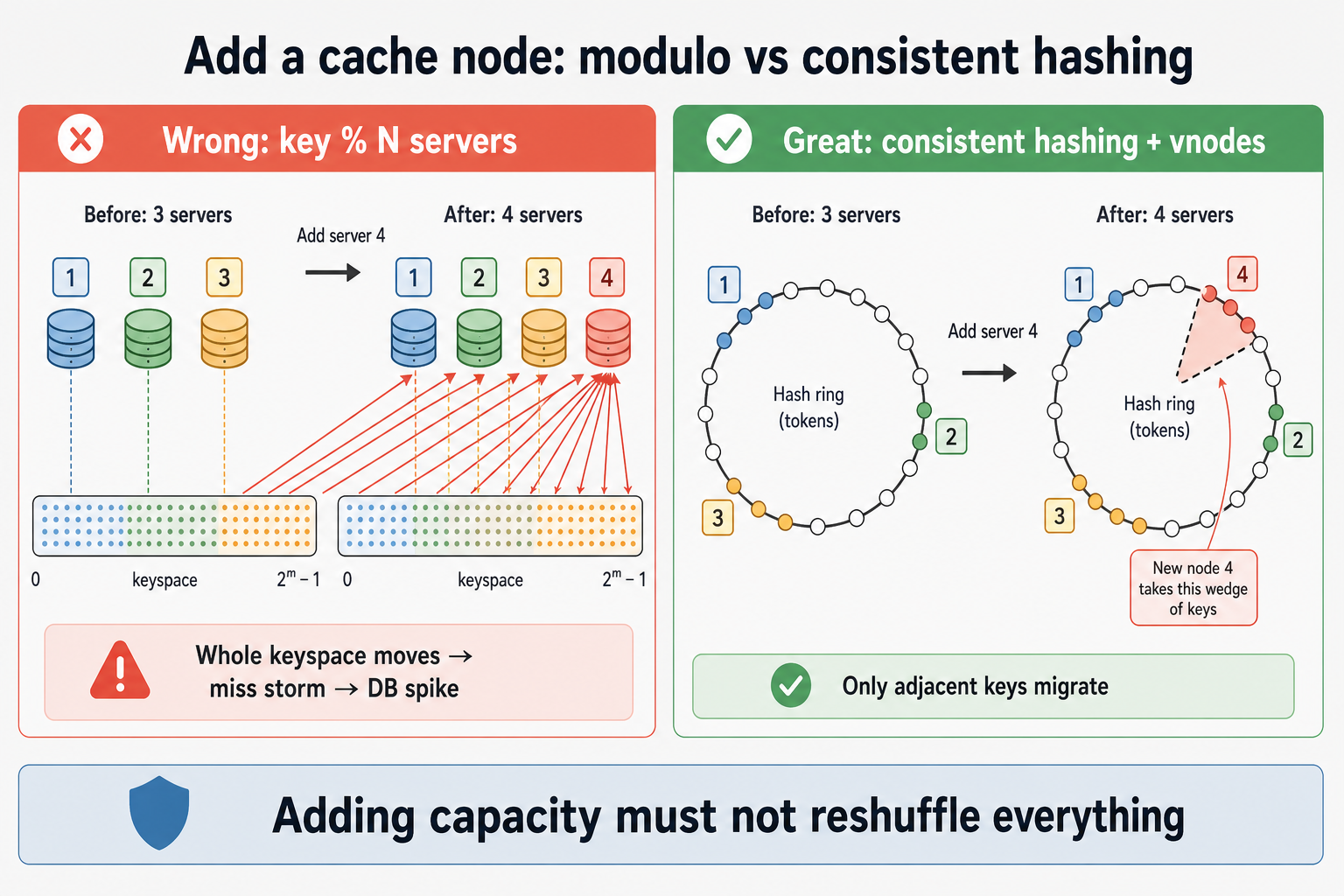
Figure: Consistent hashing migrates a wedge; modulo hash reshuffles almost everything.
Virtual nodes: Each physical machine owns many tokens on the ring so load stays balanced when node count is small. Rebalance runs in background with throttle and handoff so two primaries do not serve conflicting values mid-migration.
Interview land: “Add node moves a wedge, not the universe—rebalance is throttled and explicit.”
4) Thundering herd on TTL expiry
Bad design: aligned TTL, no coalescing
Ten thousand clients cache product:9001 with TTL = 3600 set at the same second during a sale warmup. At expiry, all keys vanish together. Every client sees miss; every app thread queries the database.
T=3600s  key expires on primary
T=3600s  10k apps → 10k DB SELECTs for same row
         DB connections maxed; cache “healthy”
Great design: jitter + singleflight + optional stale-while-revalidate
- TTL jitter:
TTL = base + random(0, jitter)so expiries spread. - Singleflight: one loader repopulates; others wait or serve stale briefly.
- Stale-while-revalidate: return last good value while async refresh runs (if product allows).
Scale inside the box: Even with coalescing, one hot key still hits one primary—shard CPU and network saturate. Combine herd control with hot key replication or app L2.
Interview land: “Expiry is a scheduled DDoS on your database unless jitter and singleflight are designed in.”
Numbered happy path (put it together)
- GET → hash → primary → hit or miss.
- Miss → singleflight → DB load → SET with jittered TTL.
- DB write → commit → DEL cache keys.
- Node add → wedge migration → throttled handoff → clients refresh ring.
If you remember one thing: The dig is wedge not reshuffle for topology, and one loader not N for miss storms.
Key challenges
- Hot keys: One logical key → one primary shard—CPU, memory bandwidth, and single-threaded primary limits bite before cluster average looks stressed.
- Rebalancing: Moving keys without dual ownership bugs—wrong value served during migration; need handoff protocol and throttled copy.
- Replication lag: User saves profile, reads replica, sees old name—apps must know which replica and whether read-your-writes is required.
- Invalidation mapping: One database row may map to dozens of cache keys; pattern deletes do not scale; version stamps help.
- Eviction thrash: Working set larger than RAM → constant eviction → rising miss rate → database overload.
- Split brain after partition: Two primaries accept writes—mitigate with quorum, epoch, fencing; caches usually favor availability with stale reads.
If you remember one thing: Hot keys and rebalance hurt more in production than picking LRU versus LFU on day one.
Scaling the system
- Horizontal: Add nodes; consistent hashing migrates adjacent wedges only; throttle migration during peak.
- Vertical: Bigger RAM on hot shards—sometimes cheaper than perfect algorithmic fairness for one monster key.
- Read scaling: Replica reads for read-heavy, stale-OK keys; primary for linearizable per-key sequence or read-after-write paths.
- Hot key mitigation: Replicate hot value to multiple nodes; in-process L2 in app tier; split logical key into sub-keys (
product:9001:shard:{0..7}) with merge on read. - Multi-region: Active-active cache writes are hard (conflicts); often read replicas per region with async replication and documented stale SLAs.
If you remember one thing: Replica reads scale throughput; primary wins when stale is unacceptable—and one hot key needs its own plan.
Failure handling
| Failure | User-visible | Mitigation |
|---|---|---|
| Primary down | Errors or brief failover latency | Health checks, automatic replica promotion, epoch bump, client retry with backoff |
| Replica lag spike | Stale reads, flip-flopping UI | Route critical reads to primary; sticky session; version in value |
| Network partition | Split brain risk | Quorum writes; minority partition stops accepting writes |
| Node add during peak | Latency during migration | Throttle rebalance; off-peak adds; pre-warm replicas |
| Cache cluster unavailable | Slow path or errors | Circuit breaker to DB with timeout and bulkhead—unbounded DB fallback is a stampede |
| Full cluster cold start | Miss storm on database | Warm cache from database in controlled rate; TTL stagger |
Degraded UX: Slightly stale data is often acceptable; wrong price or balance is not—route those reads to primary or short TTL plus strict invalidation.
If you remember one thing: Under partition, most caches choose availability + stale reads—unless the interviewer scopes money paths to primary reads.
API design
Caches expose binary protocols (RESP for Redis) or thin REST wrappers. Interview clarity matters more than opcode trivia.
Core operations:
| Op | Semantics |
|---|---|
GET key | Return value or miss (nil) |
SET key value [EX ttl] | Upsert with optional TTL |
DEL key [key ...] | Invalidate one or many keys |
INCR key / DECR key | Atomic counter on single key |
MGET keys[] | Batch read to reduce round trips |
EXPIRE key seconds | Adjust TTL on existing key |
Cluster routing (client view):
| Mode | Behavior |
|---|---|
| Smart client | Computes hash locally; follows MOVED/ASK redirects when topology changes |
| Proxy | Single endpoint; proxy forwards to correct shard |
Error semantics: Distinguish miss (key not present—trigger cache-aside load) from error (timeout, CLUSTERDOWN—do not blindly hammer database). HTTP wrappers often use 404 for missing resource versus 503 for cache unavailable—document the mapping.
Request flow (GET, cache-aside):
App --GET key--> Client lib --hash--> Primary shard
                              |
                              hit --> return value
                              miss --> singleflight --> DB --> SET + TTL --> value
If you remember one thing: A miss triggers a controlled refill path—not an unbounded parallel database query per client.
Observability (what you measure)
Vanity hit ratio hides miss storms and hot shards. Measure what proves the cache protects the database.
| Metric | Why it matters |
|---|---|
| Hit ratio (global and per key prefix) | Trend breaks when invalidation or eviction fails |
| Miss rate spike correlated with DB QPS | Herd on expiry or rebalance |
| p99 GET latency per shard | Hot key or slow primary before cluster average moves |
| Per-shard QPS and CPU | One shard melting while cluster looks green |
| evicted_keys / memory usage | Working set exceeds RAM; eviction thrash |
| Rebalance progress / keys migrating | Latency during node add |
| Replication lag (bytes or seconds) | Stale read incidents after write |
| Database query rate on cache miss path | Proves cache is not protecting DB |
| Singleflight wait time | Herd control working or overloaded |
Alerts that catch real incidents: Top 10 keys by QPS; miss rate ×10 in five minutes; DB connection pool >80% while cache CPU calm; rebalance duration over SLO.
If you remember one thing: Chart database QPS from cache miss alongside hit ratio—green cache plus rising DB means design failure.
Security and abuse
- Network isolation: Cache ports not on public internet; VPC, TLS in transit where supported, ACLs by app role.
- No secrets in cache keys or values logged at debug—keys often embed user ids; treat values as sensitive if they mirror database rows.
- AuthZ at app layer: Cache does not replace authorization—any app with cluster access can read keys unless encrypted at rest in value (uncommon for generic cache).
- Denial of service: Unbounded key space from attackers (
user:random:*) fills memory—rate limit key creation, cap key length, monitor memory per tenant prefix. - Injection: If values deserialize to objects, use safe formats (JSON with schema)—not arbitrary pickle.
If you remember one thing: The cache is a performance layer, not a security boundary—auth stays in the application.
Cost awareness
- RAM is the main bill: 100 GB replicated three ways is 300 GB of RAM before overhead—right-size working set versus “cache everything.”
- Cross-AZ replication traffic: Every write replicates—hot write keys cost network as well as CPU.
- Over-caching cold data: Storing long-tail keys evicts hot data—LFU or TTL discipline reduces waste.
- Rebalance and ops time: Node adds during peak cost engineer time and customer latency—schedule migrations.
- Database fallback cost: Miss storm turns cache savings into database scale emergency—cheaper to fund jitter and singleflight than emergency DB vertical scale.
Say in the interview: Cache size is a cost decision with an SLO, not “as big as possible.”
When users are stuck but the dashboards look fine
Textbooks teach boxes and arrows. On-call teaches this: the cache cluster can look healthy while the database melts—or while users see flip-flopping data after failover.
Caches are not “faster databases.” They are coordination surfaces where topology, TTLs, invalidation, and fallback paths interact. The interesting failures are miss herds, wedge migrations done wrong, replica lag after save, and unbounded database refill when the cache slows down.
Scene 1: p99 latency jumps right after you “fixed” capacity
The moment: Traffic grows; you add cache nodes to fix latency. For hours, scroll and checkout get slower, not faster. Support reports timeouts while cluster CPU averages still look fine.
The trap: Rebalance moved huge key ranges at once. NICs saturated copying data; clients still talked to old owners; replicas lagged behind primaries. Adding capacity triggered a migration storm, not instant relief.
What to build: Throttle migration bandwidth; schedule node adds off-peak; pre-warm replicas before cutover; alert on per-shard imbalance and rebalance duration, not only average CPU.
Scene 2: Database load spikes while cache dashboards stay green
The moment: Brief checkout errors; database connections max out; cache hit ratio still looks acceptable on the global graph.
The trap: Thundering herd on one product key at TTL expiry—aligned TTLs from a bulk warm load, no singleflight. Thousands of simultaneous misses each hit the database. Global hit ratio hides one key driving the incident.
What to build: TTL jitter; singleflight in app tier; stale-while-revalidate where product allows; correlate evicted_keys, miss rate per key prefix, and DB QPS on the miss path.
Scene 3: Inconsistent reads after failover
The moment: Two browser tabs show different profile names; a “lost” write reappears after refresh. On-call sees successful failovers in the log.
The trap: Clients cached stale topology and sent writes to a dead primary; replica promoted but not caught up; brief split-brain window before epoch fencing. Users expected read-your-writes from replicas.
What to build: Push topology updates quickly; read primary for critical keys after write; epoch on promotion; document no read-your-writes from replicas unless you build it (sticky routing, version check).
Scene 4: Cache slow → database stampede
The moment: Timeouts everywhere; database overload; team insists “cache cluster is up.”
The trap: Hot key saturated single-threaded primary; connection pool to cache exhausted; apps used unbounded parallel database refill on every miss or timeout. Slow cache is not down—so binary up/down alerts miss it.
What to build: Circuit breaker on database fallback; bulkhead concurrent refill per key; cap parallel loaders; alert on cache GET p99 and pool wait, not only primary ping.
[ Apps spike GETs ] → [ Cache primaries at CPU max ]
       → latency ↑, timeouts
       → clients fall back to DB in parallel → DB overload → worse cache refill
In the interview: Pick one scene. Tell what users felt, which metric lied, and what you would ship—singleflight, jitter, throttled rebalance, or primary read after write. You do not need all four; you need to sound like someone who knows green is not the same as correct.
Bottlenecks and tradeoffs
Memory versus hit ratio
The tension — Bigger cluster means fewer database hits; RAM is not free and replication multiplies footprint.
What breaks — Diminishing returns; eviction thrash when working set exceeds RAM; cold keys evict hot ones.
What teams do — Track evicted_keys and tail latency; tier hot data; right-size per shard; LFU or TTL on long-tail keys.
Say in the interview — Cache size is a cost decision with an SLO, not “as big as possible.”
Strong consistency versus cache speed
The tension — Apps want read-your-writes; caches favor speed and partition tolerance with stale replicas.
What breaks — Promising strong consistency everywhere without primary reads or sync replication.
What teams do — Database as truth; delete on write; short TTL on contested keys; primary read for critical paths.
Say in the interview — Most caches are eventually stale—say what your app tolerates and what it does not.
Rebalance versus availability
The tension — Adding nodes should increase capacity; migrating keys risks wrong values and latency spikes.
What breaks — Dual ownership during move; redirect storms; database miss wave if you used modulo hash.
What teams do — Consistent hashing wedge migration; handoff protocol; throttled copy; hinted handoff for reads during move.
Say in the interview — Adding a node is an ops event, not a free horizontal scale button.
Cache-aside versus write-through
The tension — Cache-aside is simple but invalidation races exist; write-through is stronger but slower on writes.
What breaks — Stale cache after write without delete; write-through melting write p99 at scale.
What teams do — Cache-aside plus delete after commit for most read-heavy products; write-through for small strongly consistent subsets.
Say in the interview — Pick pattern from read/write ratio and consistency bar, not from buzzwords.
If you remember one thing: Caches fail open to the database in the worst way unless you engineer miss and fallback behavior.
Interview tips
You have the full design in mind now. These five back-and-forths are how interviewers test whether you can defend it under pressure. Each one starts with a tempting shortcut, an interview push, and a clear answer.
Modulo hashing — your cluster reshuffles when you scale
You might say: “We hash the key modulo the number of servers to pick a shard.”
Interview Push: “You have four nodes and add a fifth—what happens to every existing key?”
Land here: Modulo changes the divisor—almost all keys remap. The cluster experiences a mass miss event: database QPS spikes, latency jumps, exactly when you thought you were scaling out. Consistent hashing places keys and nodes on a ring; adding a node only moves keys in the wedge near the new token. Virtual nodes spread load evenly across physical machines. Rebalance runs in the background with throttling and handoff so two owners never serve different values for the same key during migration.
Invalidate on update — one row, many cache keys
You might say: “When the database updates, we invalidate the cache.”
Interview Push: “One product row feeds the product page, search snippet, and cart preview—how do you invalidate?”
Land here: Name a key naming scheme (product:{id}, product:{id}:summary) and either maintain an explicit invalidation list on write, use a version column in the database echoed in cached values, or publish change events to a small invalidation service. Pattern deletes (KEYS product:9001*) do not scale on large clusters. DELETE affected keys after database commit—not before. TTL is a safety net for missed invalidations, not the primary consistency tool for price or inventory.
Read-after-write — replicas lie politely
You might say: “We read from replicas for speed on every GET.”
Interview Push: “User saves their display name, refreshes immediately, still sees the old name—why?”
Land here: Replication lag. The write landed on the primary; the read hit a replica behind by milliseconds or seconds. For read-your-writes, route that user’s next read to the primary, use sticky routing to a caught-up replica, or embed a version in the value and retry on mismatch. Say which fields tolerate staleness (display name for a few seconds) versus which do not (account balance). The cache is not a magic fix—routing and consistency mode are.
Thundering herd — TTL is a scheduled database spike
You might say: “We set TTL so data stays fresh automatically.”
Interview Push: “A viral product key expires at the top of the hour—what hits the database?”
Land here: Every cached copy expires together if TTLs were aligned at warm load. Thousands of concurrent misses each issue a database query unless singleflight coalesces to one loader. Add TTL jitter (base + random), probabilistic early refresh, and stale-while-revalidate where slightly old data during refill is product-OK. This is why expiry is a design problem, not an ops surprise.
Cache versus database — who owns truth
You might say: “The cache is our source of truth—it’s faster.”
Interview Push: “Primary crashes with no persistence—what did we lose, and where do reads go?”
Land here: In-memory state is ephemeral. Database is truth. After failover or cold start, cache misses refill from the database; anything not yet written to the database is gone. Optional RDB/AOF persistence trades durability for fork latency on large heaps—mention p99 impact if you bring it up, but do not confuse cache persistence with database reliability. Strong answers: “We never write product inventory only in cache without the database commit path.”
Red flags to avoid without correcting yourself: “Cache is source of truth,” “modulo hash when nodes change,” “invalidate with KEYS *,” “replica read right after write with no plan,” “miss means fire unlimited DB queries.”
After each interview push, close with one real part of the design you would build—consistent hashing with vnodes, delete-after-commit, singleflight, or primary read on critical keys—not “we’ll optimize later.”
What should stick
After reading this guide, you should be able to explain:
- Same key, same machine — Route each key to one owner so reads and writes agree; when you add a server, only a slice of keys should move (ring math stays After one mock).
- Hit / miss / clear — On miss, load the database once and store a copy; after a database write, delete that copy (or bump a version) so readers do not keep yesterday’s value.
- Database is source of truth — Cache is a speed layer that can disappear; cold start and failover refill from the database.
- Expiry can stampede the DB — Many clients missing the same key at once burns the database; stagger expiry and load once per key.
- One viral key can melt one shard — Extra copies or app-side buffering help; “add more nodes” alone does not.
Tell it in the room: “Database is truth. GET hits the fast copy or loads the DB once and stores with a time limit. On write, commit DB then delete the cached copy. I’d call out one hot key and many clients missing the same key at once. Adding a server should move only a wedge of keys—not reshuffle everything.”
Related Topics
- Rate Limiter System Design - Shared in-memory state, hot keys, and atomic updates
- Facebook Feed System Design - Hot post keys, cache stampede, and TTL jitter on read paths
- WhatsApp System Design - Caching versus source of truth on messaging metadata
- Caching Strategies - Fundamentals behind cache-aside, read-through, and write-through
- Consistent Hashing - Ring mechanics and virtual nodes in depth
Practice this path: Distributed Cache System Design.
Frequently asked follow-ups
- What happens when you add a node—modulo hash versus consistent hashing?
- How do you handle a hot key on one shard?
- How do you invalidate cache after a database update?
- Can the cache be strongly consistent everywhere?
- How is this different from just using Redis?
Deep-dive questions and strong answer outlines
Walk through a GET on a sharded cache cluster.
The client or proxy hashes the key to a token on the ring, routes to the owning primary (or a replica if stale reads are acceptable). On a hit, return the value from memory. On a miss in cache-aside, the application loads from the database, then SETs the key with a TTL. Mention singleflight on miss so one viral expiry does not spawn thousands of identical database queries.
You add one server to the cluster—what happens to key placement?
With modulo hashing (hash(key) % N), almost every key moves when N changes—cache miss storm and database spike. With consistent hashing and virtual nodes, only keys in the wedge near the new token migrate; rebalance runs in the background with throttling and handoff so two owners do not serve conflicting values during migration.
Explain cache-aside and how you keep data fresh after a write.
The application reads the cache first; on miss it loads the database and populates the cache. On database update, the application commits the write then DELETEs affected cache keys (or bumps a version embedded in the value). Avoid updating the cache before the database without careful ordering—you can race and write stale data back. TTL is a safety net, not the primary invalidation strategy for critical fields.
The primary crashes—what happens to in-flight writes and reads?
Health checks detect failure; a replica promotes with an epoch or quorum bump so old primaries cannot accept writes. Clients refresh topology. In-flight writes may be lost depending on sync policy—say that out loud. Reads may hit stale replicas until catch-up; money paths often read the primary. The cache is ephemeral; the database is still source of truth.
One logical key gets a million reads per second—what do you do?
Hashing spreads average load but not one dominant logical key—all traffic still lands on one primary shard. Mitigate with read replicas for that key, an in-process L2 cache in app servers, splitting the key into sub-ranges, or replicating the hot value to multiple nodes. Alert on per-shard QPS and CPU, not only cluster averages.
A popular key's TTL expires at the same second—what hits the database?
Thundering herd: thousands of concurrent misses each query the database. Mitigate with singleflight (one loader per key), TTL jitter so expiries spread, probabilistic early refresh, and stale-while-revalidate where product allows slightly old data during refill.
AI feedback on your design
After a practice session, InterviewCrafted summarizes strengths, gaps, and interviewer-style expectations—similar to a written debrief. See a static example report, then practice this problem to get feedback on your own answer.
FAQs
Q: Do I need to memorize Redis protocol opcodes in the interview?
A: No. Interviewers care about behavior—GET/SET semantics, TTL, atomic increment, cluster redirects—not whether you recall RESP byte layouts. Name the operations and what the application does on hit versus miss.
Q: Where does CAP fit for a distributed cache?
A: Under partition, caches usually choose availability and accept stale reads rather than refusing all requests. That matches most product needs—brief staleness beats outage. Strong consistency per operation requires reading the primary or quorum reads at higher latency cost.
Q: Is the cache the source of truth?
A: Almost always no. The database (or durable store behind the cache) owns truth. The cache is ephemeral acceleration. If a primary dies without persistence, you lose in-memory state and rebuild from the database on miss—design invalidation and refill accordingly.
Q: How do I talk about persistence (RDB/AOF) without getting lost?
A: Persistence trades durability for operational cost—fork latency on large heaps can spike p99, and AOF fsync policy affects loss window. For most cache interviews, say the database is truth and persistence is optional for warm restart, not a substitute for the database.
Practice interactively
Open the practice session to use the canvas and stages, then review AI feedback.