Essay
System Design Without Memorization
Why memorized architectures fail in system design interviews, and a reusable loop for reasoning through any prompt from requirements and trade-offs.
TL;DR: There is no single right architecture for a system design prompt. Start with requirements, split the problem into smaller parts (a feed is a write path, a read path, ranking, and storage), apply a small set of patterns to each part, and say the trade-off out loud. Learn patterns, not blueprints.
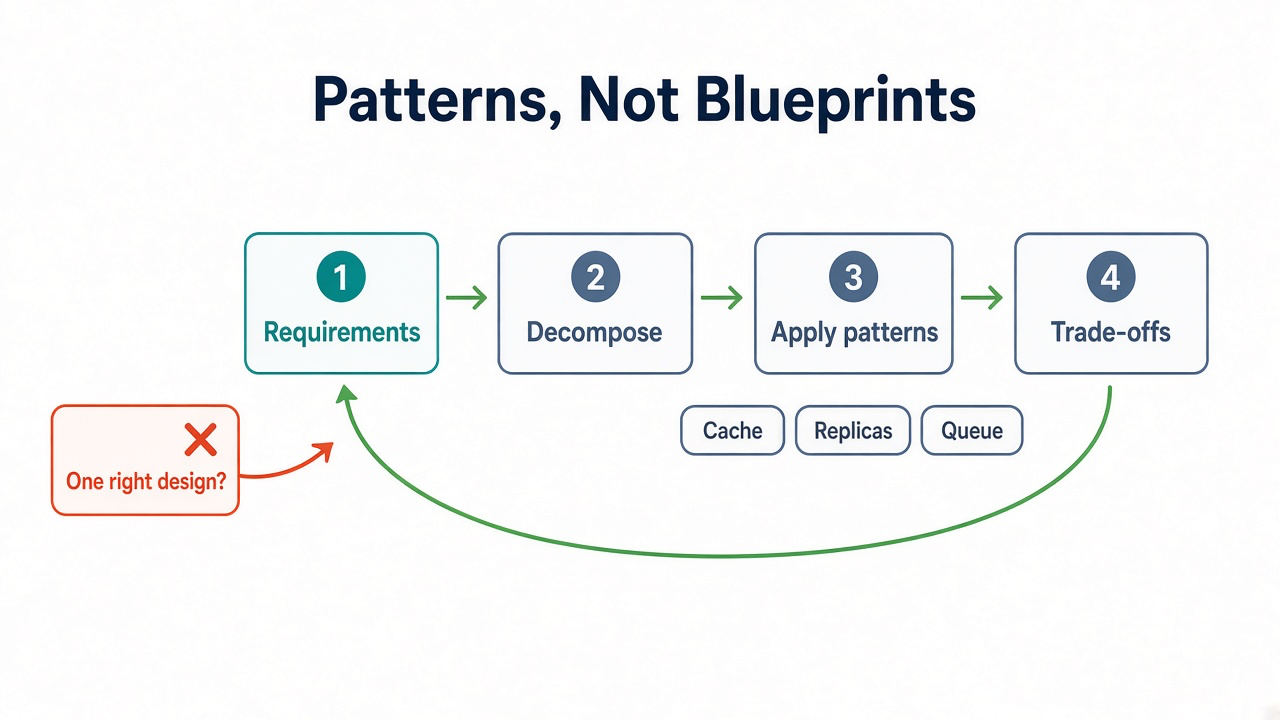
Candidates memorize "how to design Twitter" and "how to design a URL shortener." Then they get "design a real-time collaboration tool" and freeze. They didn't memorize that one.
Memorization doesn't scale, because the list of prompts never ends. Reasoning does. This essay is about the reasoning: one loop you can run on any prompt, a small set of patterns that keep coming back, and one example worked end to end. It is written for engineers with a system design loop coming up who have been collecting diagrams and want a better use of their time.
There is no single right architecture
Say this to yourself before any practice session: there is no single right architecture. There is a design that fits the requirements you agreed on, and a design that doesn't.
Take a news feed. For a small social app with a few thousand users, one database and one server can be the right answer. For an app where a few accounts have fifty million followers, you need a very different shape. Both designs are correct for their own assumptions. Neither is correct for the other's.
That is why a memorized diagram is risky. It carries someone else's assumptions, and you don't know which ones. When the interviewer says "now make the feed real time," you can't tell which box to change. You only know the picture.
What interviewers can score is the reasoning attached to the picture. Did you ask what matters? Does each box have a job? Can you say what you gave up? The four signals interviewers watch all sit in that reasoning. None of them sits in the diagram alone.
The loop: requirements, decompose, patterns, trade-offs
The loop has four steps. Each one feeds the next.
- Requirements. What does the system do, how big is it, what must stay true, and what is out of scope?
- Decompose. Split the system into smaller problems you can solve one at a time.
- Apply patterns. For each small problem, pick from a short list of known solutions.
- Trade-offs. For each choice, say what you gain, what you give up, and what would change your mind.
You can run it in your head on the train. You can run it on a whiteboard for 35 minutes. The steps stay the same. Only the answers change.
Step 1: Requirements come before boxes
Before you draw anything, get four things on the board.
- What it does. The two or three core operations. Post, read, follow. Shorten, redirect.
- How big it is. Users, requests per second, data size. Rough orders of magnitude are enough.
- What must stay true. Fast reads? Never lose a write? Always available? Pick the top one or two.
- What is out. "Search is out. Ads are out." Boundaries keep you from building the world.
Spend two or three minutes here. A clear problem makes every later step easier, and a fuzzy one makes every later step a guess. If you want practice turning vague asks into scope, Ambiguity Handling and Problem Framing and Non-Functional Requirements Deep Dive are built for it.
Step 2: Decompose into smaller problems
Every large system is a few small problems stuck together. A chat product is messaging, presence, delivery, and storage. A search engine is crawling, indexing, ranking, and serving. A rate limiter is counting, deciding, and rejecting.
You have not seen "design X" before, but you have seen "store a lot of data," "serve reads fast," and "deliver an update to many people." Name the parts, then solve them one by one.
Step 3: Apply a small set of patterns
The patterns that keep coming back fit on one page.
| Pressure in the requirements | Pattern to reach for |
|---|---|
| Many more reads than writes | Caching, read replicas, precomputing results |
| Reads must be close to users | CDN and edge caching |
| One database is too big or too busy | Sharding |
| Writes must not slow the user down | Message queues and background workers |
| Traffic too high for one server | Load balancing |
| Data must survive a machine failure | Replication |
None of these is a default. Each one answers a pressure, so find the pressure first. A cache added "because designs have caches" is a cost with no benefit: more moving parts, stale data, and one more thing that can fail.
Step 4: Say the trade-off out loud
For every choice, say three things. What are you optimizing for? What are you giving up? What would make you choose differently?
"I'd cache feed pages because reads far outnumber writes. The cost is that a new post may take a few seconds to appear. If the product needed instant visibility, I would rethink this." That is a complete answer. "I'd use Redis" is not. Trade-Off Thinking goes deeper on how to structure that sentence.
One example: a news feed, taken apart
Here is the loop on a prompt you may well get: "Design a news feed." The numbers are assumptions I am choosing for the example. Your interviewer may pick others, and that's fine, as long as your design follows whichever you agree on.
Requirements
Say you agree on this. Users post short updates and follow other people. Opening the app shows recent posts from people they follow. About 10 million people use it daily. Each opens the feed about 20 times a day and posts roughly once every two days.
Quick math: 200 million feed reads a day is around 2,300 reads a second. Five million posts a day is around 60 writes a second. Reads outnumber writes by about 40 to 1. Slightly stale posts are fine. Losing a post is not. Search and ads are out of scope.
That single ratio already tells you what to optimize. This is a read-heavy system.
Decomposition
Split it into four problems:
- Write path: a user posts, and the post is stored.
- Read path: a user opens the app and sees a feed, fast.
- Ranking: which posts show first. Start with newest first. Say you would improve it later.
- Storage: where posts, follow relationships, and feed data live.
Patterns for each part
Write path. Store the post in a durable database first. Then, in the background, add it to the feeds of followers. A message queue lets the author's request finish quickly while workers do the fan-out. The pattern here is "don't make the user wait for work they don't need to see."
Read path. With reads at 40 times writes, precompute. Keep each user's recent feed as a ready-to-serve list in a cache, so opening the app is one lookup and not a join across many tables. This is the "many reads, few writes means precompute" pattern.
Ranking. Keep it simple. Sort by time, and mention that a ranking service can reorder the list before it is returned. Naming the seam is enough in an interview. Building the model is not.
Storage. Put posts in a primary database with replicas for read load. When one machine can't hold everything, shard by user ID. A common trap is a hot key: one account with millions of followers sends heavy traffic to a single shard. Hot Partition Problem shows how that plays out in production.
Trade-offs
Now say what you chose and what it cost.
- Precomputing feeds makes reads fast, but a post takes a moment to reach every follower. You accept that delay.
- Fan-out on write is cheap for most users and expensive for accounts with huge audiences. A common fix is a hybrid: precompute for ordinary accounts and merge posts from very large accounts at read time. You state this as the next step if the interviewer pushes on celebrities.
- Caching feeds adds stale data and a new failure mode. If the cache goes down, reads fall back to the database. Say how you would protect it.
Notice what happened. You never recited "how Twitter does it." Each decision came from the ratio you computed in the first two minutes. When the interviewer says "now users expect to see posts instantly," you know which choice to revisit: the delay you accepted in the write path.
To try the same prompt with feedback, open the Design a news feed problem. The Design Twitter problem pushes the celebrity case harder.
Draw while you talk
Don't design in your head and then draw at the end. The interviewer follows your thinking through the board, so the diagram is a shared reference as much as a result.
Start with the smallest picture: client, API, database. Then zoom into the part that matters. Add the queue because writes need to be fast, and say so as you draw it. Label arrows with what travels along them. Keep it rough. A diagram that grows with your reasoning beats a perfect one drawn in the last five minutes.
If explaining is the part that worries you, System Design as Communication covers how to walk someone through a design so they can follow it.
Handle "what if" questions
"What if traffic grows ten times?" "What if a data center goes down?" "What if the product needs strong consistency?" These are not traps. They test whether your design can bend.
A design built from stated requirements bends easily, because you know which assumption each choice rests on. Ten times the traffic breaks your read estimate, so you add replicas or more cache capacity. A lost data center breaks your single-region assumption, so you talk about replication and failover. A demand for strong consistency breaks the "stale is fine" assumption, so you explain the cost, using ideas from the CAP theorem and replication lag.
A memorized design can't do this. It has no record of why it looks the way it does.
Practice with variety
If you only practice "design Twitter" and "design Uber," you learn two stories. Pick problems that force different decisions:
- A read-heavy one: Design a URL shortener.
- A real-time one: Design a chat system.
- A background-work one: Design a notification system.
- A protect-the-system one: Design a rate limiter.
After each run, write down which pressure drove the main choice. After five or six runs, you will notice the same handful of pressures again and again. That recognition is what people call "system design sense," and it comes from variety, not from volume of one kind.
Use a timer. Thirty-five minutes, out loud, same loop each time. The prep plan lays out how to spread this over several weeks.
Your next step
Pick one prompt you have already memorized an answer to. Close the notes, set 35 minutes, and run the four-step loop out loud with a different assumption than you remember, such as ten times fewer users or strong consistency required. See which parts of your memorized design survive.
The ones that survive are the patterns you actually know. The rest were blueprints. Start a practice problem and find out which is which.
Frequently asked questions
- If there is no right architecture, how do interviewers judge my answer?
- They judge the reasoning, not the picture. They check whether you asked about scope and scale, whether each component has a job, and whether you can say what breaks as traffic grows. Two designs can both pass if each one fits the assumptions its author stated. The interview rubric breaks this into four signals.
- What do I do when the prompt is something I have never seen?
- Run the same loop. Ask what the system must do and how big it gets, then split it into parts you recognize: storing data, serving reads, moving work in the background, delivering updates. A "real-time collaboration tool" is a write path, a fan-out of changes to other users, and storage for history. You have seen each piece before.
- Is it still useful to study how real companies build things?
- Yes, as examples of trade-offs, not as scripts. Read how a company handled a hot key or a cache outage and ask which constraint forced the choice. Production stories like The Cache Stampede That Took Down Our API are good material because they show what the design cost when it failed.
- How do I know which pattern to reach for?
- Look at the pressure in your requirements. Many more reads than writes means caching and replicas. Writes that must not slow users down means a message queue. One database that is too big or too busy means sharding. If you cannot name the pressure, you are not ready to add the pattern yet.
- How many patterns do I actually need to know?
- Fewer than most people fear. Caching, replication, sharding, queues, load balancing, and the strong versus eventual consistency choice cover most prompts. Add indexing and a CDN for read-heavy products. Depth on six patterns beats a shallow list of thirty.
- How do I practice this without a partner?
- Pick a prompt on Practice system design, set a 35-minute timer, and talk through the loop out loud. Then change one requirement, such as "now ten times the traffic," and redesign only what that change affects. That second pass is where reasoning gets stronger.
- What if the interviewer pushes toward a design I did not choose?
- Treat it as new information, not criticism. Ask what constraint they have in mind, then compare the two options on that constraint. Saying "that works if we need X, and here is what it costs" shows you are reasoning and not defending a memorized picture.
What's next?