Essay
The New Interview Reality: Making AI Work For You
AI writes code, so interviews weigh system design, performance reasoning, and how you direct AI. What to practice so you stand out.
TL;DR: The bar has moved from writing good code to thinking above the code. System design, performance reasoning, and using AI as a multiplier are what separate candidates now. Practice decomposition, trade-offs, and scale. Let AI draft the boilerplate and challenge your plan, but own the design and be ready to explain it.
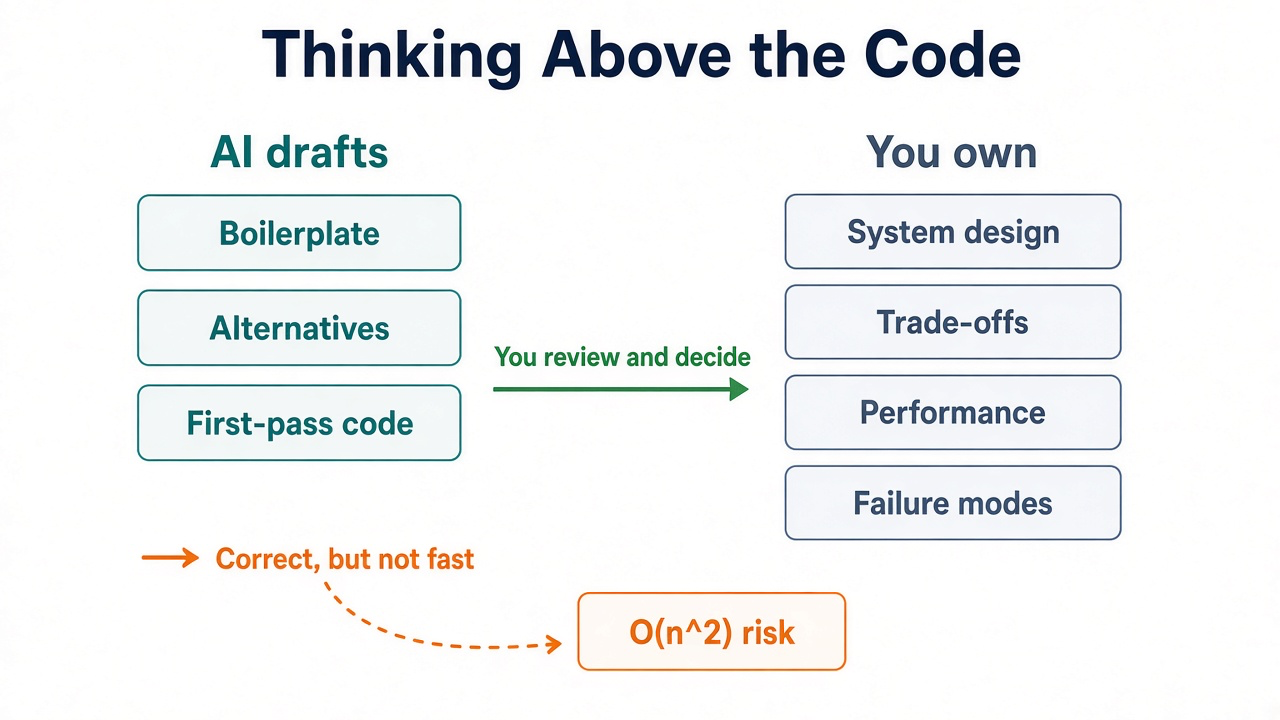
AI can write a function in seconds. It can suggest a design pattern. It can debug your code. So why would a company still ask you to code on a whiteboard?
Because the game has changed. The question is no longer "can you write good code?" It is "can you think at a level above the code?" This essay is for engineers who are preparing for interviews now and want to know where that bar sits. For a shorter tour of how each round is shifting, see How AI Is Changing Tech Interviews (And What Stays the Same).
The shift: From coding to thinking
When anyone can prompt a tool to generate working code, the value of "someone who writes clean code" drops. What rises is someone who knows what to build, why to build it, and how to make it hold up at scale.
Think about a team lead reading two candidate packets. Both solved the coding problem. One wrote, "I chose a hash map for O(1) lookups." The other wrote, "I chose a hash map because the lookup runs on every request, the data fits in memory today, and I would revisit if the key set grows past a few million." The second one is describing a system. The first is describing a line of code.
Companies are adapting. They weigh three things more heavily:
- System design: Can you architect a solution? Can you reason about trade-offs, scale, consistency, and failure?
- Performance: Can you find a bottleneck? Can you reason about latency, throughput, and resource use? Can you notice when a draft is O(n²) and you need O(n)?
- Making AI work for you: Can you prompt well? Can you judge what comes back? Can you use it without losing quality or ownership?
Writing good code is the entry fee. Thinking about systems is the differentiator.
Use AI, don't compete with it
The engineers who do well treat AI as a multiplier, not a replacement. They do not say "write the whole thing." They ask it to:
- Generate boilerplate while they focus on the hard parts
- Suggest alternatives when they are stuck
- Explain a concept they are learning
- Review their approach before they build it
They stay in the driver's seat. They make the architecture calls, and they own the performance.
Here is what that looks like in an interview. You are asked to design a system. You are not expected to write every line. You are expected to break the problem down, make decisions out loud, and reason about scale. A candidate who says "the tool would scaffold the API layer, so I will spend my time on the data model and what happens when traffic spikes" sounds like someone who has used these tools for real work. That is the skill the round is checking, and it is the one a tool cannot supply for you.
There is a second signal in that answer. It shows you know which work is cheap now and which is not. Interviewers are tired of candidates who treat every task as equally hard. The engineers they want to hire know where the real risk sits in a project, and they spend their time there.
Competing with AI on typing speed is a losing plan. Competing on judgment is a plan that pays off.
System design is the new center of gravity
Interviews are tilting toward system design. The reason is simple: it tests thinking, not typing. You cannot paste an architecture. You have to reason your way to one while someone watches.
The prompts have not changed. Design a feed, design a chat, design a URL shortener. You can practice them right now with Design a news feed or Design a chat system. What changed is the bar. Interviewers now look for:
- A clear breakdown of the problem before any boxes are drawn
- Explicit trade-offs (why Redis here? why eventual consistency there?)
- Scale awareness: what breaks at 10x, and at 100x?
- Failure thinking: what happens when the cache goes down?
None of these can be answered for you in real time. They need judgment, and judgment shows up when you think out loud. If you want a habit for the trade-off part, trade-off thinking is a good place to begin, and failure-first design thinking covers the last bullet. To see how this connects to speaking well in the room, read System Design as Communication.
Performance thinking matters more
When AI writes code, it usually writes correct code. It rarely writes fast code for your situation. It does not know your latency budget. It does not know your request rate. It does not know what your cloud bill can bear.
Someone has to think about that. That someone is you.
Picture an interviewer who gives you a working function that loops over every user for every request. They ask, "How would this behave under load?" A strong candidate says, "It scales with the user count on every call. With a million users that is too slow. I would index it or cache the result and ask how fresh it needs to be." That answer is not complicated. It is a short chain of cause and effect, delivered calmly.
Expect questions like "What is the bottleneck?" and "How would you make this faster?" A common pattern is the candidate who jumps straight to an answer, such as "add a cache," without asking how often the data changes. A cache on data that changes every second adds a new bug instead of fixing the slow one. The better move is to ask first, then pick the fix.
The interviewer is not hunting for a clever trick. They are checking whether you ask about numbers before you propose a fix. As implementation becomes cheap, that reasoning becomes the scarce part.
Making AI work for you in practice
Before you code: Use AI to explore. Ask about trade-offs between two approaches. Ask for common pitfalls in this kind of system. Get the thinking right before you write a line.
While you code: Hand over the repetitive parts. Scaffolding, boilerplate, and test structure are good candidates. Save your attention for the decisions that are hard to reverse.
After you code: Ask it to review. "What edge cases might I have missed?" "Where would this slow down?" Treat it like a rubber duck that sometimes has a useful idea, and be ready to disagree with it.
Picture a candidate designing a notification service. They ask an AI tool for three ways to deliver messages and get back polling, WebSockets, and a message queue. The tool gives a tidy list. What it cannot tell them is which one fits a team of four engineers with a small budget and a launch in six weeks. That choice, and the reasons for it, is the part of the answer the interviewer remembers.
Always: Verify. Understand. Own it. If you cannot explain a line you accepted, you do not own it yet. When AI Codes For You: What You Still Need to Know goes deeper on the checks to run before anything ships.
How to prepare for this reality
-
Double down on system design. Practice out loud. Focus on trade-offs, not implementation detail. Get comfortable saying, "I would use X because Y, but if we had constraint Z, I would look at W." System design interviews: start here is a good first read.
-
Build performance intuition. Know when O(n²) is fine and when it is a disaster. Understand caching, indexing, and batching. Practice turning "it feels slow" into a question about numbers.
-
Practice with AI as a partner. Use it while you prepare, but practice judging its output. What would you change? What did it miss? That evaluation skill is what interviews check. How to Actually Learn From AI-Generated Code shows a way to do it.
-
Keep the coding fundamentals. You still need to understand what AI produces. You still need to debug when it is wrong. You still need to clear the "can you write a loop" bar. The ceiling moved up toward systems and performance, but the floor is still there.
For how AI-assisted rounds sit beside OA, DSA, LLD, and system design in a full loop, see Software Engineer Interview Process: Every Round Explained. If you are aiming at staff-level roles, The Staff Engineer Readiness Test: What AI Can't Answer For You shows where the bar goes next.
The opportunity
This shift helps engineers who adapt. The ones who lean into system design, performance thinking, and directing AI will stand out. The ones who keep preparing for "write perfect code in 45 minutes" will find the bar has moved without them.
AI can code. You need to think. That is the new interview reality.
Pick one prompt today and design it out loud for thirty-five minutes with a timer. Practice system design has problems ready, and Practice LLD does the same for code structure.
Frequently asked questions
- Why do companies still test coding if AI can write code?
- Because the question changed to "can you think at a level above the code?" Writing a function is the easy part now. Deciding what to build, spotting what is wrong with a draft, and explaining the trade-offs are the parts interviewers still cannot get from a tool.
- How should I use AI when preparing for interviews?
- Use it as a sparring partner. Ask it for alternatives, for pitfalls in your design, and for edge cases you missed. Then decide what you agree with and why. Also spend time with the tools off, since live rounds usually do not allow them. How to Actually Learn From AI-Generated Code shows how to make that practice stick.
- What does performance reasoning mean in an interview?
- It means you can estimate where a design gets slow and why. You ask how many requests per second, how big the data gets, and what happens when the cache is cold. You do not need exact numbers. You need numbers that are close enough to change a decision. See caching strategies and indexing strategies for the usual levers.
- What happens if I rely on AI during the interview?
- Rules vary by company, so check what is allowed. Where AI is allowed, interviewers watch how you direct it and whether you catch its mistakes. Where it is not allowed, leaning on it in practice leaves gaps. Either way, the person scored is you, not the tool.
- Is system design really the center of interviews now?
- For many mid and senior roles, yes. It is the round that is hardest to pass with a prompt and easiest to separate strong candidates on. Coding rounds still exist and still filter people out. Read Software Engineer Interview Process: Every Round Explained to see where each round sits.
- What if I am early in my career and not ready for system design?
- Start small. Learn to break a problem into parts, name one trade-off, and explain one failure. Use System design interviews: start here for the basics, and look at How to Approach LLD Interviews if your target roles lean toward code structure.
- How do I show judgment if I have never designed a large system?
- Show how you choose between two options. Say which one you would pick, what it costs, and what would make you change your mind. A clear reasoning habit on a small problem convinces interviewers more than borrowed vocabulary from a big one.
What's next?