Essay
When AI Codes For You: What You Still Need to Know
Copilot and ChatGPT can write code, but you still own what ships. What to verify, what interviews test, and when to push back on the draft.
TL;DR: AI-generated code is a first draft, not a finished product. Verify correctness, security, and performance, and understand every line before you ship. Use AI to go faster, own what you merge, and practice without it so your fundamentals hold up in interviews.
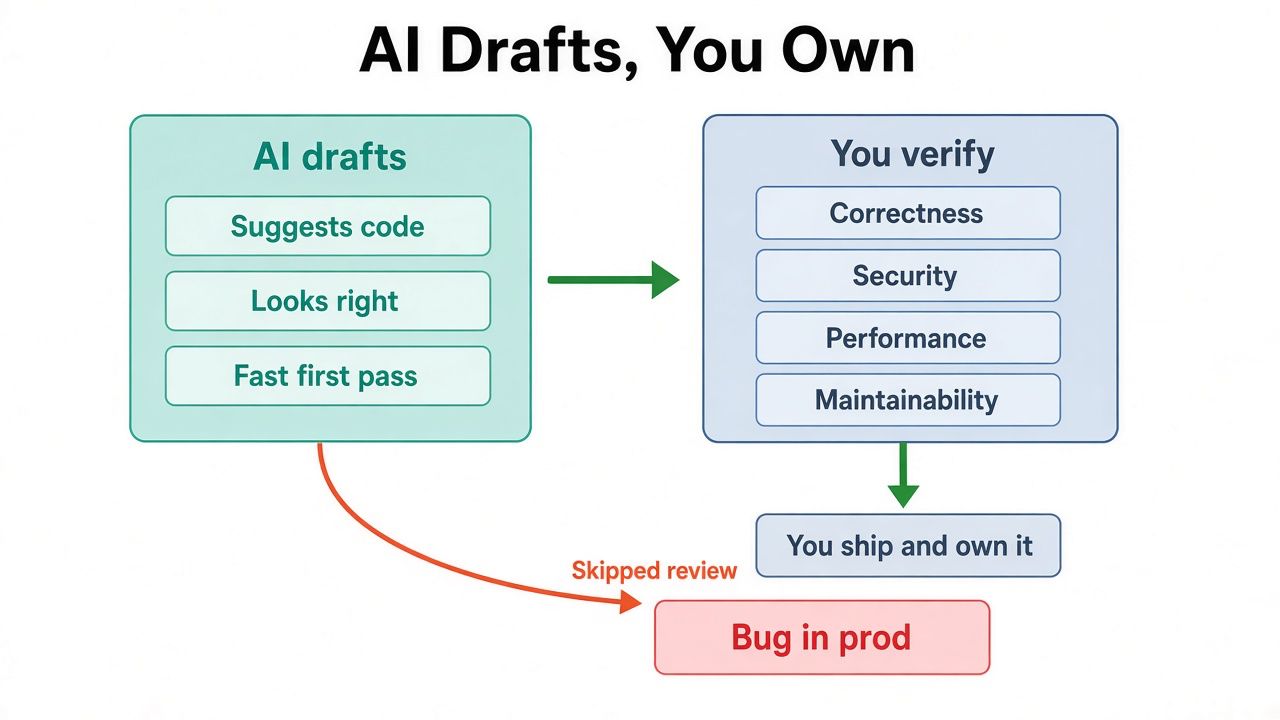
Your IDE suggests a function. You accept it. It works. You move on. A week later, that code causes a production bug. The AI wrote it. You shipped it. Who's responsible?
You are.
AI coding assistants are powerful. They're also confidently wrong. They hallucinate APIs. They copy patterns from bad examples. They optimize for "looks right" over "is right." Your job when AI codes for you isn't to blindly accept. It's to understand, verify, and own.
This essay is for working engineers and interview candidates who already use Copilot or ChatGPT every day. If you want the interview side of the shift, read The New Interview Reality in the AI Era next.
Treat AI output as a first draft
Never paste and ship. Treat every AI-generated snippet as a draft that needs your review. Ask:
- Does this solve the right problem? AI often solves a problem, not your problem. It might implement a generic solution when you need something specific.
- Do I understand every line? If you can't explain it, don't ship it. You'll be the one debugging at 2 AM.
- What edge cases did it miss? AI tends to handle the happy path. Empty inputs, null values, race conditions. You need to think about those.
I've seen engineers accept AI-generated code that looked perfect but failed on empty arrays, or assumed a specific date format, or had a subtle off-by-one error. The AI didn't know your domain. You do.
Picture a pull request where the AI wrote a function to charge a customer and retry on failure. It reads cleanly. The tests pass. Nobody asks what happens when the first call succeeds but the response times out. The retry fires, and the customer is charged twice. That bug lives in a gap between the prompt and the real system. Only someone who understands retries and backoff and idempotency will see it in review.
The habit is simple. Read the diff like you would read a teammate's pull request. Start with the failure paths, then the happy path.
The fundamentals still matter
AI can write a function. It can't tell you when to use that function. It can't tell you why this approach is better than that one. It can't design your system.
Interviewers know this. They're not testing whether you can prompt an AI. They're testing whether you understand complexity, data structures, and trade-offs. They're testing whether you can reason about code when the AI gets it wrong.
The engineers who thrive with AI are the ones who already had strong fundamentals. They use AI to go faster, not to hide gaps. If you're relying on AI because you don't understand the basics, you're building on sand.
Here's a quick way to see where you stand. Take the last AI suggestion you accepted and explain it to a teammate with the screen turned off. If you stall at "and then it just…", that's the gap. The gap is not a failure. It's the exact thing to study this week.
Use AI to learn, not to skip
When AI generates code you don't understand, that's a learning opportunity. Don't just accept it. Ask: "Why did it do it this way? What's the time complexity? What would break if I changed this?"
Use AI like a tutor, not a shortcut. Ask it to explain. Ask for alternatives. Ask what the trade-offs are. Then verify. Check the documentation. Write a test. The goal isn't to get code faster. It's to understand the code you get.
A common pattern: an engineer asks for a caching layer, gets forty lines back, and ships it because it works in the demo. A better prompt is "What are the ways this cache can serve stale data, and how would I detect each one?" The answer teaches you more than the code did, and it hands you the test cases. If you want a repeatable version of this habit, How to Actually Learn From AI-Generated Code lays out the loop step by step.
What to verify before you ship
Correctness: Does it actually work? Write a test. Try edge cases. Don't assume. If the AI also wrote the tests, add at least one by hand. Shared blind spots are the usual way a bug passes review.
Security: AI loves to suggest eval(), string concatenation for SQL, and other patterns that create vulnerabilities. Review with security in mind. Check that request validation happens before the data touches anything important, and that authentication and authorization are enforced on the server, not assumed.
Performance: AI often picks the simplest solution. Is it O(n²) when O(n) would work? Does it load everything into memory when streaming would be better? A loop that is fine for 100 rows can take a service down at 10 million.
Maintainability: Is this code you'd want to debug in six months? Is it readable? Does it follow your team's patterns? Code that works but ignores your conventions still costs the team every time someone has to read it. For more on this lens, see Code Review as Teaching.
Run this four-part check on every non-trivial suggestion. It takes five minutes. A production incident takes five days.
The interview reality
Interviews don't let you use AI. You're on a whiteboard or a shared editor. You have to think, reason, and write code yourself.
The engineers who lean too heavily on AI struggle in interviews. They've forgotten how to reason through a problem from scratch. They've forgotten the syntax. They've forgotten the patterns.
Use AI to accelerate, but practice without it. Do a LeetCode problem without Copilot. Design a system without ChatGPT. Your interview performance depends on what's in your head, not in your tabs.
A simple weekly rhythm works. Pick one day for a timed problem with no assistant. Pick another for a design question you talk through out loud on Practice system design, or a class design on Practice LLD. Notice where you freeze. Those are the places AI has been doing the thinking for you.
Some companies now run AI-enabled rounds, and the bar there is different. They watch how you judge the output, not whether you can type fast. For the other rounds around it, see AI changing tech interviews. When your loop includes an AI-enabled coding round (common at Meta), also map the rest of the process — DSA, design, behavioral — in Software Engineer Interview Process: Every Round Explained.
Own the code you ship
When you accept AI-generated code, it becomes yours. You're responsible for what it does. You're responsible when it breaks. You're responsible for understanding it.
The best engineers I know use AI heavily, and they review everything. They understand the code they ship. They know when to push back. They know when the AI is wrong.
Ownership shows up at 2 AM. When the pager goes off, nobody asks which tool wrote the line. They ask who can fix it. The person who understood the code before merging is the person who fixes it in ten minutes. Reading unfamiliar code well is its own skill, and The Art of Reading Production Code is a good place to build it.
Use AI. But don't outsource your judgment.
Frequently asked questions
- Should I trust AI-generated code without review?
- No. Treat every AI-generated snippet as a first draft. Verify correctness with tests and edge cases, check for security issues (eval, SQL concatenation), and make sure you understand every line before you ship. When you accept AI code, it becomes yours.
- What do interviewers test if AI can write code?
- Interviewers test whether you understand complexity, data structures, and trade-offs, and whether you can reason about code when the AI gets it wrong. They are not testing whether you can prompt an AI. The wider shift is covered in The New Interview Reality in the AI Era.
- How should I use AI when coding?
- Use AI like a tutor, not a shortcut. Ask it to explain, suggest alternatives, and outline trade-offs. Then verify. The goal isn't to get code faster. It's to understand the code you get. For a step-by-step habit, read How to Actually Learn From AI-Generated Code.
- What is the fastest way to review AI-generated code?
- Read the diff the way you would read a teammate's pull request. Start with the inputs and the failure paths, not the happy path. Ask what happens on empty input, on a timeout, and on a retry. If you can't answer, the code isn't ready. Code Review as Teaching goes deeper on reviewing well.
- Is it a problem if AI-generated code passes all my tests?
- Not by itself, but the tests may be just as shallow as the code. If AI wrote both, they probably share the same blind spots. Add at least one test you wrote by hand for a case the AI never mentioned, such as empty input, a duplicate request, or a very large payload.
- Does using AI make me a worse engineer?
- It can if it replaces thinking. Engineers with strong fundamentals tend to get faster with AI because they spot bad suggestions quickly. Engineers who skip the basics tend to get stuck the first time the AI is wrong and they can't tell why.
- How do I practice for interviews if I use AI every day?
- Schedule AI-free sessions. Solve one problem in a plain editor, then talk through a design out loud on Practice system design or Practice LLD. Both train the skill interviews measure: reasoning without autocomplete.
- When should I push back on what the AI suggests?
- Push back when the suggestion ignores a constraint you know about, such as scale, team conventions, or a security rule, or when you can't explain why it works. A confident tone from the tool is not evidence. Ask it to justify the approach, then check the answer against the docs.
What's next?