Essay
How to Actually Learn From AI-Generated Code
Accepting AI suggestions is easy. Learning from them is harder. A five-step loop for turning Copilot and ChatGPT output into skill you keep.
TL;DR: Don't accept AI code blindly. Interrogate each suggestion: what problem, why this approach, which edge cases, what complexity. Then delete it and rewrite it yourself. If you can't recreate it, you didn't learn it. Compare with your own first attempt, write down what you learned, and aim to need the tool less over time.
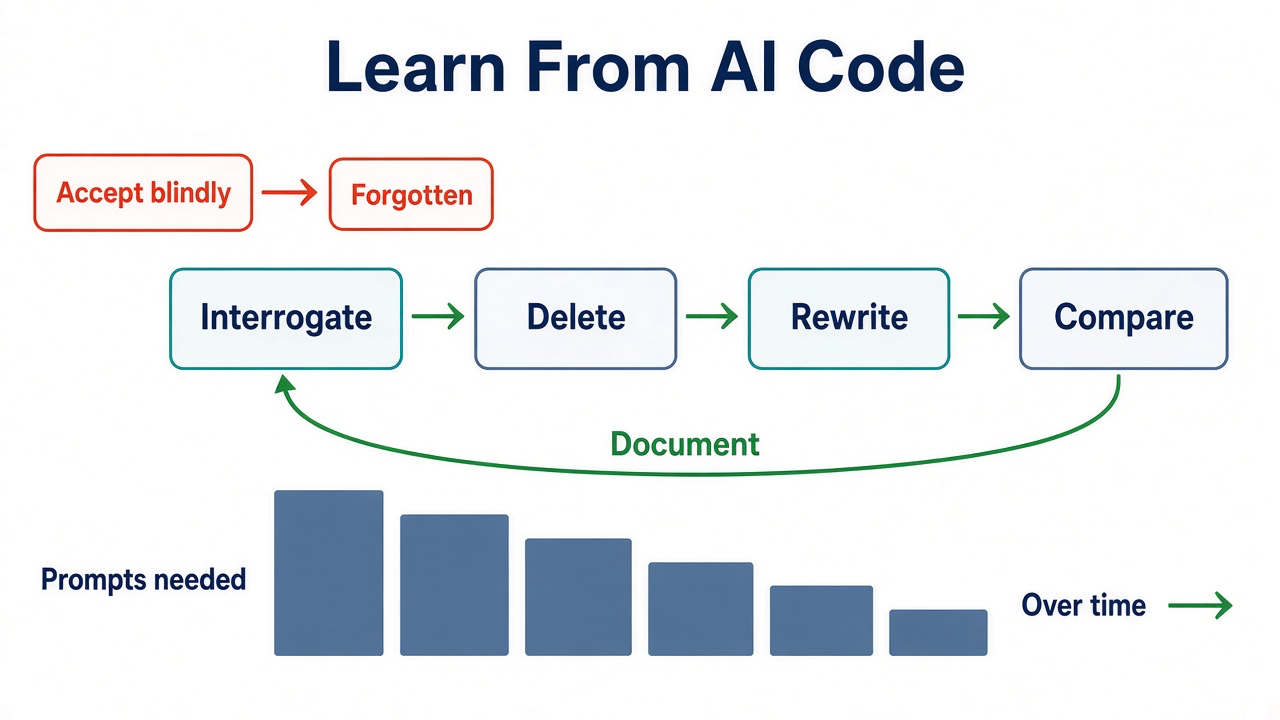
AI generates code. You accept it. You move on. An hour later, you've forgotten what it did. That's not learning. That's outsourcing.
The cost doesn't show up today. It shows up six months later, when you're asked to change that code and realize you never knew how it worked. Or in an interview, when nobody lets you open a chat window.
This essay is for engineers who use Copilot or ChatGPT daily and want to get better because of it, not despite it. It pairs with When AI Codes For You, which covers what to verify before you ship. This one covers what to do so that you actually learn. Here's how to turn AI-generated code into understanding.
Don't accept blindly: interrogate
When AI suggests code, ask it (or yourself):
- What problem does this solve? In your own words. If you can't explain it, you don't understand it.
- Why this approach? What alternatives exist? Why is this one chosen?
- What are the edge cases? What would break this? Empty input? Null? Concurrent access?
- What's the complexity? Time and space. Could it be better?
Treat each suggestion as a quiz. Before you accept, answer these questions. If you can't, slow down. Read the code line by line. Look up the APIs. Understand before you move on.
Picture asking for a rate limiter and getting back a short function with a counter and a timestamp. It looks fine. Now run the quiz. Which rate limiting algorithm is this: fixed window, sliding window, or token bucket? What happens at the edge of a window, when a client sends a burst just before and just after the reset? If you can't answer, you have a reason to slow down, and a clear list of what to learn.
Delete it and rewrite it yourself
The best way to learn from AI code: accept it, understand it, then delete it and write it yourself from scratch. Without looking.
If you can't recreate it, you didn't really learn it. The act of writing forces understanding. When you get stuck, that's your knowledge gap. Fill it.
I do this with every non-trivial AI suggestion. It takes longer. It's worth it. The code I rewrite myself, I remember. The code I accepted blindly, I forget.
You don't need to do this for everything. Boilerplate you already understand can stay. Do it for the suggestions that taught you something new: a library you hadn't used, a pattern you couldn't name, logic you needed two reads to follow. Give yourself a short timer, say 15 minutes. When the timer ends, open the AI version and note exactly where yours differed.
Use AI as a Socratic tutor
Instead of "write this function," try:
- "Explain how X works step by step."
- "What's the trade-off between approach A and approach B?"
- "What would break if I changed this line?"
- "Walk me through the execution with this input."
You're not asking for code. You're asking for explanation. That shifts the interaction from "give me the answer" to "help me understand." Understanding sticks. Answers don't.
Here's a concrete case. You're given a caching snippet that stores results in a map with no expiry. Ask: "What are the ways this can serve stale data, and what would you change?" A good answer will bring up expiry, invalidation, and memory growth. Those are the same ideas behind caching strategies, and now you've met them through code you care about, instead of from a list.
Treat the answers with the same suspicion as the code. Tutors that sound confident can still be wrong. Check one claim in the official docs each session. That habit alone catches most hallucinations.
Compare with your first attempt
Before you ask AI, try solving the problem yourself. Write a first draft. Then ask AI. Compare.
- What did AI do differently?
- Why is its approach better (or worse)?
- What did you miss?
- What did it miss?
The comparison teaches you. You learn from the diff. You see patterns. You improve your first draft over time. Eventually, your first draft gets close to what AI suggests, because you've internalized the patterns.
Your draft doesn't need to be good. A rough version that handles the main case is enough. The point is that you've committed to a shape before seeing someone else's. Without that, you can't tell which differences matter.
This is the same move good reviewers make. They form a view of the change before they read the comments. Code Review as Teaching goes further on why that diff is where learning happens.
Document what you learned
When AI shows you something new (a library, a pattern, a trick), write it down. One paragraph. "I learned that X works by Y. Use it when Z."
A personal knowledge base compounds. In six months, you'll have a catalog of patterns you've actually understood. That's more valuable than a thousand accepted suggestions.
Keep the format boring so you actually do it. One file. Date, a title, three lines: what it is, when to use it, where it fails. The "where it fails" line is the one that makes you think about trade-offs instead of collecting tricks. Before an interview, skim the file. It's a map of what you really know, not what you've seen.
Know when to go deeper
Some AI suggestions are worth a deep dive. A new algorithm. A framework you've never used. A pattern that solves a class of problems.
When that happens, pause. Read the docs. Try variations. Break it. Fix it. Understand it. That investment pays off. The next time you see a similar problem, you'll know the pattern, with or without AI.
A useful test for "go deeper": did the same idea appear in more than one suggestion this month? If a retry loop, a queue, or a lock keeps showing up, stop skimming. Read about message queues or retry and backoff properly, then try a design problem like Design a URL shortener to see the idea used under pressure. Reading code you didn't write is also a craft, and The Art of Reading Production Code covers how to do it well.
The goal: fewer prompts over time
The best outcome of learning from AI code: you need it less. You've internalized the patterns. You can write the code yourself. You use AI for speed, not for capability.
If you're prompting the same things every week, you're not learning. You're repeating. Change the pattern: understand, practice, document. Make each interaction a step toward independence.
This matters beyond your own growth. Hiring is moving toward people who can judge, not just generate. The New Interview Reality in the AI Era describes what that looks like in the room, and Staff Engineer Readiness Test: What AI Can't Answer shows the bar at the far end.
AI is a powerful tutor. But like any tutor, it only works if you engage. Accept less. Question more. Rewrite. Compare. Document. That's how you learn.
Frequently asked questions
- How can I learn from AI-generated code instead of just using it?
- Interrogate before you accept: what problem does it solve, why this approach, which edge cases, what's the complexity? Then delete the code and rewrite it yourself without looking. If you can't recreate it, you didn't learn it. Use AI as a tutor and ask for step-by-step explanation and trade-offs.
- Why should I rewrite AI code myself?
- Writing forces understanding. When you get stuck, that's your knowledge gap. The code you rewrite yourself you remember. The code you accepted blindly you forget. It takes longer, but it builds real skill.
- How do I use AI as a learning tool?
- Ask "Explain step by step," "What's the trade-off?," and "What would break if I changed this?" Try the problem yourself first, then compare with the AI. Document what you learned. The goal is to need AI less over time.
- Should I rewrite every AI suggestion?
- No. Rewrite the ones that teach you something new: an unfamiliar library, a pattern you haven't used, or logic you couldn't explain. Boilerplate you already understand is fine to accept after a quick read. For the review side of that decision, see When AI Codes For You.
- How do I know if I really understood the code?
- Run two checks. Explain it out loud to a teammate, or to a rubber duck, without opening the file. Then change one requirement and predict what breaks before you run anything. If both go well, you understand it.
- What should I write in a learning log?
- One short paragraph per entry: what you saw, how it works, and when to use it. Add one line on where it fails. Keep entries in a single searchable file. Review it before interviews, because it shows the patterns you have truly absorbed.
- Does this approach work for interview prep?
- Yes. Interviews reward code you can write and explain without help. Practicing the rewrite step trains exactly that. Pair it with timed problems on Practice LLD and talk through designs on Practice system design.
- How do I stop prompting the same things every week?
- Track your prompts for two weeks. Any prompt that shows up three times is a pattern you haven't absorbed. Study it, write it by hand twice, and add it to your log. If you're curious how seniors judge that kind of independence, read Staff Engineer Readiness Test: What AI Can't Answer.
What's next?