Essay
How AI Is Changing Tech Interviews (And What Stays the Same)
Take-homes, live coding, and system design are shifting now that AI writes code. What interviewers test today, and what to prepare for.
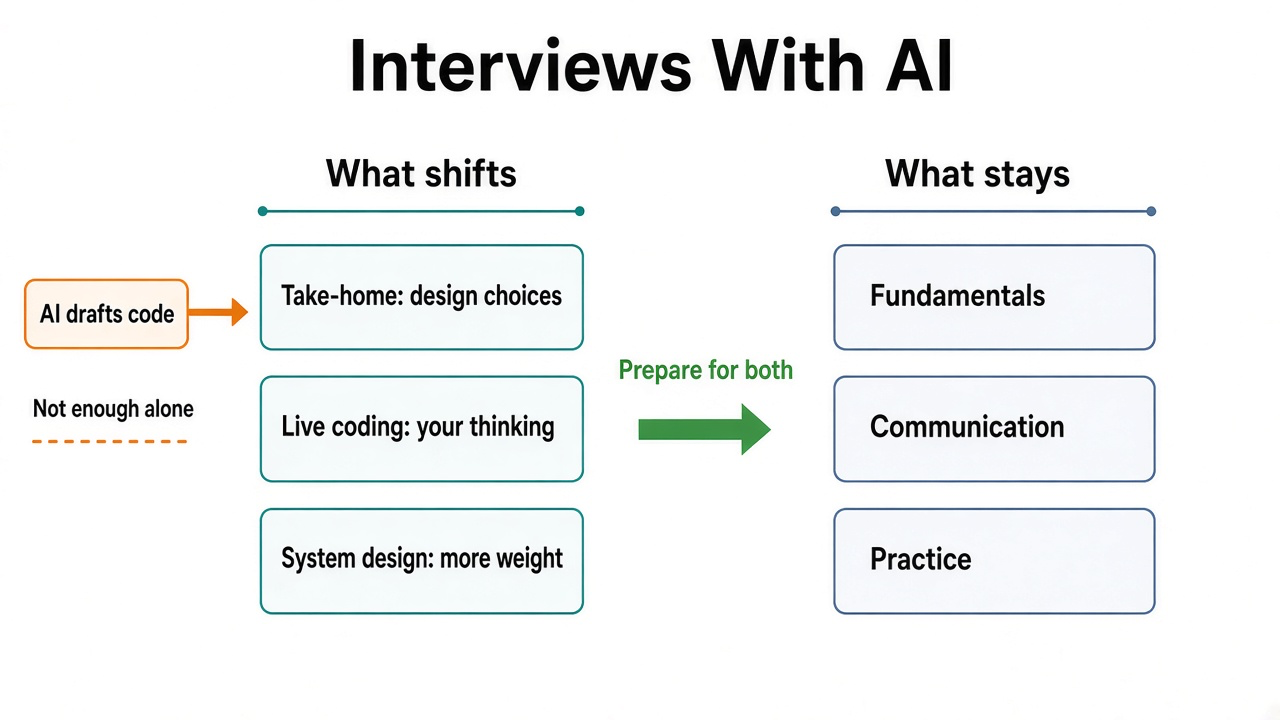
TL;DR: AI has not ended coding interviews. It has moved them. Take-homes lean on design decisions and follow-up questions, live coding scores how you think and talk, and system design carries more weight. Have a clear answer on how you use AI and where it fails. Fundamentals, communication, and practice still decide who gets the offer.
AI can write code, and interviewers know it. So what happens to a hiring loop built around people writing code?
The short answer: it evolves, it does not disappear. Companies are moving the signal they look for from "can you type a working solution" to "can you reason about one." If you are preparing for interviews this year, that shift decides where your hours should go. For the wider picture of how AI changes what companies test, read The New Interview Reality: Making AI Work For You.
Take-homes are getting harder
Take-home assignments used to say "build a small app in four hours." A good model can now do most of that in minutes, so many companies changed the task. Some give a deliberately buggy codebase and ask you to review it. Others ask for a short design doc next to the code. Others keep the build task but add a follow-up call that matters more than the submission.
Picture a candidate who submits a clean, working take-home. On the follow-up call, the interviewer asks, "Why a queue here instead of calling the service directly?" and then "What happens if the uploads grow ten times?" The candidate who made those choices answers in two minutes. The candidate who accepted the first draft from a tool goes quiet. Both submissions looked the same on paper. The call is where they separate.
The buggy-codebase version is worth a closer look. You get a small service with a few planted problems: a missing null check, a query inside a loop, a retry that never gives up. Nobody expects you to fix everything. They want to see what you notice first, how you rank it, and whether you can explain the risk in a sentence a teammate would act on. Candidates who list twenty nitpicks and miss the loop that hits the database on every row tend to score lower than candidates who find three real problems and say why they matter.
So treat the take-home as the start of a conversation. Keep a short README with the decisions you made and the alternatives you rejected. Know where your code is weakest and say so before they ask. If you want a vocabulary for this, trade-off thinking is the habit to build.
Live coding is focusing on communication
When you code live, the interviewer is watching how you think. Do you restate the problem? Do you ask about edge cases before you type? Do you react well when they drop a hint? Can you debug when the output is wrong?
An AI tool cannot do any of that for you in the room. That is the point of the round. The code on the screen is the smaller part of the evidence. The larger part is the sequence of decisions you narrate along the way.
A common pattern: a candidate goes silent for six minutes, then types a correct solution. They feel good about it. The interviewer has nothing to write down except "got there eventually." Another candidate talks through a slower first idea, spots the flaw out loud, and fixes it. That second candidate usually gets the stronger feedback, even with messier code. The habits behind this are covered in communication and interview strategy.
Debugging is the other half of this round. Interviewers often plant a small bug, or let you create one, and then watch what you do. Do you read the error message? Do you guess, or do you form a theory and test it? Saying "I think the index is off by one, so let me print the loop bounds" tells them far more than silently changing numbers until the output looks right. Even where a tool is allowed in the room, you still need to know whether its fix is correct.
System design carries more weight
System design is hard to outsource. You are drawing, talking, and making decisions in real time, with someone who can interrupt at any point. There is no prompt to polish and no second attempt.
Many companies now give it more weight in the final decision, especially for senior roles. It is where a candidate's judgment shows: how they handle an unclear problem, what they pick first, what they admit they do not know. If you have been spending all your time on algorithm puzzles, this is the round most likely to surprise you.
Here is a typical moment. The interviewer says, "Design a feed for a photo app." A prepared candidate does not start drawing. They ask how many users, how often people post, and whether a feed can be a few seconds stale. Those three answers change the design completely, and asking them shows the interviewer you have built or operated something before. A candidate who skips the questions and draws a famous architecture from memory usually gets stuck on the first "why" that follows.
You do not need a perfect design. You need a design you can defend. Start with System design interviews: start here, then practice on real prompts such as Design a URL shortener. If your target role is closer to code structure than infrastructure, How to Approach LLD Interviews covers the low-level design side.
"How do you use AI?" is a real question
Interviewers ask this now, and they are listening for four things:
- Do you use it at all? (Most candidates do, and interviewers know.)
- Do you understand where it fails?
- Do you review what it gives you?
- Can you still work without it?
A good answer is specific. "I use it for boilerplate and to explore alternatives, and I review every line before I commit. It is weak on our internal conventions and it will happily invent an API that does not exist." That tells the interviewer you have used it enough to find its edges.
Interviewers also use this question to judge your habits under change. If a team adopts a new tool every quarter, they want someone who tries it, measures whether it helped, and drops it when it did not. A candidate who can describe one time a tool saved real effort and one time it wasted effort comes across as someone with judgment, not someone repeating a slogan.
Two answers sink candidates. "I never use it" sounds out of touch, and the interviewer will wonder why. "It writes most of my code and it is usually right" sounds like a risk to the team. If you want the longer version of the verify-before-you-ship habit, read When AI Codes For You: What You Still Need to Know.
What has not changed
Fundamentals still matter. Data structures, complexity, and core system design ideas are still what you lean on when the tool is wrong or unavailable. AI can help you apply an idea faster. It cannot fill a hole in your understanding, and a follow-up question finds that hole quickly.
Communication still matters. Can you explain your thinking? Can you take a hint without getting defensive? Can you disagree politely? These are the same skills a team needs from you on day one, so interviewers weigh them heavily.
Practice still works. A common pattern is two candidates with the same background, where one ran five mock interviews and the other read five articles. The first one sounds calm when the question gets hard. The second one knows the material and still loses the thread. The candidates who do well are the ones who rehearsed. Timed problems, mock interviews, and out-loud design sessions all pay off. Nothing about AI changed that. If anything, it made the gap between prepared and unprepared candidates easier to see.
How to prepare
Prepare for two worlds. In one, you have AI: take-homes and daily work. In the other, you do not: live coding and whiteboard design. A weekly split works well. Use AI for one or two sessions and learn from what it produces, using How to Actually Learn From AI-Generated Code as your guide. Spend the rest of your time with the tools off, explaining your reasoning to a timer or a friend.
Add a debugging session each week, where you read broken code and say out loud what you would check first. Add a system design session each week, drawing and talking for thirty-five minutes. If you want the round-by-round map for a full loop, Software Engineer Interview Process: Every Round Explained lays it out.
The interviews are changing. The preparation is not: know the fundamentals, communicate clearly, and practice under pressure. When you are ready to try a real prompt, open Practice system design or Practice LLD and start with one problem today.
Frequently asked questions
- Are coding interviews going away because of AI?
- No. They are changing shape. Take-homes ask for more design decisions, live coding scores your reasoning as much as your code, and system design gets more weight. For the full loop, see Software Engineer Interview Process: Every Round Explained.
- Can I use AI during a take-home assignment?
- Read the instructions first. If the rules allow it, use it the way you would at work and say so in your README. If the rules are silent, ask the recruiter. Either way, expect a follow-up call where you explain every choice, so only submit code you could defend line by line.
- How do interviewers tell if I understand code an AI wrote?
- They change the problem. A common pattern is to ask "what breaks if traffic grows ten times?" or "add one more requirement" and watch whether you can edit the code calmly. People who understand the code adapt in minutes. People who pasted it get stuck.
- What should I say when asked how I use AI?
- Give a specific answer. Name what you use it for, such as boilerplate, test scaffolding, or exploring alternatives. Then name what you always check yourself, such as edge cases, security, and performance. For more depth on verifying output, read When AI Codes For You: What You Still Need to Know.
- Should I practice with AI or without it?
- Both. Practice with AI for take-homes and daily work, and practice without it for live coding and whiteboard design, because that is the format you will meet in many rounds. Use How to Actually Learn From AI-Generated Code to make the AI-assisted practice count.
- Is system design only for senior engineers?
- Senior roles lean on it hardest, but many companies ask a smaller version for mid-level roles, and some ask a low-level design round instead. Start with System design interviews: start here or How to Approach LLD Interviews depending on the role you are targeting.
- What has not changed in tech interviews?
- Fundamentals, communication, and practice. You still need to reason about data structures and complexity, handle hints, debug under pressure, and explain your thinking to another person. Interviewers read these skills as signals of how you will work on their team.
What's next?