Real Engineering Stories
How to Migrate From a Monolith to Microservices (Step by Step)
Playbook order-of-operations: bounded contexts, strangler routing, data ownership, events, testing, and rollback at each migration stage.
"We need to move to microservices." I have heard that sentence justify everything from a careful evolution to a multi-quarter outage generator. Microservices are not an achievement badge; they are an operating model: more deployable units, more networks, more partial failure, more data fragmentation—in exchange for team-scale autonomy and independent scaling when boundaries are real.
This guide is the step-by-step migration path I wish more teams had written down before the Jira epic closed. You do not need to read all twelve steps in one sitting—start with Read this first, then skim the cautionary story below so the steps have stakes.
Related reading on this site: What Is the Strangler Pattern? — facade phases, shadow traffic, and data strangulation. How Do You Handle Data Consistency in Microservices? — sagas, outbox, idempotency, and reconciliation once storage splits.
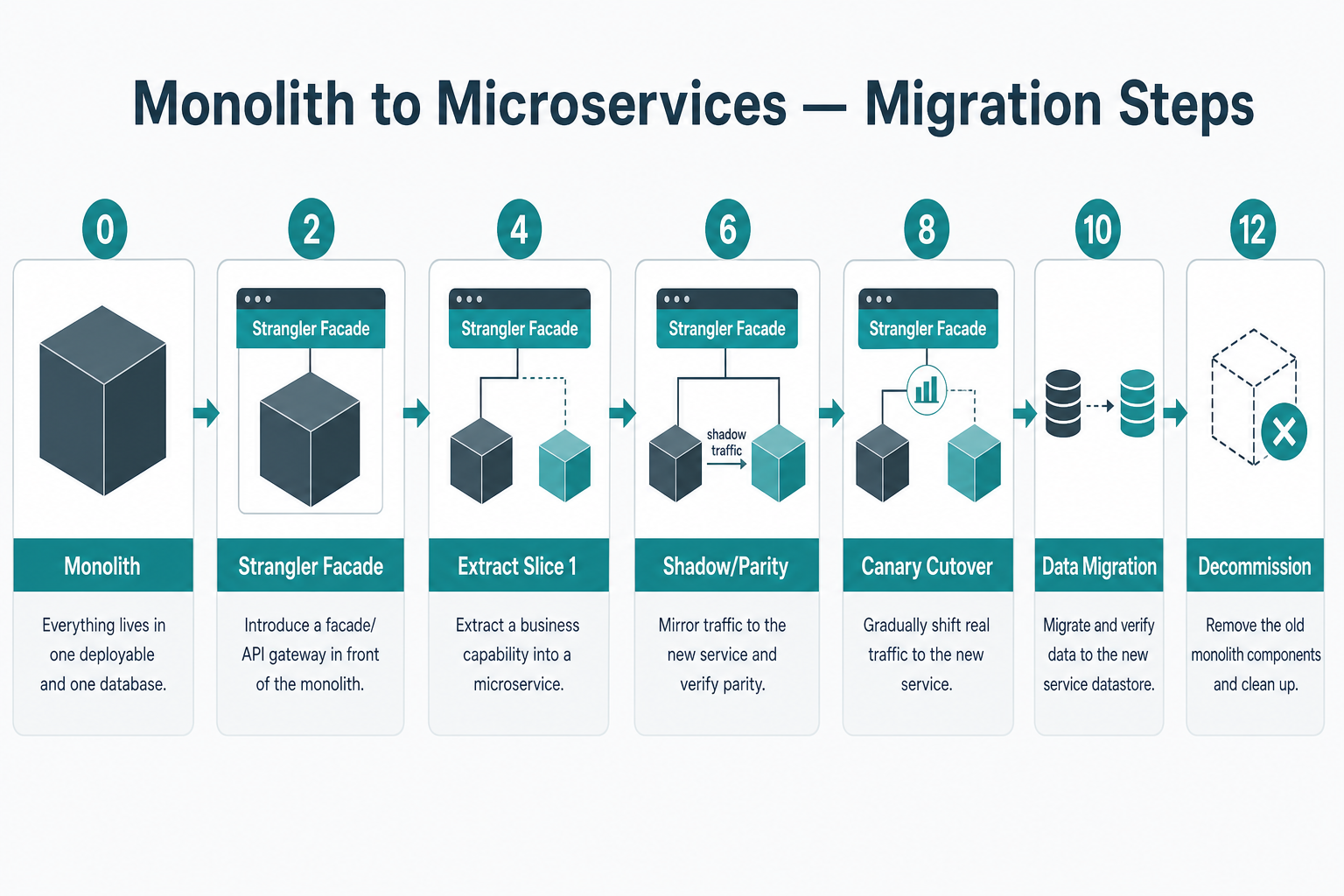
Twelve steps from validating the goal to decommissioning legacy—each with exit criteria and rollback levers.
Read this first (about 5 minutes)
If you only have a few minutes, here is the whole playbook in plain English:
- Ask why — Maybe a cleaner monolith fixes the pain. Microservices are not free.
- Draw what you have — Who calls what, which tables get written, which user flows matter.
- Name business areas — Split by product meaning (checkout, notifications), not by tech layer (all SQL files).
- Fix basics first — Logs, deploy rollback, tracing. Two broken services are worse than one monolith.
- Add a front door — Put a gateway in front with no behavior change yet.
- Pick one small slice — Notifications or search, not payments on day one.
- Build the new piece — Monolith still owns the truth until you trust the new path.
- Shadow-test — Run the new path in the background; compare answers before users see it.
- Move traffic slowly — 1%, then 5%, then more—with one switch to roll back.
- Move the data — This often takes longer than the code. One writer at a time.
- Use async workflows and align teams — Fewer live call chains; clear owners per service.
- Delete old code — Migration is not done until legacy paths are gone.
When to read the full steps: You are planning a real cutover, writing a design doc, or prepping for a senior interview. Jump to the step you are on; each section stands alone.
Story: what happens when you skip the steps
This is a shortened version of The Monolith to Microservices Migration That Almost Failed. It is here so the playbook is not abstract—you can see which steps were missing when things broke.
Setup: A growing e-commerce shop ran orders, payments, inventory, and shipping in one Node.js app and one PostgreSQL database. Leadership wanted microservices for speed and scale.
What they did wrong: They extracted four services in four weeks, turned off the monolith on a Monday morning, and hoped synchronous HTTP calls would replace one database transaction.
What the playbook would have changed
| Skipped step | What broke |
|---|---|
| Step 0 (validate goal) | No proof microservices fixed the real pain |
| Step 4 (strangler pass-through) | No stable front door to roll back one slice |
| Step 7 (shadow parity) | Behavior gaps found only by paying customers |
| Step 8 (gradual cutover) | 100% flip concentrated all risk in one deploy |
| Step 9 (data ownership) | No clear “who owns the row” during transition |
| Step 10 (async workflows) | Payment committed; inventory step failed with no compensation |
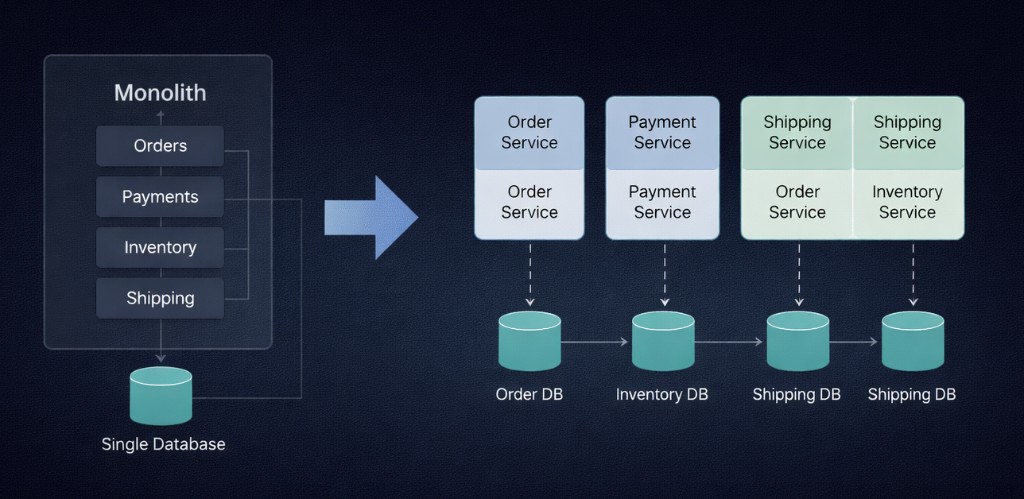
The team jumped from left to right in one cutover. The steps below spread that move across many reversible slices.
The full postmortem, RCA, and recovery design are in the long-form failure story. The steps below are the order of operations that team wished they had followed.
Step 0 — Validate the goal (seriously)
Ask: What problem are we solving?
| If the pain is… | Often the better first move is… |
|---|---|
| Slow releases because code is tangled | Modular monolith, clearer modules, CI/CD |
| One hot endpoint needs scale | Extract that slice only, or scale the monolith horizontally if feasible |
| Team conflicts on one codebase | Ownership boundaries in code, then align repos |
| "Industry best practice" | Stop; measure cost of coordination you are willing to pay |
If a modular monolith with strict module APIs and independent test suites fixes 70% of the pain, you may never need twenty services—or you will be ready to split along seams that already exist.
Exit criterion for Step 0: written goals (e.g. deploy frequency, blast radius, scaling target) and non-goals (e.g. "not building a platform team empire in Q1").
Step 1 — Map the system as it runs today
Goal: Base every later decision on how the system actually behaves, not on the diagram from three years ago.
What to produce
-
Runtime map (who calls what)
- Synchronous: HTTP/RPC paths from clients → monolith → third parties; note depth (e.g. “handler calls 4 internal services and 2 externals”).
- Asynchronous: message topics and queues—producers, consumers, retry and DLQ behavior.
- Schedulers: cron, Airflow-style jobs, nightly batch—what they touch and in what order.
- Failure behavior: timeouts, circuit breakers, fallbacks (even if informal).
-
Data map (who owns what row)
- List tables (or key collections) with primary writers and main readers (app modules, not people).
- Mark large or fast-growing tables and hot keys (partition risk later).
- Draw foreign keys or logical dependencies across areas (e.g. order → payment → inventory)—these are migration seams or traps.
-
User and operator journeys
- Trace checkout, signup, refunds, admin flows across modules and data.
- Note where UX is synchronous (user waits) vs background (email, reporting).
How deep to go
Enough that an engineer can answer: “If we split X out, what still breaks if X is down for five minutes?”
Common mistakes
- Mapping only services and skipping jobs and batch—the first outage is often “we forgot the nightly job still wrote that table.”
- Treating shared DB as neutral; every cross-table join is coupling evidence.
Exit criterion: diagrams and notes are reviewed by on-call and staff; no major path is “unknown.”
Step 2 — Define bounded contexts (domains), not "layers"
Goal: Name cohesive business areas so each future service has a clear reason to exist and language (same words mean the same thing inside the boundary).
What a bounded context is (practically)
A bounded context is where one ubiquitous language and one set of rules apply—for example Catalog vs Cart vs Checkout vs Billing. The word “Order” might mean something slightly different in fulfillment than in payments; that tension is a boundary signal.
Good extraction units (vertical slices)
- Move together when product changes (“we’re changing how pricing works”).
- Center on an aggregate root (one entity that guards invariants—e.g. a Cart or Shipment).
- Prefer few synchronous calls into other contexts; many events out is fine.
Red flags for a bad first slice
- Horizontal cuts: “all repositories” or “all DTOs”—no product meaning.
- Utility soup first unless it truly blocks everyone.
- Hardest workflow (full checkout) because executives asked—without Steps 3–4 in place.
Concrete outputs
- A context map (boxes and arrows: upstream/downstream, partners, anti-corruption layers where models differ).
- A ranked list of candidate slices with risk, value, coupling score.
Exit criterion: you can defend slice #1 in one sentence: “We extract X because it wins Y and depends lightly on Z.”
Step 3 — Establish platform prerequisites
Goal: Make two services almost as operable as one well-run monolith—otherwise you multiply chaos.
Minimum viable platform (before extract #2)
- Identity between services: service accounts, JWT validation (or mTLS policy), who may call what—documented in a small internal spec.
- Observability: structured logs (request/correlation id), RED/USE-style metrics per entrypoint, distributed tracing across gateway → monolith → new service.
- Deploy: blue/green or canary, one-click rollback, secrets outside git.
- API discipline: versioning story, default timeouts, retry only where idempotent, idempotency keys on writes that hit money or inventory.
Why this step is non-optional
Without a shared observability and deploy language, every new service becomes a snowflake, incidents become whodunit across logs, and migrations pause while you build tooling under pressure.
Exit criterion: first extracted service has dashboards, alerts, SLO drafts, and runbook skeleton before it owns revenue-critical path.
Step 4 — Insert the strangler facade (pass-through first)
Goal: Get a stable front door with no behavior change—prove the hop is safe before you route anything exotic.
What you do
- Deploy API gateway, reverse proxy, or edge router in front of the monolith so all external traffic hits it first.
- Configure transparent forward to existing upstream (same paths, same host routing rules as today).
- Move cross-cutting concerns here if helpful: TLS termination, WAF, coarse rate limits, request ID injection.
What to measure
- p95/p99 latency versus pre-gateway (expect small overhead; catch keep-alive and connection pool issues).
- Error rates unchanged; saturation of gateway and monolith acceptable.
Reading: What Is the Strangler Pattern?.
Common mistakes
- Changing routing rules or auth in the same release as “gateway go-live”—if something breaks, you cannot isolate the cause.
- Skipping load or soak test on the new path.
Exit criterion: 100% production traffic through the facade week(s) with parity; emergency bypass documented.
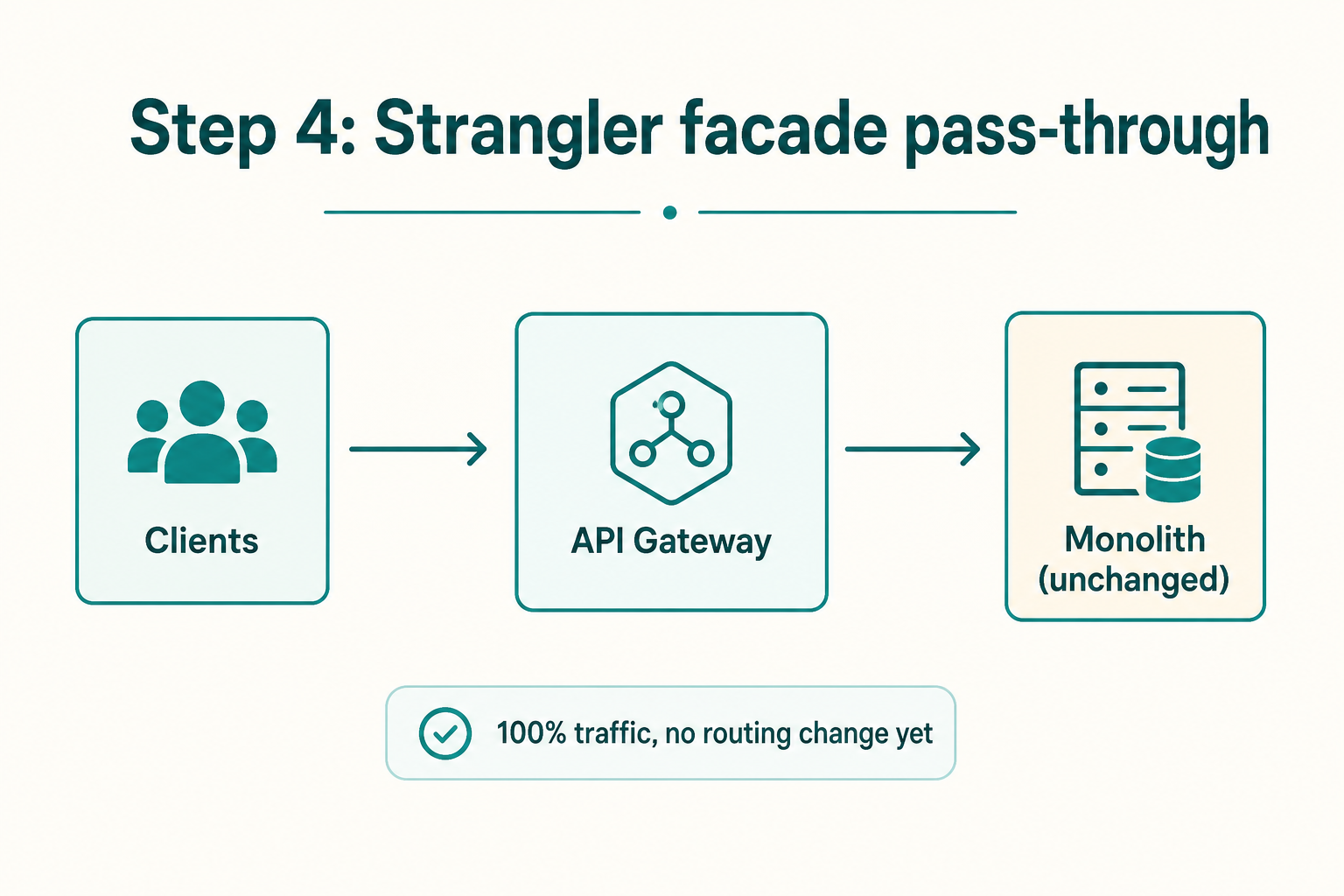
Step 4: gateway pass-through—prove the extra hop is safe before you route anything new.
Step 4: every request goes through the gateway, but still lands on the monolith—no routing changes yet.
Step 5 — Pick the first slice (small, valuable, loosely coupled)
Goal: Win a credibility milestone: one service that proves the platform and reduces real pain, without betting the company.
Ideal first slice checklist
- Value: removes a bottleneck, improves scale, or gives a team autonomy on something they fight over.
- Coupling: low fan-out (not “this handler calls 15 downstreams synchronously”).
- Data: a cluster of tables with one obvious primary writer in code today.
- Blast radius: failure or rollback should not brick checkout for everyone if you can avoid it.
Examples that usually work well
- Notifications (email/SMS/push), search/index jobs, file/PDF generation, feature flags, recommendation reads—often leaf or read-heavy.
What to avoid as slice #1 (usually)
- Core authorize-and-capture payment path without mature platform (unless you truly must).
- Anything that requires perfect dual-write on day one across payments and inventory.
Outputs
- One-pager: scope, out of scope, success metrics, rollback (route flag back to monolith).
Exit criterion: engineering + product sign the one-pager; on-call knows who owns the new service.
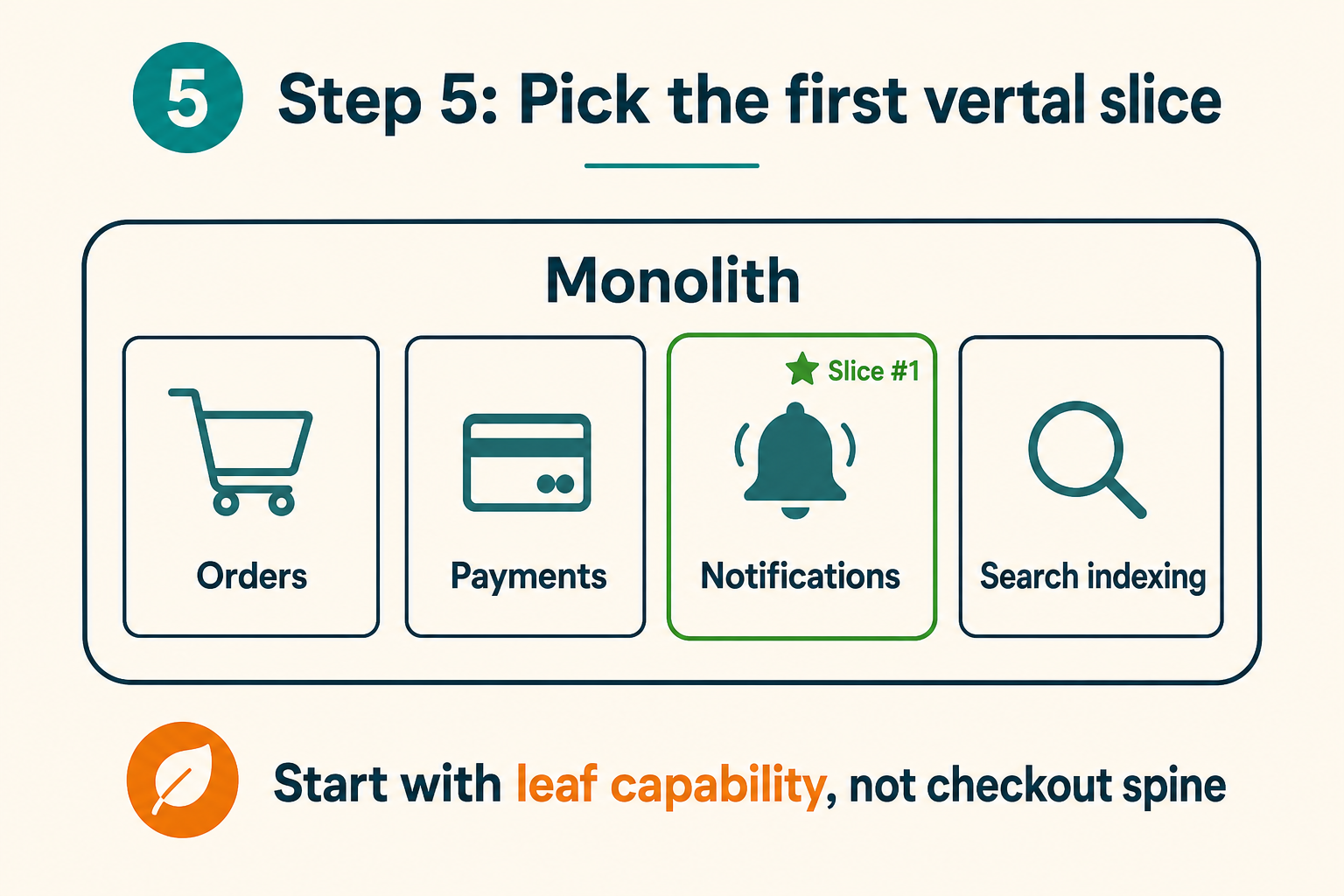
Step 5: one product-shaped slice first—leaf capabilities beat “extract all repositories.”
Step 5: pick one vertical slice (often notifications or search), not a horizontal layer like “all repositories.”
Step 6 — Build the new service; keep the monolith authoritative initially
Goal: Ship running code behind the facade with clear authority: the monolith (or existing DB) still owns truth until you say otherwise.
Typical technical shape
- Start read-only or async: new service serves reads from a replica/projection, or consumes events/queues, before it becomes the only writer.
- Monolith stays canonical for writes to shared tables until parity + cutover plan exist.
- Feature flags in the gateway or app: route internal testers, then canary cohorts.
Database stance
- Temporary shared database only with written rules: which module may INSERT/UPDATE which tables.
- Avoid “new service writes whatever it wants” to shared tables— that is distributed monolith logic with two deployables.
Operational stance
- Same logging, metrics, tracing standards as Step 3; deploy independent of monolith where possible.
Exit criterion: new service deploys to prod, handles flagged traffic or workload, no conflicting writes to shared data without a documented migration plan.
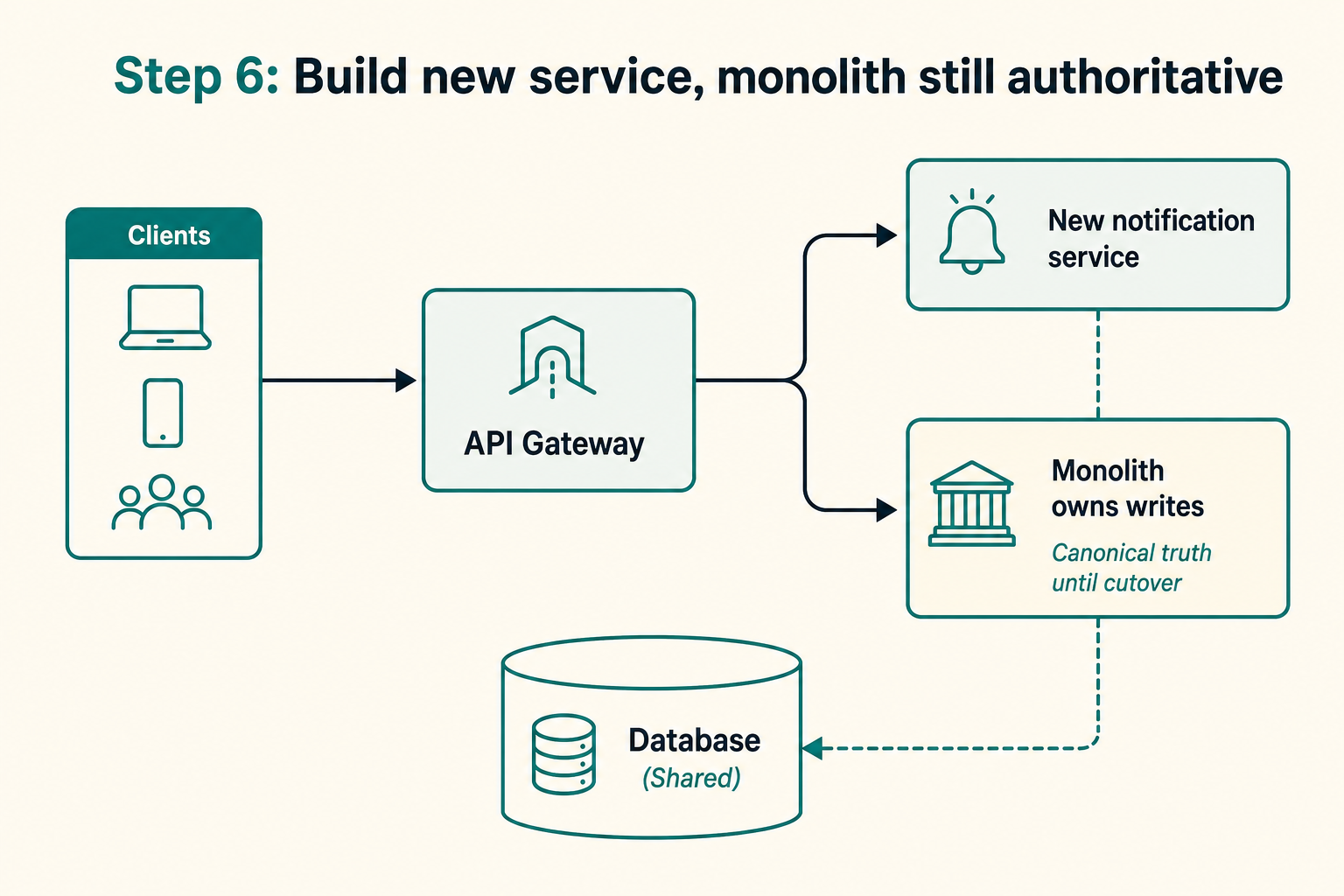
Step 6: ship the new service early; keep one clear owner of truth until cutover.
Step 6: the new service runs in production, but the monolith still owns writes until you prove parity.
Step 7 — Shadow traffic and prove parity
Goal: Show the new path is semantically equivalent (or intentionally different with sign-off), not “mostly the same.”
Shadow / dark launch
- Duplicate production requests to the new implementation without returning its response to users (or return it only in sandbox).
- Diff responses: allow tolerances for non-deterministic fields (timestamps, IDs) via schema or rules.
- Store diff rate, examples, and top mismatch causes.
Contracts
- Consumer-driven contracts or schema tests so a breaking change fails CI before prod.
- Golden fixtures from production-like data (sanitized).
Human gate
- Product/support review when behavior is meant to change (e.g. rounding, sort order).
Exit criterion: agreed diff threshold met for a sustained window (e.g. two weeks); exceptions documented; runbook says disable new path in one step.
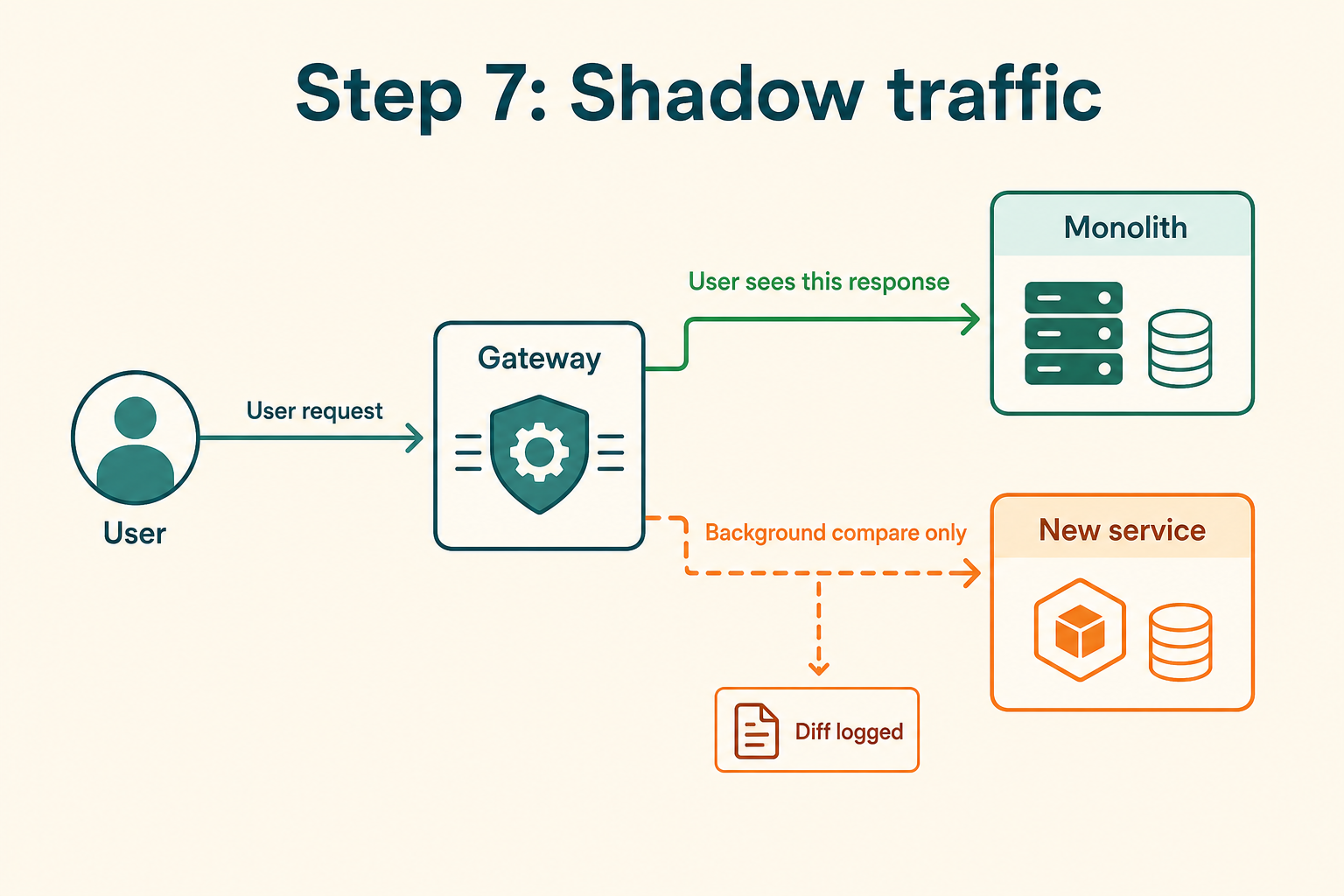
Step 7: shadow mode—learn from production without changing what the user sees.
Step 7: users still get the monolith answer while the new path is tested quietly in the background.
Step 8 — Gradual cutover and explicit rollback
Goal: Move real users in small steps; always know how to go back.
Traffic ramp (example only—tune by risk)
- 0% → internal → 1% → 5% → 25% → 100% for that route or tenant.
- Some teams use per-region or per-segment gates instead of pure percentage.
What to watch
- Golden signals: latency, errors, saturation, throttling.
- Business metrics: conversion, payments completed, refunds, support tickets with specific tags.
- Error budget: pause ramp if burn is unhealthy.
Rollback
- Single lever: flag or route table flips traffic back to monolith path for that slice only.
- No “revert five repos” as the only story.
Common mistakes
- Watching only 500s while wrong business outcomes return 200.
- No comms plan—support learns from angry customers first.
Exit criterion: slice at 100% on new path with SLOs stable over your chosen bake period; rollback tested at least once in staging or a drill.
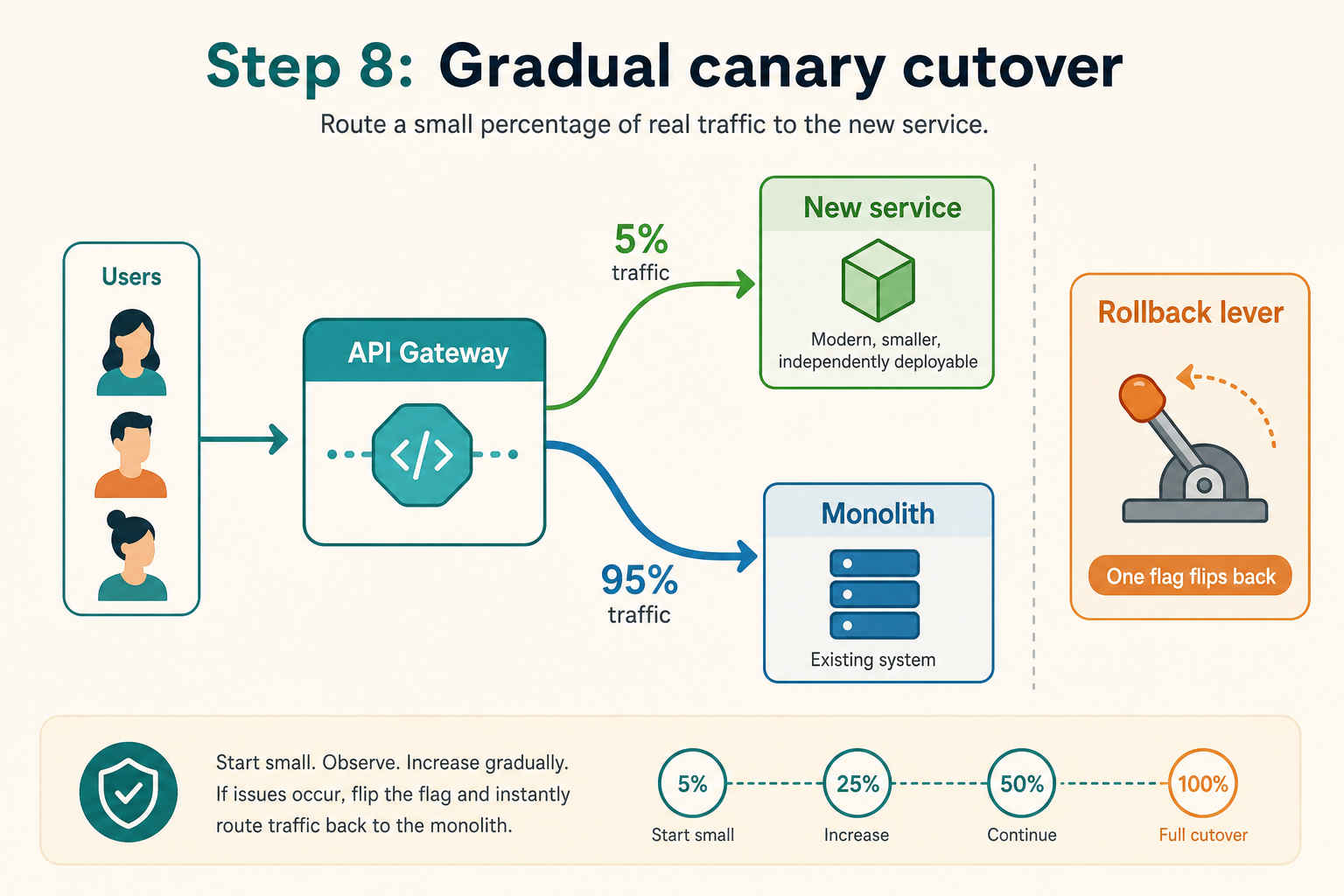
Step 8: ramp real users slowly—watch business metrics, not only HTTP errors.
Step 8: move real users in small steps (for example 1% then 5%) with one rollback switch.
Step 9 — Untangle data (the longest thread)
Goal: Align storage ownership with service ownership so teams can evolve schema and deploy without silent coupling.
Data ownership rules (write these down)
- One primary writer per aggregate at any time—even if tables still live in one physical database during transition.
- Readers may use replicas, projections, or APIs; they must not silently
UPDATEanother team's tables. - Batch jobs and admin tools count as writers; migrate or freeze them when you flip ownership.
- Exit criterion: no undocumented writers; reconciliation jobs green for the slice's data pairs.
Typical sequence
- Single writer per table (transition rules in writing—even if still one physical DB).
- Schema separation on shared infra (Postgres schemas, separate MySQL DBs on same host) as a stepping stone.
- Outbox or CDC so other systems see changes reliably without “RPC then maybe publish.”
- Migrate data: backfill, verify counts/checksums, dual-write only with reconciliation jobs and an exit date.
- Flip primary write to new store; freeze legacy writes; archive and later drop old tables per retention policy.
Reality checks
- Data migration often takes longer than code migration—plan quarters, not sprints, for large domains.
- Dual-write without reconciliation is how silent drift starts.
Reading: How Do You Handle Data Consistency in Microservices?.
Exit criterion: for the slice, one primary datastore owner; no undocumented writers; reconciliation green.
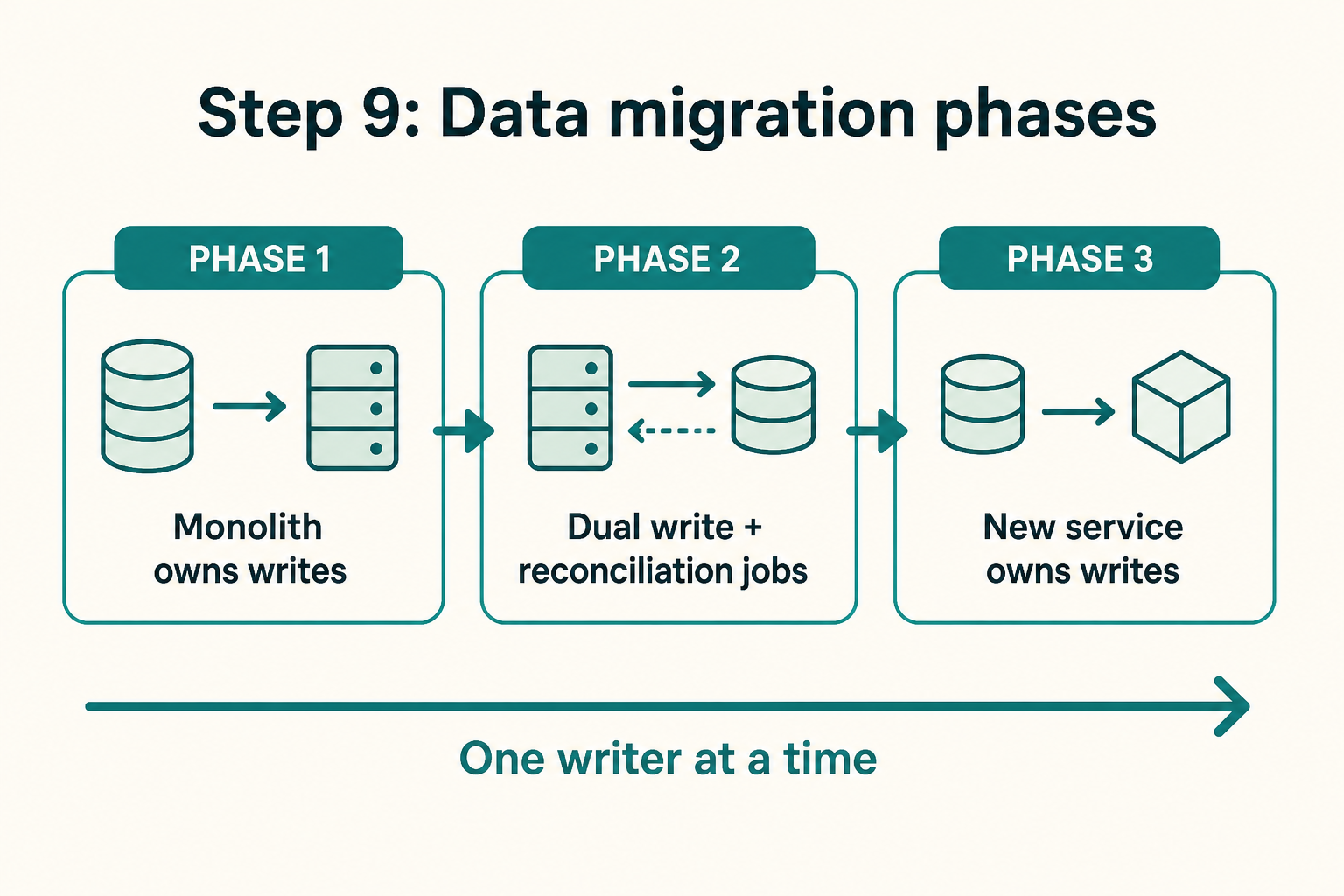
Step 9: data ownership phases—include batch jobs and admin tools as writers.
Step 9: move data ownership in phases—one clear writer at a time, with checks between phases.
Step 10 — Replace synchronous chains with workflows
Goal: Stop encoding multi-step business processes as deep synchronous RPC chains—timeouts and partial failure will eat you.
What to introduce
- Events and/or queues for handoffs: “payment captured” → “reserve inventory” → “confirm order.”
- Sagas (choreography or orchestration) with timeouts, retries, idempotency, and compensation (refund, release reservation).
- Clear workflow states visible in logs/metrics (stuck orders are a design surface).
Rule of thumb
If the user request thread waits on three network hops that each commit business state, you have built a latency stack and ambiguous failure (“did the second hop commit?”).
Exit criterion: critical journeys have documented async flow; no Sevs from “RPC timeout mid-workflow” without recovery path; dashboards show state counts and age.
Step 11 — Scale the organizational side (Conway's law)
Goal: If architecture splits and ownership does not, you get dysfunctional interfaces and blame between teams.
Align deliberately
- Team ↔ service ownership: on-call roster, roadmap accountability, SLOs per externally visible capability.
- Interfaces: SLAs between teams (not just “best effort REST”).
- Communication: RFC-lite for breaking API changes; deprecation windows.
Healthy signals
- Teams deploy without daily synchronized releases unless the business truly requires it.
- Post-incident reviews improve contracts, not just “more monitoring.”
Unhealthy signals
- Every change needs five approvals from five teams—your boundaries may be wrong or APIs are too chatty.
Exit criterion: for each service, named owner, on-call, and documented dependencies; no “everyone owns the monolith module” ambiguity for migrated slices.
Step 12 — Decommission deliberately
Goal: Finish the migration: dead code and dead tables cost money and confuse everyone.
Checklist per retired capability
- Traffic: gateway and tracing show zero production requests to legacy path for this slice.
- Data: no application writes to legacy tables; batch jobs migrated or cancelled.
- Code: remove feature flags and delete monolith modules (not comment-out).
- Ops: archive or delete dashboards, alerts, runbooks that only applied to old path.
- Docs: internal wiki points to new system only.
Data retirement
- Confirm retention/compliance before DROP; often archive to cold storage first.
Celebration metric
Measure deletions (lines, tables, flags)—that is proof you reduced complexity, not just added services.
Exit criterion: PR merges that remove legacy; postmortem-style note: “This slice is done; here is what we learned.”
Summary checklist (printable)
- Validate goal; consider modular monolith.
- Map runtime + data + journeys.
- Draw bounded contexts; pick vertical slice #1.
- Platform: observability, deploy, API standards.
- Strangler pass-through.
- Build new path; monolith authoritative until proven.
- Shadow/compare; contract tests.
- Canary cutover; rollback lever.
- Migrate data with outbox/CDC/reconciliation.
- Sagas/async for cross-domain workflows.
- Align teams and on-call.
- Delete legacy paths and data.
Key Takeaways
- Start with the problem, not the buzzword — A modular monolith may be enough. Microservices trade simplicity for team autonomy and targeted scale.
- The cautionary story is real — Big-bang cutover without shadow testing and rollback levers left ~100 orders broken and a 15% error rate in under an hour.
- One slice at a time — Pick a leaf capability first (notifications, search). Avoid the payment spine until your platform is boring and reliable.
- Gateway first, routing second — Pass-through weeks prove ops; only then split traffic with flags and canaries.
- Shadow before users — Compare old and new answers in the background. HTTP 200 with wrong business logic still loses money.
- Data migration is the long pole — Code can move in weeks; who owns each row often takes quarters. One writer at a time.
- Finish the job — Delete monolith modules and old tables. Half-migrated systems confuse on-call forever.
How I'd answer in interviews
"I wouldn't start by splitting repos. I'd validate the problem, strengthen the monolith into modules, put a strangler in front, extract one vertical slice with shadow traffic and parity checks, migrate data with clear ownership and outbox or CDC, replace sync chains with sagas for multi-step flows, and only decommission the monolith path when metrics and tracing prove no traffic uses it—with rollback at every step."
Related reading on this site
- What Is the Strangler Pattern? — facade lifecycle, shadow mode, and Phase 5 data strangulation in depth.
- How Do You Handle Data Consistency in Microservices? — local ACID, eventual consistency, sagas, outbox, and reconciliation after you split storage.
- The Monolith to Microservices Migration That Almost Failed — big-bang cutover story: ~100 stuck orders, 15% error rate, rollback to monolith.
FAQs
Q: How long should a migration take?
A: For a large product, think in quarters or years, not weeks. Moving code behind a gateway can happen quickly. Moving data safely—without two systems writing the same rows and drifting apart—usually takes much longer. If someone promises a full migration in six weeks, ask what they are not doing: shadow testing, gradual traffic, data checks, or rollback planning. Those shortcuts are how the failure story in this guide happened.
Q: Should every service have its own database from day one?
A: Eventually, each service should own its data so teams can change schema without stepping on each other. On day one, many teams use a softer step: separate schemas in the same database, or clear written rules about which service may write which tables. The dangerous pattern is two services both updating the same table whenever they feel like it—that feels like microservices but behaves like a monolith with extra network calls.
Q: What is the safest first service to extract?
A: Pick something useful but not in the middle of checkout. Good first slices: sending emails or push notifications, building search indexes, generating PDFs, or serving read-heavy recommendations. These usually fail without charging the wrong card. Avoid extracting payments or inventory reservation first unless you have strong logging, tracing, rollback, and data ownership rules already working.
Q: How do I convince leadership to avoid a big-bang cutover?
A: Use blast radius language they understand. One bad deploy that takes down everything vs moving 1% of traffic to a new path and watching conversion and error rates for a day. Share numbers from real incidents: in our embedded story, error rate went from 0.1% to 15% in about 25 minutes, and ~100 orders needed manual repair. Incremental migration costs more calendar time but avoids a single “bet the company” weekend.
Q: Do microservices require Kubernetes?
A: No. You need a reliable way to deploy, roll back, and see what broke (logs and metrics). Kubernetes is one option; managed platforms, VMs, or serverless also work. A few well-owned services on a simple platform beat a complex cluster nobody on the team understands.
Q: How do you decide who owns data during migration?
A: At every phase, write down one team that is allowed to write each important record type—even if the data still lives in one physical database. Early on, the monolith may still own writes while the new service proves it matches behavior. Later, you flip writes to the new service and run check jobs to catch drift. If two writers exist without checks, you will eventually get “customer charged but order missing” tickets. For workflow patterns after the split, see data consistency in microservices.
Q: What if we are a small team—should we still follow all twelve steps?
A: Follow the ideas, not every ceremony. Even a team of five benefits from Step 0 (why migrate?), one vertical slice, shadow testing, and a rollback switch. You can skip heavy platform work only if you already have decent deploys and logs. Do not skip “who owns the data” because you are small—that is when dual writes hurt fastest.
Keep exploring
Real engineering stories work best when combined with practice. Explore more stories or apply what you've learned in our system design practice platform.